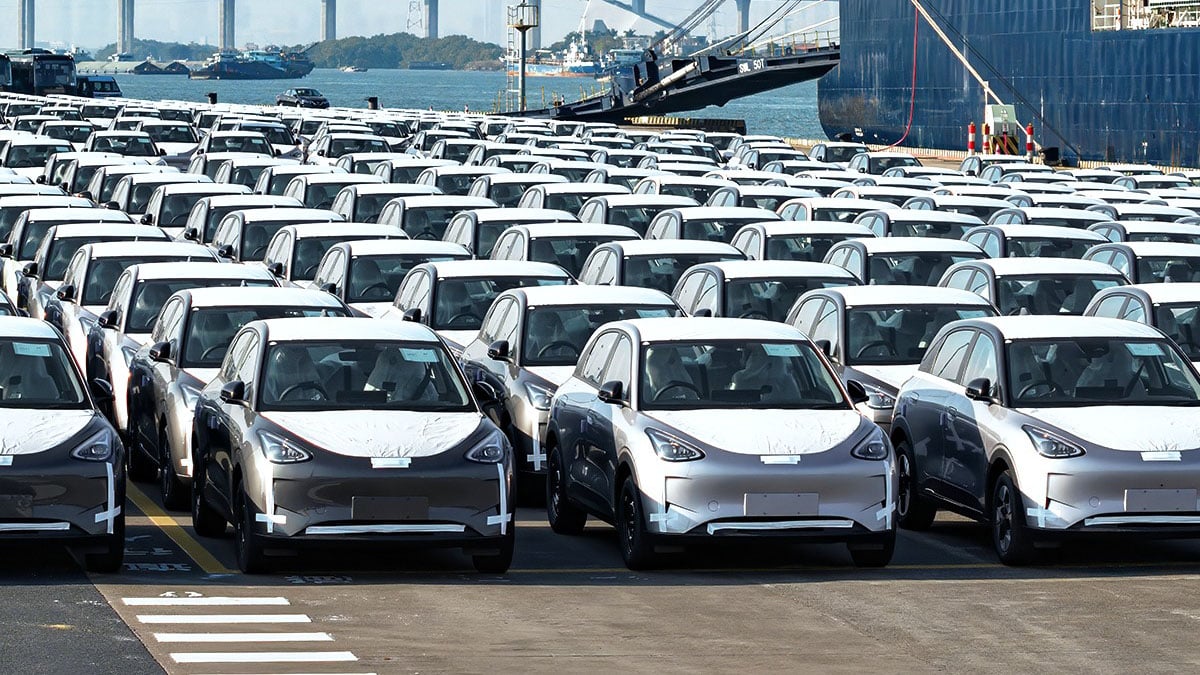
Chery hosted Canada’s Minister of International Trade, Maninder Sidhu, at its Wuhu, China, plant this week, where he discussed the Chinese automaker’s upcoming models and plans to sell affordable EVs in Canada, drawing criticism from the country’s automaker lobby and its largest auto union.
“Visited Chery’s plant in China to discuss their upcoming models and hear about their plans to introduce affordable EVs to Canadians,” Sidhu wrote on X on Wednesday.
He said he also discussed research Chery is doing “with universities like Concordia and the University of Toronto,” and that the company is “working with Canadian technology, too.”
“Blackberry’s QNX technology will power the cars they want to bring to the Canadian market,” Sidhu wrote.
Photos he posted show Sidhu with Chery executives beside several vehicles, including models from the company’s Omoda and Jaecoo brands.
Chery has not announced a QNX agreement for Canada, and neither Concordia nor the University of Toronto has published an announcement of a research partnership with the carmaker. BlackBerry’s QNX unit makes operating-system software for digital cockpits and driver-assistance systems.
QNX already runs in some Chery vehicles. BlackBerry said in March 2021 that a Desay SV Automotive cockpit controller built on its QNX Hypervisor and real-time operating system was used in the Chery Tiggo 8 Plus and Jetour X90. It has not said which QNX products would go into models bound for Canada.
A Trade Trip to China
The stop came during a four-day visit to China, from November 3 to 6, in which Sidhu co-chaired the Canada-China Joint Economic and Trade Commission in Beijing with Commerce Minister Wang Wentao.
He also traveled to Shanghai for the China International Import Expo, where Canada is the guest country of honor. Sidhu has said Canada aims to grow its exports to China by 50% by 2030.
The trip builds on Prime Minister Mark Carney’s visit to Beijing in January, when the two countries agreed to replace Canada’s 100% surtax on Chinese-built EVs with an annual import quota.
Automakers Push Back
Brian Kingston, President and CEO of the Canadian Vehicle Manufacturers’ Association, responded by quoting Sidhu’s post.
“Chinese EVs are ‘affordable’ because of weak labour and environmental laws, massive government subsidization and significant domestic overcapacity,” Kingston wrote on X.
He said the average hourly wage at a Chinese auto plant is about $1.93 to $4.27, citing Reuters, against an average of C$44.52 ($31.70) plus pensions and benefits at unionized auto plants in Canada.
Kingston also said China’s grid relies on coal for 60% of its power, compared with more than 80% from renewable and non-emitting sources in Canada.
He cited a Center for Strategic and International Studies estimate that China’s industrial policy provided more than $230 billion in subsidies between 2009 and 2023, and said Chinese auto production overcapacity exceeds 20 million vehicles a year.
Kingston’s Figures
The C$44.52 figure mentioned by Kingston matches the top hourly rate for a production assembler at the end of Unifor’s 2023 pattern agreements with Detroit’s automakers, according to Unifor. It is that contract’s top rate, not an industry average, and that contract expired on September 20.
Under the new agreements Unifor reached with Ford and GM this year, full-rate production wages rise 3% a year to C$50.20 ($35.80) an hour by the end of the three-year term, according to the union.
On power, think tank Ember says fossil fuels generated 58% of China’s electricity in 2025, down from about 62% in 2024. Ember does not give a coal-only share on its China page.
Canada’s Energy Fact Book, Fall 2026 Edition, puts renewables at 65% of the country’s 2024 electricity production and non-emitting sources, including nuclear, at 78%, slightly below Kingston’s “over 80%.”
The subsidy figure comes from a June 2024 analysis by Scott Kennedy of the Center for Strategic and International Studies, which estimated Chinese government support for the EV sector at $230.9 billion from 2009 to 2023.
It counts buyer rebates, a sales-tax exemption, charging infrastructure, research funding and government purchases. Kennedy called it a “conservative estimate” because it excludes local rebates, cheap land, power and credit, and support for battery makers and other suppliers.
Kingston did not give a source for the 20 million-vehicle overcapacity figure.
The CVMA represents Ford, General Motors and Stellantis in Canada. Kingston told lawmakers in April that the quota was equivalent to about 30% of the EVs sold in Canada in 2025. He said in September that Canada should return to tariff-free trade with the U.S. under the USMCA.
Union Points to Brampton
Unifor President Lana Payne criticized the visit while “thousands of auto workers are fighting to save their jobs, including in Minister Sidhu’s own riding of Brampton,” according to inSauga.
“Anyone who understands the auto industry knows the problem China poses to hundreds of thousands of jobs here in Canada and across North America and to the entire manufacturing industry,” Payne said.
Sidhu represents Brampton East. Stellantis‘ Brampton assembly plant has been idle since late 2023, and the automaker has weighed selling it. inSauga reported that Stellantis has signed a memorandum of understanding to sell the plant to Brampton-based Roshel, which wants to use it for defense manufacturing.
A Stellantis joint venture with Dongfeng separately plans to build two electrified Jeep models in China from 2027 for export to markets including Canada.
Unifor has run a “Sell Here, Build Here” campaign since the quota deal. BYD also inquired about taking over the Brampton plant to make buses, a local politician said in September.
Chery’s Canada Plans
No Chery passenger-car plant appears on Transport Canada’s Appendix G list of precleared foreign manufacturers, which now includes two Geely factories, a search of the live registry showed this week.
Chery’s Omoda & Jaecoo brand was the first Chinese brand to set a Canadian timeframe, saying on its website in September that it would arrive in “late 2026.”
Charlie Zhang, VP of Chery, later told Reuters the launch would come early next year. He had said in May that Chery planned to start selling two fully electric models in British Columbia, Ontario and Quebec in the fourth quarter of 2026, subject to regulatory approvals.
An early-2027 launch would put Chery’s first sales into the quota’s second year, when at least 10% of permits must go to vehicles with a free-on-board value of C$35,000 ($24,900) or less.
Chery is also considering building cars in Canada, including by taking over idle capacity at existing plants or partnering with local investors.
“Even without the American market, Canada is a market that is worth having a factory for manufacturing,” Guibing Zhang, Executive Vice President of Chery, told Bloomberg last month. He said Charlie Zhang has been in frequent contact with Joly.
If it goes ahead, Chery would become the first Chinese carmaker to build vehicles in Canada. A Canadian plant would also let it sell outside the quota.
Chery has also said it hopes to enter the U.S. at a suitable time. Charlie Zhang told Reuters last month that Chery was open to “a potential partnership with American carmakers” and could find “a China-free solution in terms of hardware and software.” U.S. officials have said Chinese cars built in Canada will not be allowed across the border.
Industry Minister Mélanie Joly has said Chinese carmakers wanting to sell beyond the quota would need to build in Canada through joint ventures with majority Canadian ownership.
Quota Still Two-Thirds Unused
The quota allows 49,000 China-built EVs and hybrids into Canada in its first year, to February 28, at the 6.1% most-favored-nation tariff. It rises to 52,185 from March.
Canada had used 16,206 permits, or 33.1%, as of the October 30 Global Affairs Canada report, leaving 32,794. No imports were recorded in October.
The Canadian business is led by Farzad Salehi, Executive Vice President and Country Director of Omoda & Jaecoo Canada, who previously ran Chery’s Middle East operations. Its website still names no models, prices or dealers and says the brand is “building a network across Canada.”
Four Omoda and Jaecoo vehicles, including the electric Jaecoo J5, were photographed in Toronto in April, and prototypes have been seen testing in Ontario.