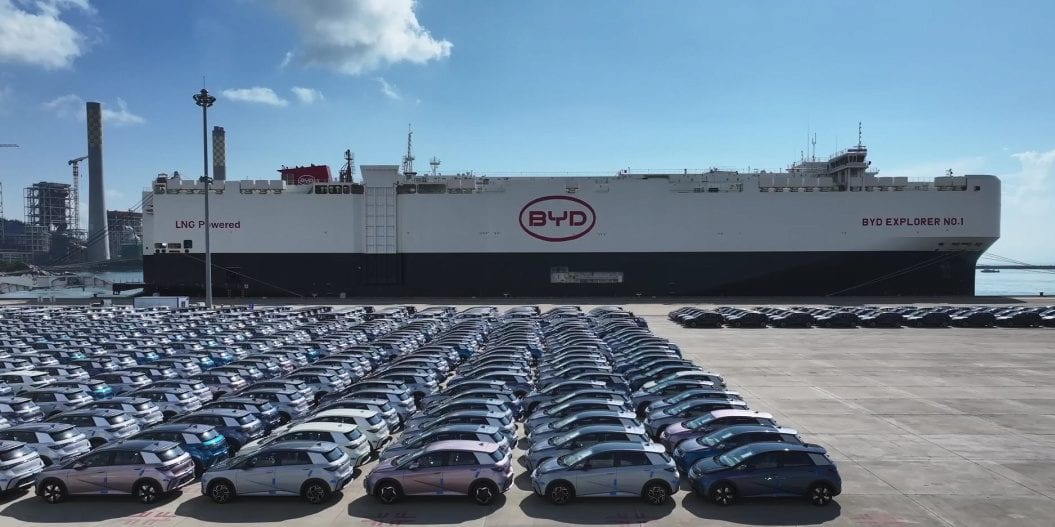

Turkey has suspended import tax exemptions granted to BYD and warned the Chinese automaker it may be required to repay the benefits it has already received if it fails to carry out a planned $1 billion factory investment in the country.
The information was first reported by Nikkei Asia on Tuesday, citing Turkey’s Ministry of Industry and Technology.
“As we have not seen progress on the project, the incentives provided to the company have been suspended since the beginning of 2026,” an official told the media outlet.
According to the report, if the investment is not completed, BYD is obligated under the law and its commitments to repay the tax exemptions it has received.
The move formalizes a breakdown in one of Turkey’s highest-profile foreign investment deals. It comes as BYD pivots its European manufacturing strategy away from building new factories and toward acquiring existing plants from struggling legacy automakers.
Plummeting Sales
The company sold just 152 vehicles in Turkey in May, a steep drop from the 3,866 units it moved in January, according to Nikkei.
According to data from the Turkish Automotive Manufacturers Association (OSD), the automaker registered 3,866 vehicles in January 2026, followed by 1,428 units in February, 833 in March, 447 in April, and just 152 in May.
This brought the cumulative total for the first five months of 2026 to 6,726 units — compared to 45,537 vehicles in 2025, more than five times its 2024 figure.
The Middle East Eye estimated earlier this month that BYD may have earned between $500 million and $1 billion in additional profit from the Turkish market as a result of the tax advantages it received under the now-suspended incentive package.
The Original Deal
BYD‘s signed an agreement with Turkey’s Ministry of Industry and Technology in July 2024 to build a research and development center and a factory in the Manisa Organized Industrial Zone in western Turkey.
The facility was designed to have an annual production capacity of 150,000 electric vehicles and plug-in hybrids and was expected to begin production by the end of 2026, creating up to 5,000 jobs.
Turkish President Recep Tayyip Erdoğan attended the signing ceremony in Istanbul.
Had the project been completed, BYD would have become the first foreign automaker since 1997 to commit to building a new production facility in Turkey.
In exchange for the investment commitment, Ankara introduced import tax exemptions for BYD and waived a requirement imposed on other automakers that they establish 20 service centers nationwide before operating in the country.
Nearly two years later, construction of the Manisa factory had not begun.
Opposition lawmakers from the Republican People’s Party (CHP) submitted a parliamentary inquiry in January questioning the project’s status, with Industry Minister Mehmet Fatih Kacır saying at the time that sanctions set out in the incentive regulations would apply if the investment was not completed.
The Turkey factory deal was originally attractive to BYD in part because Turkey is not a member of the European Union, but maintains a customs union with the bloc.
That deal allows many industrial goods manufactured in the country to enter the EU market without customs duties.
The arrangement would have given BYD tariff-free access to European markets without the need to navigate the EU’s additional tariffs on Chinese-made electric vehicles, which range from 17% to 35.3%.
Strategy Shift
BYD has since confirmed that the Turkey project is on hold.
Executive VP Stella Li told Reuters last week that construction in Manisa has not begun and that the company has not set a timeline for moving forward.
“Right now our first priority is Hungary,” Li said, referring to BYD‘s passenger car plant in the city of Szeged. “The second priority will be to focus on finding a second facility in Europe.”
That second facility, Li said at a press event in Berlin the same day during the European launch of the Dolphin G model, would ideally not be a new build.
“We would prefer to take over an existing plant,” she told reporters, identifying Spain as among the countries on BYD‘s shortlist.
The Iberian Peninsula — both Spain and Portugal — has been mentioned before as a potential location for a third factory, after Hungary and Turkey.
The search for already built factories, however, marks a significant change in BYD‘s approach to overseas expansion.
Rather than constructing greenfield factories from scratch — the model it pursued in Turkey and Hungary — the company is now looking to acquire underutilized plants from European automakers facing excess capacity.
Alfredo Altavilla, a senior adviser to BYD in Europe, recently told Reuters that Chinese automakers are scouting existing factories because the European Union’s proposed “Made in Europe” rules for minimum local content in vehicles would take effect before entirely new plants could begin production.
“There is no time to start a greenfield plant today,” Altavilla said. “All you can do is find a brownfield, take it over and refurbish.”
Stella Li confirmed last month at the Financial Times‘ Future of the Car conference in London that BYD is in talks with Stellantis and other European automakers about taking over underutilized factories across the continent.
“We are talking to not only Stellantis, we’re talking to other companies too,” she also told Bloomberg at the time.
BYD would prefer to operate the plants independently rather than through joint ventures — something Li has also mentioned when questioned about the company’s Canadian expansion, in the wake of the trade deal between Ottawa and Beijing.
Hungary Factory
BYD‘s first European passenger car factory — in Szeged, Hungary — began trial production in January after several repeated delays.
Li told Reuters the company is still installing equipment at the plant and now expects full vehicle assembly to begin in the fourth quarter of 2026 — roughly a year behind its original schedule, which targeted production before the end of 2025.
The Szeged plant has a planned capacity of up to 300,000 vehicles per year, though initial output is expected to be lower. The compact Dolphin Surf will be the first model assembled at the site.
Hungary has become BYD‘s primary foothold in Europe.
The company has operated an electric bus factory in Komárom since 2017, runs battery assembly operations at two sites, and relocated its European headquarters from the Netherlands to Budapest in 2025.
Last month, BYD guided to full-year sales of 5.0 to 5.5 million new energy vehicles in 2026 — implying year-over-year growth of 10% to 20% — while reiterating an overseas sales target of 1.5 million units.
The figure marks an increase from the 1.3 million overseas target it initially set in January.