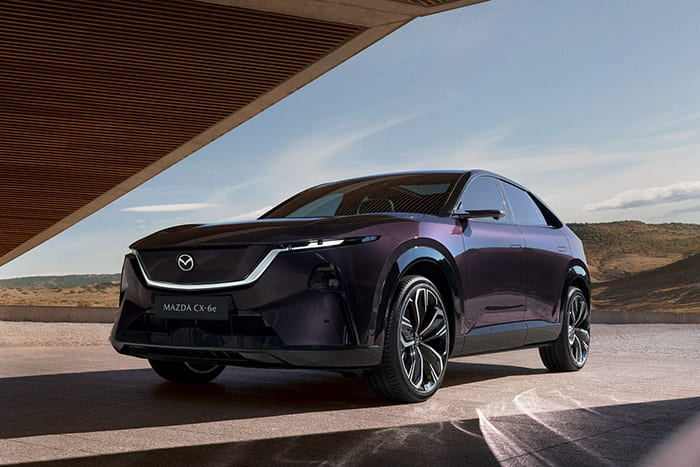

Mazda has launched the CX-6e electric SUV in Australia, its second battery-electric model built in China by partner Changan, as the Japanese carmaker relies on its joint venture for EVs until its own platform arrives in 2029.
The CX-6e is priced from A$56,990 ($39,700) on the road in Victoria for the GT grade and A$59,990 ($41,800) for the Azami.
The SUV follows the 6e sedan, which is built at the same Changan Mazda plant in Nanjing and starts at A$49,990 ($34,800) in Australia.
‘Past a Point of No Return’
Mazda Australia expects the CX-6e to become a volume model.
“In terms of numbers, I think the CX-6e potentially has the ability to grow to 1000 per month,” Vinesh Bhindi, Managing Director of Mazda Australia, told CarExpert at the model’s local launch.
“But I say that cautiously because it is driven by two elements: fuel prices and tax incentives,” he said.
Bhindi added that he believed the market had “gone past a point of no return when it comes to electrification”.
All 1,000 free upgrades to the higher grade that Mazda offered early buyers were claimed within weeks, and 56% of pre-orders came from customers new to the brand, CarExpert reported.
Mazda Australia had more than 2,000 firm orders for the 6e and CX-6e combined by June, Bhindi told Drive at the time.
Changan Platform | Mazda Design
The CX-6e uses a 78 kWh lithium iron phosphate battery and a single rear motor producing 190 kW.
Mazda Australia quotes a WLTP range of up to 484 km, while The Driven lists 468 km. The model weighs 2,130 kg and reaches 100 km/h in 7.9 seconds.
It charges from 30% to 80% in as little as 15 minutes on a DC fast charger, Mazda says.
The Azami grade adds 21-inch wheels and camera-based door mirrors.
The battery carries a warranty of eight years or 160,000 km, The Driven reported.
It is built on a Changan platform shared with the Deepal S07, with design by Mazda.
The Driven‘s reviewer called it a competent and comfortable family car and criticised an oversized dashboard screen.
In Europe, deliveries of the CX-6e began in August, with German prices from €49,990 ($56,000). The 6e sedan starts at €44,900 ($50,300) there.
Mazda’s UK arm priced the CX-6e from £42,990 ($56,800) to £45,350 ($59,900) on September 1, with deliveries due late this year.
“The CX-6e combines great design, driving enjoyment, and advanced technology,” Jeremy Thomson, Managing Director of Mazda Motors UK, said then.
Own EV Delayed to 2029
Mazda’s dependence on Changan reflects a slower plan for its own EVs.
The company said in May that its first dedicated EV would arrive in 2029, two years later than planned.
It cut planned electrification spending through 2030 to about $7.5 billion from $12.5 billion, and now expects EVs to make up about 15% of its sales in 2030.
“We made the decision before we started,” Chief Executive Officer Masahiro Moro told Automotive News in May. “For battery EVs we were always careful.”
Mazda has described itself as an “intentional follower” on EVs.
It plans three new hybrid models between 2028 and 2030 using its new Skyactiv-Z engine, with a hybrid CX-5 due in 2027.
More Changan-built models may follow.
“We’ve started to talk about what other opportunities might be there,” Bhindi told Australian outlet GoAuto in late September, when asked about further models with the Chinese partner.
Mazda has also said it will adopt Tesla’s charging standard in Japan from 2027.
The MX-5 Question
The gap between Mazda’s volume EV and its best-known car is wide.
Moro told Germany’s Auto Motor und Sport in an interview reported in late July that the next MX-5 “must also be ready for a scenario without a combustion engine”.
He set a weight target for engineers of between just under 1,000 kg and 1,200 kg, without carbon fibre.
That is roughly half the weight of the CX-6e.
Jo Stenuit, Design Director at Mazda Europe, said in February that the next MX-5 “will have some form of electric power assistance”, Dutch outlet Auto Rai reported.
Mazda’s US arm later told MotorTrend that the company was “exploring various possibilities while considering regulations and other factors” for the car’s powertrain.
It confirmed the weight target, saying it was meant “to realize the ‘Jinba ittai’ driving experience that is the MX-5’s appeal”.
Moro did not say the next MX-5 will be electric, and Mazda has given no launch date.
Bhindi suggested demand is limited for now. “We don’t see that many customers coming into the showroom and saying, ‘An electric MX-5? That’d be for me’,” he told CarExpert.
An electric option “could potentially attract a different type of buyer to the brand”, he added.