Uber and Chinese autonomous driving company Momenta have started a supervised robotaxi pilot in Munich, the first time riders in Germany can be offered an autonomous ride through the Uber app, the companies said on Wednesday.
The rides are free and non-commercial, and a trained safety operator is on board every trip, in line with the test permits Germany’s Federal Motor Transport Authority (KBA) has granted Momenta.
The launch puts Uber and Momenta on Munich’s streets with passengers ahead of Waymo, which is testing in the city and is targeting a commercial service for the end of 2027.
How the Pilot Works
Rides are initially available in a defined area covering large parts of northern Munich, including the neighborhoods around the Olympic Park.
Riders who have pre-registered and been selected, and who request an UberX, Electric or Comfort trip inside that area, may be offered a ride in a supervised autonomous vehicle. Pick-ups and drop-offs happen at designated stops.
Riders can join an interest list in the Uber app from Wednesday, with access granted in phases. The companies said the service will expand step by step to more areas of Munich “within the applicable regulatory framework.”
The companies did not say how many vehicles are in the pilot, and the release does not name the car. A photo Momenta published shows a white crossover carrying Momenta and Uber branding.
The Permits Behind It
Momenta Europe GmbH holds three Level 4 testing permits on the KBA’s list of approvals, in the version dated November 5. The first was granted on July 8 and runs until July 31, 2028. Two more were granted on October 20 and run until October 31, 2028.
None of the three carries a geographic restriction. Under the KBA’s rules, such permits are valid throughout Germany, taking into account the vehicle’s capabilities.
Momenta announced the first permit on July 29. Founder and Chief Executive Officer Xudong Cao said it gave the company “a strong foundation as we advance our projects in Germany and move toward commercial deployment.”
In its Chinese-language release, Momenta said it was the first Chinese company to obtain Level 4 testing approval covering urban roads nationwide in Germany.
Later Than First Planned
The pilot builds on the strategic agreement Uber and Momenta signed in May 2025 to deploy Momenta’s robotaxi technology in markets outside the U.S. and China, starting in Europe. At the time, the companies said the first deployment would begin in early 2026, with safety operators on board.
In September 2025, the companies named Munich as the starting point for Level 4 testing in 2026, with plans to expand to other European cities. Uber Chief Executive Officer Dara Khosrowshahi said at the time that “Germany has shaped the global automotive industry for more than a century.”
In its Hong Kong listing prospectus, Momenta said it planned to launch international commercial robotaxi services in Abu Dhabi and Munich in 2026. It said it had “completed system integration with Uber” and was testing in Munich.
Momenta’s Wider Push
Momenta runs its European headquarters in Böblingen, near Stuttgart, and has an office in Munich. It says its driver-assistance systems are in more than 1.4 million customer vehicles from automakers including Mercedes-Benz, BMW, Audi and Volkswagen, up from the 400,000 vehicles it cited in September 2025.
The company, which describes its approach as “Physical AI,” listed in Hong Kong on July 8, raising about HK$6.8 billion ($867 million) at HK$295.60 a share. Its shares closed at HK$149.80 ($19.10) on Wednesday, up 1.2% on the day but about 49% below the offer price.
Its robotaxi business is still small. Momenta said in its prospectus that its robotaxi operations were conducted in China and remained at an early stage during the period it covered, with 31 robotaxis under operation in 2025.
Outside China, Momenta, Mercedes-Benz and UAE taxi company Lumo announced a robotaxi fleet based on the Mercedes-Benz S-Class in Abu Dhabi in December 2025, with formal operations planned for this year.
In December 2025, Southeast Asian ride-hailing company Grab made a strategic investment in Momenta, and the two agreed to partner on deploying autonomous services using Momenta vehicles on Grab’s platform.
Xie told Reuters in September that Momenta planned to deploy vehicles in Dubai next year and was in talks with a “few” European cities. “The size of our robotaxi fleet will be in the … hundreds at the end of this year and then it will be several thousand at the end of next year,” Xie said.
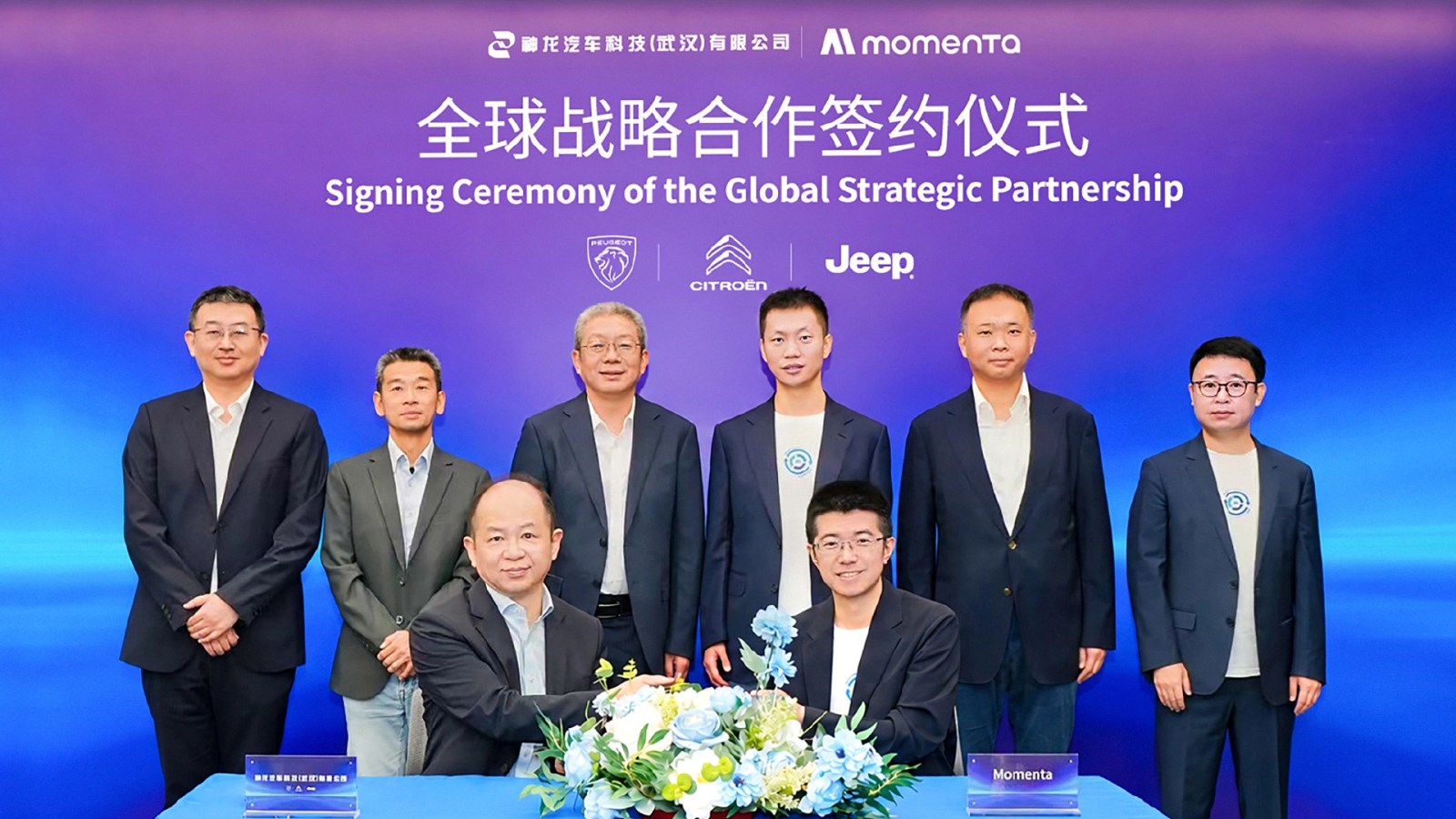
Momenta has also added Western automaker business since the listing. In September, it won a deal with Stellantis‘ China venture DSAT to bring its driving software to Peugeot and Jeep models worldwide.
Uber’s Third European City
Munich is the third European city where Uber riders can be matched with an autonomous vehicle, after Zagreb and London, based on Uber’s announcements.
On August 19, Uber began offering autonomous rides in Zagreb with Croatian company Verne and Pony.ai, with a licensed operator on board at launch. On September 3, Uber and Wayve launched supervised rides in London in Ford Mustang Mach-E vehicles, with a trained, licensed private-hire driver on board.
In Madrid, WeRide, Uber and fleet operator AVOMO received a national Level 4 permit on September 10 and said they expected commercial operations to begin by the end of 2026. Uber and Pony.ai said in August they plan to deploy more than 2,000 robotaxis in Europe.
Pony.ai said in a company post in October that it is working to bring its robotaxis to London on Uber, with testing expected to start “in the coming weeks.”
In the U.S., Uber said on Monday that riders in Las Vegas can now be matched with Zoox’s purpose-built robotaxis through its app.
Uber’s Second Munich Bet
Momenta is not Uber’s only autonomous partner in the city. On June 1, Uber, Israel’s Autobrains and Nvidia announced a robotaxi program with Munich as its first deployment city, pending regulatory approval.
That program pairs Autobrains’ “Agentic AI” driving software with Nvidia’s Drive Hyperion Level 4 compute platform and is designed to work across vehicle brands. The companies have not announced a passenger launch date. On the KBA’s November 5 list, Autobrains’ testing permits are for Level 3 and restricted to defined areas.
Wednesday’s launch comes two days after a leadership change in Uber’s autonomous business. Sarfraz Maredia, the company’s Global Head of Autonomous Mobility and Delivery, and Danny Guo, its Vice President of Engineering and Science, were both due to leave on November 16.
Uber is also preparing its U.S. robotaxi with Lucid and Nuro, which Lucid has said has entered pre-production. Uber shares closed at $68.81 on Tuesday, down 15.8% this year.
A Crowded Test Bed
Munich has drawn several other self-driving projects. Waymo brought its first robotaxis to the city in September, using Jaguar I-Pace SUVs to collect data ahead of its planned 2027 launch.
Munich’s municipal utility, Stadtwerke München, received three Level 4 testing permits without geographic restriction on August 14, the KBA list shows. Its transit operator MVG began testing three autonomous Volkswagen ID. Buzz vans in the Gern neighborhood in September.
On November 17, MVG began carrying registered test passengers on an automated MAN Lion’s City 12 E electric bus on Line 178, between Petuelring and Freimanner Hölzl, with safety drivers from MAN and MVG on board.
“The vehicle steers on its own, accelerates, brakes and signals,” said Michael Roth, Head of Bus Strategy and Bus Product Strategy at MAN. “The safety driver remains on board at all times to monitor the systems.”
The bus is part of MINGA, a project backed by about €13 million ($14.3 million) from Germany’s Federal Ministry of Transport through mid-2027.
Germany has allowed Level 4 vehicles on public roads in defined operating areas since a 2021 law. Munich’s mobility department has said the country’s Passenger Transport Act must still be amended for robotaxis to be used “beyond pilot operations,” according to the Süddeutsche Zeitung.