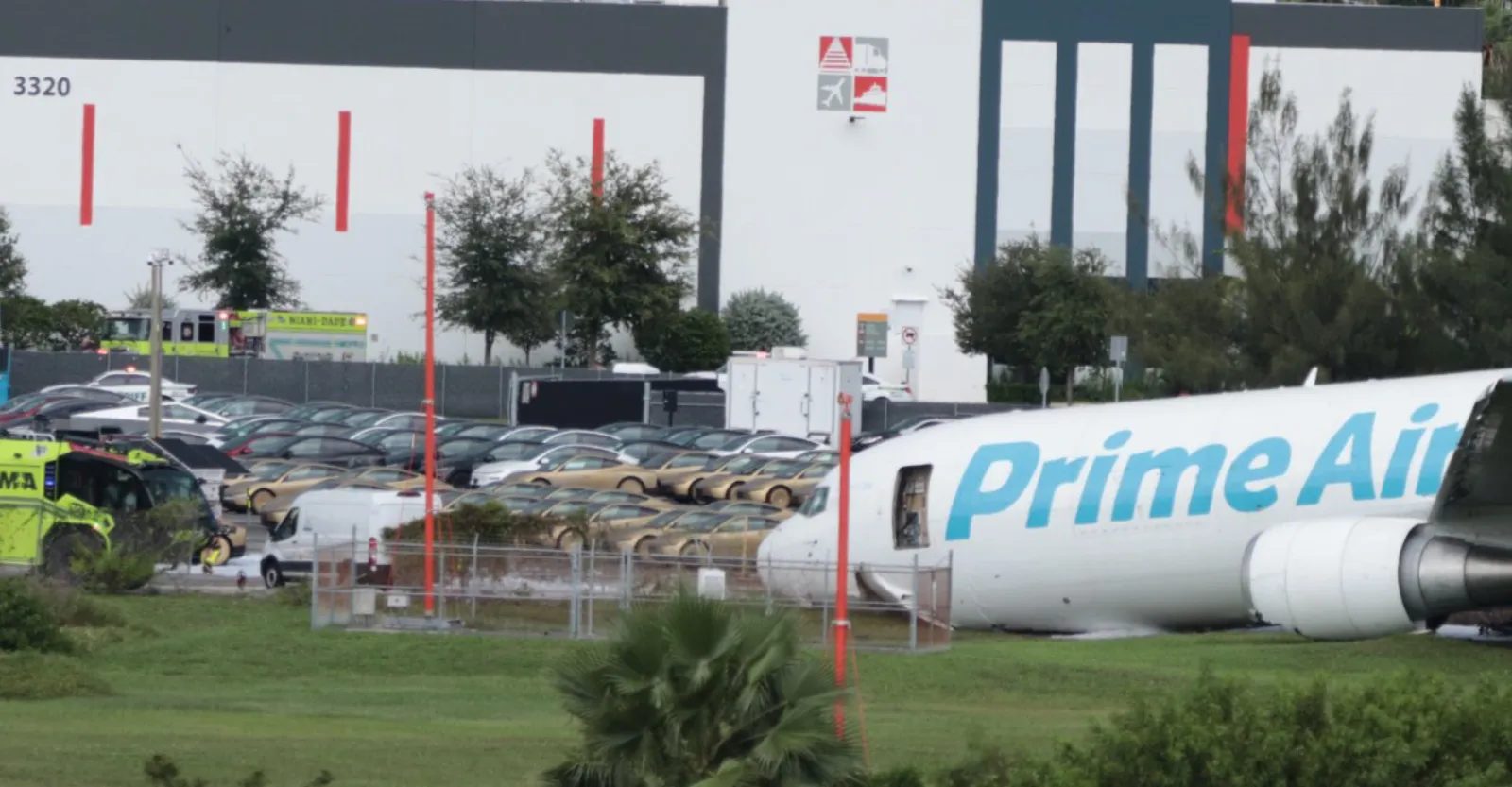

An Amazon Air Boeing 767 freighter that overran a runway at Miami International Airport on Sunday nearly hit dozens of Tesla Cybercab robotaxis, photographs and video from the scene show.
Rows of the gold two-seaters, are visible in images of the wreckage within a few car-lengths of the aircraft’s nose, with a Miami-Dade Fire Rescue crash tender positioned between them and the fuselage.
Neither Tesla nor Miami-Dade Fire Rescue had said as of 5 p.m. Eastern time whether any of the vehicles was struck or damaged, and the fire department has identified the vehicles it says the plane hit only as “multiple vehicles.”
The Crash
Prime Air Flight 7598, a Boeing 767-300 registered N1997A and operated for Amazon by 21 Air, overran the airport’s diagonal runway on landing at about 2 p.m. after arriving from San Juan, Puerto Rico, according to the Federal Aviation Administration.
The aircraft left the airfield, struck vehicles and caught fire, and came to rest on its belly beside a perimeter road; Miami-Dade Fire Rescue said more than 60 units responded and that there were “multiple patients,” without giving a count or describing injuries.
The fire department placed the struck vehicles near the 2100 block of Northwest 42nd Avenue.
One of the airport’s four runways reopened by late afternoon after a full ground stop, and the airport said it was still “experiencing impacts.”
The FAA and the National Transportation Safety Board are investigating, and Amazon said it was “still gathering details” and working with authorities.
“We can confirm that an Amazon Air plane operated by 21 Air experienced an incident while attempting to land at Miami International Airport today,” Amazon spokesperson Kelly Nantel said in a statement posted on the company’s news site on Sunday.
“This is a fast-moving situation and we’re still gathering details. We’re working closely with local authorities and officials to understand exactly what happened. Right now, our absolute priority is the safety, well-being, and care of everyone involved. We’re doing everything we can to support those affected,” the company added.
The statement did not address the condition of the crew, the cargo, or the vehicles the aircraft struck.
The Lot
Tesla launched unsupervised Robotaxi service in Miami on July 3 with a handful of Model Ys in a geofenced zone in the western suburbs.
Within days, industry analyst Grayson Brulte of The Road to Autonomy reported finding a staging lot “on the fringe of Miami International Airport,” about two miles from the main terminal entrance, holding about 21 Cybercabs on Florida license plates alongside Model Y robotaxis.
Tesla’s investor and most followed X content creator Sawyer Merritt posted video on Saturday of what he counted as 35 Cybercabs at the same lot, and on Sunday wrote that the crash occurred “right where all those Cybercabs/Teslas were parked,” adding that the cars’ Sentry Mode cameras were likely to have recorded the accident.
Photographs from the scene show a fenced lot of mixed vehicles, dozens of them the gold-painted Cybercabs, bordered by a logistics warehouse marked 3320, with a Miami-Dade Fire Rescue vehicle and the aircraft’s nose immediately beyond the fence line.
The Cybercabs visible in the images appear intact, but the photographs cover only part of the lot and the impact area on the far side of the aircraft is obscured by the fuselage and by semi-trailers.
Tesla
Cybercabs have not entered commercial service in Miami; Tesla’s Florida fleet in operation consists of Model Ys, and the company gave the first public Cybercab rides in Austin only last week, at an invitation-only event that was not livestreamed.
The National Highway Traffic Safety Administration (NHTSA) opened an audit query on Friday into Tesla’s self-certification of a vehicle with no steering wheel, pedals or mirrors, and Tesla shares fell 6.5% that day.
Tesla has listed installed Cybercab capacity above 125,000 units a year and has said the car will be sold to consumers for under $30,000 before 2027; Ark Invest has estimated production cost at about $18,000 a unit, which would put the value of 35 cars at roughly $630,000 at cost.
If any of the vehicles were struck, it would be the first loss of Cybercabs to an external event.
The model’s only reported collision to date, in May, was a minor incident that Tesla-focused accounts on X said was not the car’s fault.