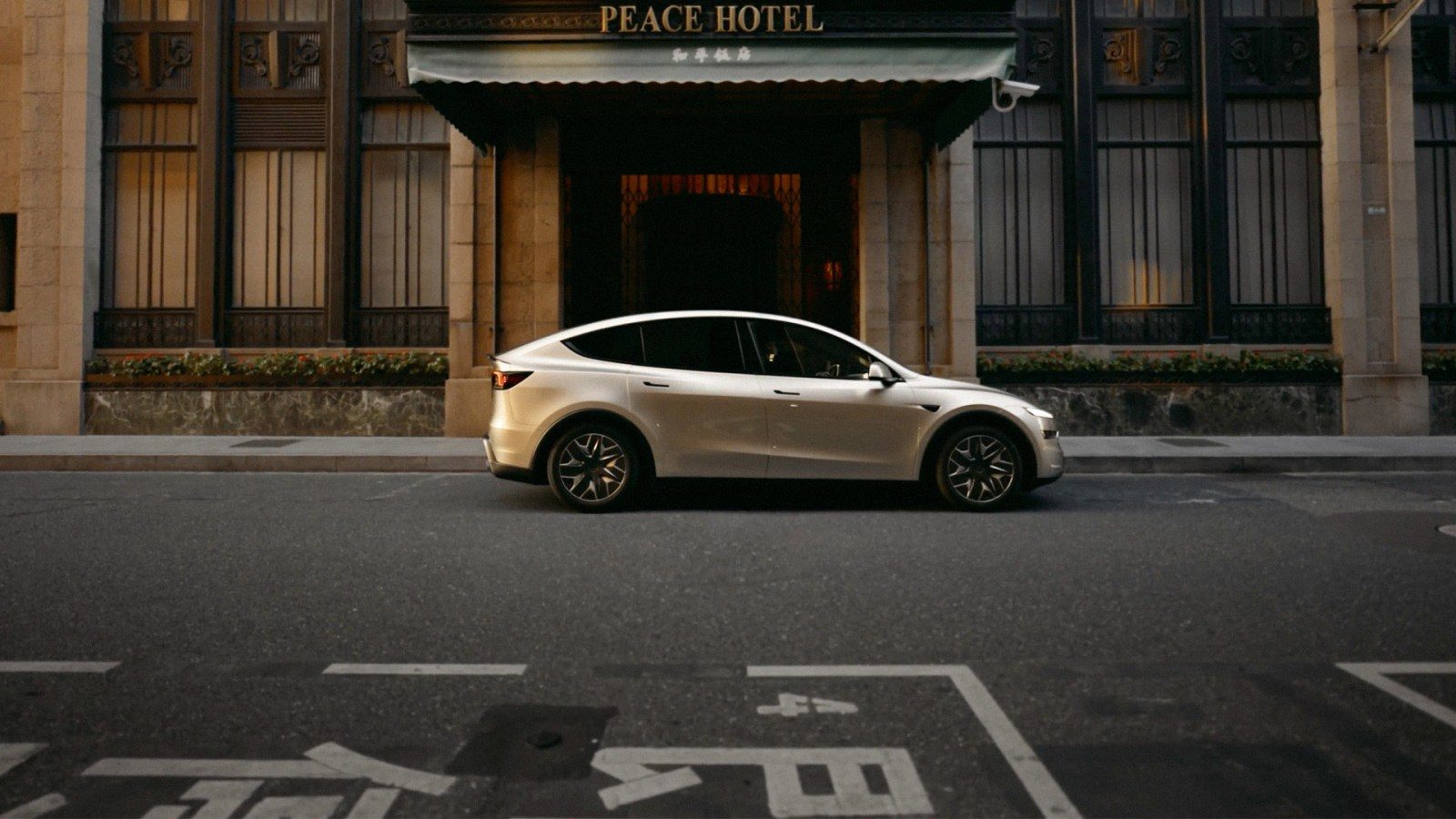

Tesla has reopened a key delivery Center in Shanghai with a refreshed facility and an upgraded vehicle handover experience — as the company works to recover domestic sales in a market where competition is fiercer than in any other worldwide market.
Over the first five months of 2026, the US brand’s retail sales in China have declined by 7.9% to 186,035 vehicles — despite a 28.4% year over year increase in output from the Shanghai Gigafactory year-to-date.
The company announced the reopening of the Minhang delivery center on Chinese social media, which highlighted three changes at the facility: a renovated venue, a redesigned customer experience, and a more efficient delivery process.
Tesla told customers to “choose Tesla in Shanghai — the real choice of over 9 million car owners.”
Considering delivery figures reported earlier this month, Tesla has surpassed over 9.7 million units by the end of the first half.
Minhang’s Role in Shanghai
The Minhang Delivery Center originally opened in October 2021 as an 11,800-square-meter facility with 72 covered delivery bays and a seminar room seating 100 customers.
Located in western Shanghai’s Minhang District, the center was designed to serve buyers in the Puxi area — the city’s most populated half, west of the Huangpu River.
In 2025, Shanghai ranked fourth among Chinese provinces and municipalities for Tesla retail volume, with approximately 47,800 units sold, according to data from China’s Passenger Car Association (CPCA).
The city posted 10.4% year-over-year growth, outpacing several larger provinces and reflecting a stable demand base in the market where Tesla‘s only Chinese factory is located.
Delivery Network
As of Tuesday, Tesla operated approximately 150 delivery centers across mainland China, according to the company’s official website.
The network is separate from its showroom and service operations, and is concentrated in the eastern coastal provinces where the bulk of sales occur.
Jiangsu leads the country with roughly 18 delivery centers, followed by Shandong with 15 and Zhejiang with 14.
Guangdong has approximately 12, while Hebei and Sichuan account for nine and eight respectively.
Most provinces have at least one, and the network reaches into western and southern regions including Guangxi, Yunnan, and Chongqing.
The distribution mirrors Tesla‘s 2025 provincial sales pattern.
Zhejiang led all provinces with 95,000 retail units, followed by Jiangsu at 87,400 and Guangdong at 74,900, ThinkerCar data showed.
Shandong placed fifth at 40,700 units, and Beijing — which has only two delivery centers — ranked sixth at 33,100 units but posted the strongest year-over-year growth of any top-ten province at 25.0%.
Last year, sales fell by around 20% in Jiangsu, Shaanxi and Yunnan. Hubei and Hebei declined modestly at 2.8% and 2.4% respectively.
As of December 31, 2025, Tesla operated 1,553 retail, delivery, service, and body shop locations globally.
This represents a 14% increase year-over-year, according to its 10K update with the SEC.
Giga Shanghai Output
The Minhang refresh arrives as Giga Shanghai enters the second half of 2026 with strong momentum.
Wholesale vehicle registrations from the plant reached 89,091 vehicles in June, a 24.4% increase from a year earlier and the highest monthly total of 2026, data released by CPCA showed.
The figure marked the eighth consecutive month of year-over-year wholesale growth, reversing a streak of sustained declines that ran through most of 2025.
Second-quarter wholesale volume from the plant totaled 254,551 units, up 32.8% from the same period last year.
For the first half of 2026, cumulative wholesale volume reached 467,949 units, a 28.4% year-over-year increase, according to CPCA.
Wholesale figures include both domestic retail sales and exports from the Shanghai factory.
The June retail breakdown has not yet been released and is expected in the coming days.
In May, the most recent month with full data, domestic retail sales reached 47,281 units — a 22.5% year-over-year increase that snapped a two-month run of annual declines.
Retail volumes had fallen approximately 24% in March and roughly 10% in April before May turned positive.
Despite the May rebound, cumulative retail sales for the first five months of 2026 stood at 186,035 units, down 7.9% from the same period in 2025, CPCA data showed.
Exports from the Shanghai plant have more than offset the domestic softness.
Through the first five months, Tesla exported 192,823 vehicles from China — more than double the year-earlier figure — and exports have now outpaced domestic retail sales for the period.
The plant runs a localization rate above 95% and produces both the Model 3 and Model Y, including the six-seat Model Y L variant that launched in China in August 2025 and has since expanded to markets across Asia-Pacific and, as of July 2026, the United States.
Competitive Landscape
The broader Chinese new-energy vehicle market has continued to expand, with competition remaining fierce.
BYD posted 403,472 wholesale new-energy vehicle units in June, with fully electric vehicles accounting for 201,472 of the total.
Exports reached a record 175,349 units, pushing the overseas share to roughly 43.5% of the month’s volume.
The Shenzhen-based giant, which produces both plug-in hybrid models (PHEV) and fully electric vehicles (BEV), sold 1,808,511 units in the first half of 2026.
Nio delivered 40,597 vehicles in June, its strongest month of 2026, with the main Nio brand accounting for 21,908 units, family-oriented Onvo contributing 11,743, and compact marque Firefly adding 6,946.
The group’s first-half deliveries reached 191,123, up 67.4% year over year.
XPeng delivered 40,126 vehicles, also a 2026 monthly high, bringing second-quarter deliveries to 103,295.
Tech giant Xiaomi delivered approximately 180,000 vehicles in the first six months of 2026, a 15% year-over-year increase that leaves the tech giant well short of the monthly pace its 550,000-unit annual target demands.