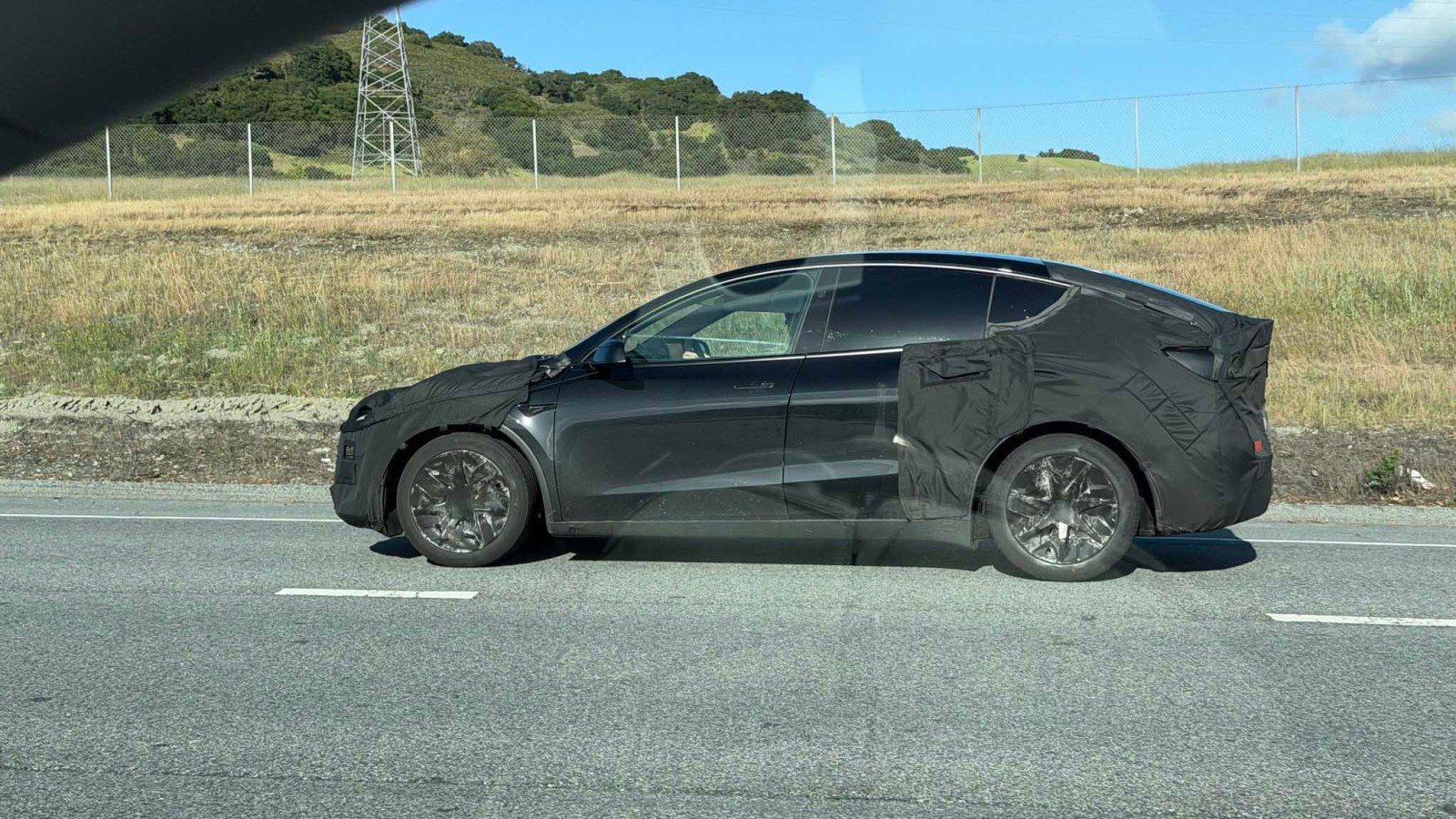

A Tesla Model Y L prototype has been spotted driving in California on Wednesday, marking the first time the six-seat SUV has been seen on American roads.
The photo was shared on X by user ‘michaelrcarroll’ on Wednesday, who flagged that the vehicle was seen on Interstate 280 in the San Francisco Bay Area — where Tesla has historically tested prototype vehicles before.
“First Model YL mule sighting in North America? I took this on I-280 NB this afternoon. It’s a looong boi…,” he wrote.
The sighting comes a month after drone footage shared by Tesla enthusiast Joe Tegtmeyer showed what appeared to be a Model Y L body inside a wooden crate at the Texas Gigafactory.
The prototype was spotted on US roads for the first time in the same week that India became the twelfth overseas market to offer the Model Y L.
Public road testing signals a much more advanced stage of US preparation, despite prior comments from Elon Musk signaling that the model “might not ever” launch in the US despite its success overseas.
Tesla‘s CEO had cast doubt upon its international shipping when asked about it in late August, saying it would not “start production in the US until the end of next year.”
“Might not ever, given the advent of self-driving in America,” he added.
Since then, the six-seat SUV has been made available in 11 other markets besides China.
The model has been introduced in Australia, New Zealand, Japan, South Korea, Thailand, Hong Kong, Singapore, Malaysia, Macau, the Philippines and, as of earlier this week, India.
The timing for the Model Y L expansion is notable, as Tesla just ended production of the Model S and Model X this quarter.
The phaseout leaves the company without a three-row vehicle in its US lineup, aside from the seven-seat Model Y — an option that fits an additional row into the standard body without added legroom.
The six-seat Model Y could fill the gap left by the Model X, which offered five, six or seven-seat configurations starting at $99,990.
Model Y L
The Model YL — a three-row version of Tesla‘s best-selling SUV — launched in China in August 2025, with deliveries beginning the following month.
It is priced from 339,000 yuan ($49,300), approximately 75,500 yuan above the entry-level five-seat Model Y.
The Model Y L shares its design with the standard Model Y from the front to the B-pillar but is noticeably longer from there back.
It features larger rear glass panels, a taller roofline and a more upright rear profile — changes designed to create additional headroom for third-row passengers.
While it retains the coupe-style sloping roofline, the slope is gentler, giving the rear end a fuller, less tapered appearance.
The Model Y L is about 7.3 inches longer than the regular Model Y, expanded both in the back and in the wheelbase.
The seven-seat Model Y is externally identical to the standard five-seat version — it simply adds a third row of seats inside the existing body without added legroom.
The Model Y L, by contrast, is a physically larger vehicle with a stretched wheelbase and a longer body, allowing for more space and comfort inside the vehicle.
Q1 Earnings
The vehicle was spotted on the same day of Tesla‘s first-quarter earnings call, during which Musk said the company plans to ramp up production of all vehicles, across all factories, through the rest of this year.
Musk did not mention the Model Y L specifically, but confirmed that the last Model S and Model X units will roll off the Fremont line in early May — with that factory being retooled for Optimus humanoid robot production.
The Fremont conversion is expected to take several months, with Optimus start of production targeted for late July or August.
The CEO outlined a lineup increasingly focused on autonomy, saying most of the company’s long-term production will shift to the Cybercab, the two-seat autonomous vehicle that began production this quarter.
When asked by Goldman Sachs analyst Mark Delaney about the company’s appetite for new vehicle models, Musk pointed to the Cybercab as the compact vehicle in the lineup and said the company’s future range would be almost entirely autonomous.
The only manually driven model in Tesla‘s long-term plans, he said, would be the new Roadster, which he suggested could be debuted within the next month — a delay from the April timeline reiterated over the past months.
CFO Vaibhav Taneja struck a more upbeat tone on the automotive side, noting that Tesla saw a demand rebound across EMEA and slight growth in the US.
The company ended the first three months of the year with its highest first-quarter order backlog in over two years.
Auto gross margins excluding regulatory credits improved sequentially from 17.9% to 19.2%, aided in part by approximately $230 million in warranty write-downs.
Tesla also raised its 2026 capital expenditure guidance to more than $25 billion, up from $20 billion, and disclosed a $2 billion acquisition of an undisclosed AI hardware company.
Taneja said the company expects negative free cash flow for the rest of 2026.