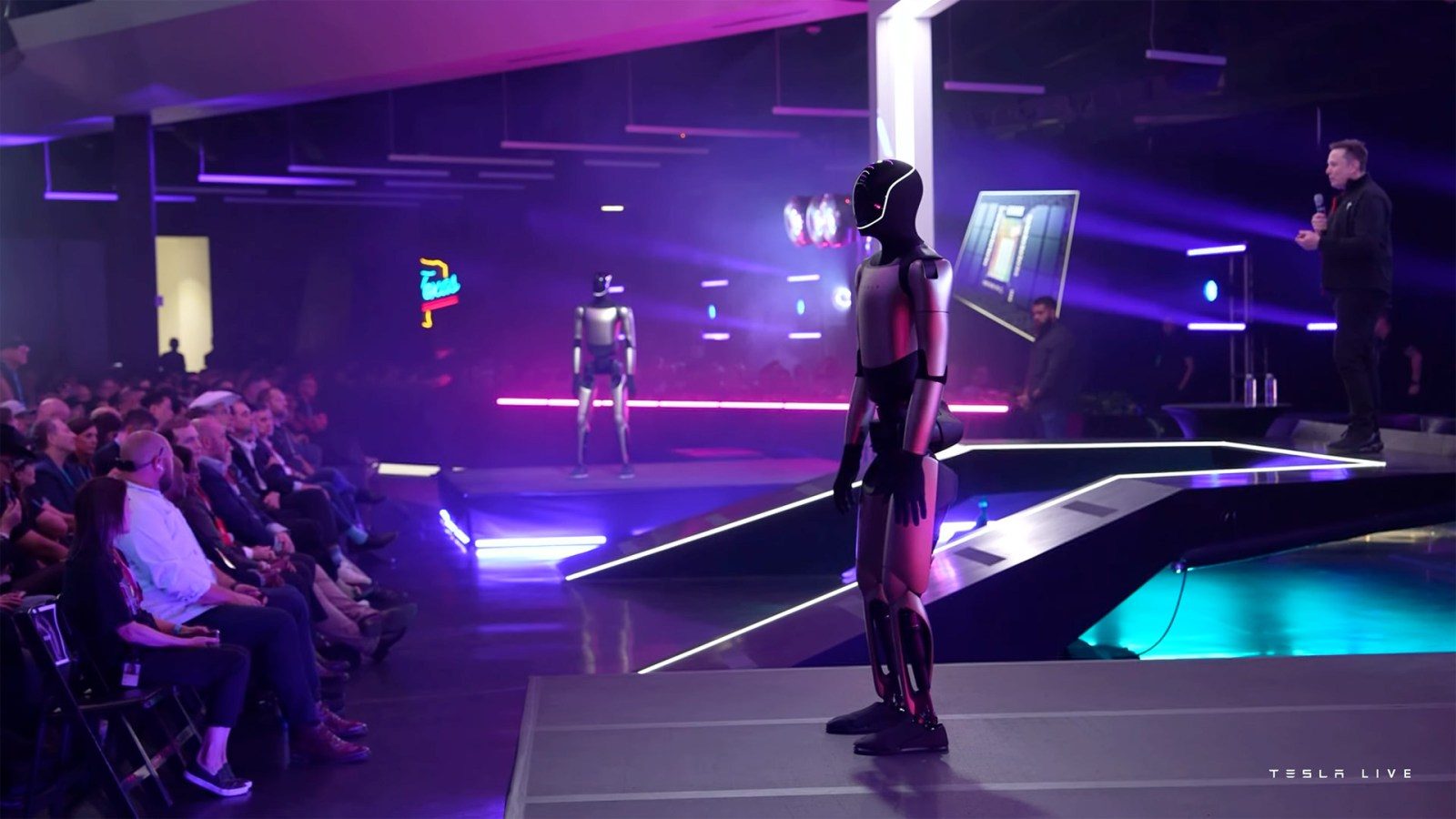

Tesla shares erased a post-earnings rally during Chief Executive Elon Musk’s remarks on the Q1 2026 conference call Wednesday, as softer timelines on Cybercab and Optimus and a $5 billion increase on CapEx weighed on the Wall Street sentiment.
The shares spiked as high as $406.77 in after-hours trading immediately after Tesla posted a non-GAAP earnings-per-share beat of $0.41 against consensus of $0.37 while announcing the production start of its fully autonomous model Cybercab.
Gross margins rebounded to 21.1% — a 478 basis-point improvement year-over-year and the highest print in five quarters.
Shares then slid through the earnings call, bottoming at $374.64 as Musk outlined slower rollouts of the autonomy and robotics products.
Additionally, the Chief Financial Officer Vaibhav Taneja confirmed the company’s 2026 capital expenditure ceiling had risen to more than $25 billion from the prior $20 billion forecast issued in January.
Tesla traded at $387.50 in pre-market Thursday, down 2.7% from Wednesday’s $386.42 close.
The Capex Commitment
Musk framed the capex uplift as a long-duration bet on a larger future revenue stream.
“We are going to be substantially increasing our investment in the future,” Musk said in the call. “You should expect to see very significant increase in capital expenditures that are I think well justified for a substantially increased future revenue stream.”
Musk sought to contextualise the figure by reference to peer spending: “Tesla is not alone in this,” he added, citing large CapEx plans at the biggest tech companies.
Amazon has projected about $200 billion of capital expenditures in 2026 across AI, chips, robotics, and low earth orbit satellites, while Google is guiding to between $175 billion and $185 billion, up from $91.4 billion a year earlier.
Tesla itself is in the middle of one of the most expensive bets in its history.
Musk has pivoted the automaker’s focus to AI-powered self-driving cabs and humanoid robots, and much of Tesla‘s $1.45 trillion market capitalisation rests on that vision.
The company had forecast more than $20 billion in capital expenses for 2026 at its January update. Last year, it spent $9 billion.
“We are in a very big capital-investment phase, which is going to start now and would last a couple of years,” Taneja said on the call, adding that the company will record negative free cash flow for the rest of 2026.
Tesla’s Own Framing
Tesla‘s shareholder letter struck a notably more upbeat tone than the market reaction.
“We continued to make meaningful progress on the build out of the infrastructure and AI software that underpins our Robotaxi and future robotics businesses in Q1,” the company wrote, citing the ramp of additional AI compute, new battery and battery-materials factories, and preparation for start of production of Megapack 3, Cybercab, and the Tesla Semi.
The company flagged demand strength across regions.
“We saw continued growth in demand for our vehicles in markets in APAC and South America, while also seeing a rebound of demand in both EMEA and North America,” Tesla wrote.
The letter closed with the company’s management saying that it is “excited about Tesla‘s positioning in 2026 with tailwinds persisting for the autos business, our continued progress on FSD (Supervised), the ramp of Robotaxi, progress on Optimus ahead of mass production and the growth of our energy production capacity… The future is incredibly bright.”
Goldman Sachs Holds at $375
Goldman Sachs analyst Mark Delaney reiterated on Thursday a Neutral rating and $375 price target on Tesla, roughly in line with Wednesday’s after-hours trough.
“1Q results were better than we had expected driven by higher margins in the Auto and Energy segments, although a portion of this was due to one-time benefits related to warranty and tariff accounting,” Delaney wrote.
The analyst flagged progress in Full Self-Driving subscriptions, up 51% year-over-year, and recent improvements in FSD and robotaxi performance with no NHTSA-reported robotaxi accidents in February and the first half of March, though he noted the fleet remains small.
“Tesla suggested that the pace of robotaxi deployments could be measured in the near-term, that it could now take until late this year for Unsupervised FSD to be released to consumers, and it’s still finalizing elements of Optimus,” Delaney wrote.
“We believe these datapoints, in combination, will sustain the debate about whether Tesla‘s approach to AI will in fact allow it to scale significantly faster than competitors in both robotaxis and robotics,” he added before admitting higher than expected CapEx.
“The cost to drive those efforts will likely be higher than we’d previously expected, with Tesla increasing its capex guidance to more than $25 bn and in turn expecting negative FCF for the remainder of 2026.”
TD Cowen Stays Bullish
TD Cowen analyst Itay Michaeli reiterated a Buy rating and $490 price target — the highest among the firms surveyed here and roughly 30% above Tesla‘s pre-market level.
“Similar to last quarter, we believe resilient quarterly results should help set a foundation for gradual sentiment improvement throughout the year as Tesla enters a period with meaningful AV/Robotics catalysts,” Michaeli wrote, citing Cybercab, robotaxi expansion, FSD eyes-off deployments, Optimus V3, and Semi as the near-term drivers.
Michaeli identified FSD eyes-off as “a particularly powerful catalyst opportunity late this year/early next, even under smaller initial ODDs” — referring to Operational Design Domains, the specific conditions under which autonomous systems are certified to operate.
The analyst linked the stock to a broader thesis: “We also view the shares as being well positioned to benefit from our Looming US EV Comeback thesis… and view management’s EV demand commentary as a positive read for our thesis.”
Michaeli’s reference to EV demand commentary aligns with Tesla‘s own shareholder-letter claim of a demand rebound in North America and EMEA.
Truist Holds at $400
Truist Securities analyst William Stein reiterated a Hold rating and $400 price target, framing the quarter as confirmation of Tesla‘s shift away from its automotive origins.
“TSLA’s transition from autos to AI is becoming more obvious now. TSLA reported modest upside to Q1 (revs & EPS) and did not guide Q2,” Stein wrote.
Stein identified two central changes in the quarter: “it is yet again raising capex from an already eye-popping $20b to $25b, which will cause negative FCF this year” and “it is accelerating an array of AI & other projects, including FSD/Robotaxi, Cortex 2, Dojo 3, Optimus, and Terafab.”
“We continue to believe these investments will make auto delivery data decreasingly relevant,” Stein wrote. “Most of the fundamental changes are positive, in our view, but our updated DCF remains $400, so we stay on the sidelines. Hold.”
Truist’s $400 target is 6% above the pre-market level, implying modest upside but no conviction to upgrade.
Mizuho Lowers Target
Mizuho analyst Vijay Rakesh lowered his price target on Tesla to $480 from $540.00 while maintaining an Outperform rating — the largest single cut among the banks surveyed, though the target remains well above the current stock level.
“TSLA reported Rev/EPS of $22.4B/$0.41 (above cons. $22.1B/$0.35),” Rakesh wrote, flagging four takeaways.
The first: “Slowing EV Demand growth in 2026E (we est EV LVP up ~4% y/y) after 2025 up ~30% y/y.”
The second: automotive gross margin excluding regulatory credits reached 19.2%, up 120 basis points quarter-over-quarter, “better with tariff relief/warranty writedowns.”
The third was the fact that Cybercab is now in production with cumulative Cybercab miles reaching 1.7 million, while FSD unsupervised launch is targeted for the second half of 2026.
Optimus production is ramping for internal testing in the second half of 2026, with commercial launch pushed to 2027.
The fourth: “AI investment — F26E Capex guided $25B (prior $20B vs. F25 at ~$9B) with 6 factories being built/switched, AI5 taped out with previously disclosed SOP in 2027E and planning to utilize INTC 14A nodes.”
“Maintain Outperform, Lower Ests and PT to $480 (prior $540) as we see TSLA well-positioned leading physical AI with Cybercab/FSD traction, humanoid longer term, offset by near-term demand headwinds,” Rakesh concluded.
The Split on Wall Street
Goldman Sachs sits at $375, essentially flat with Thursday’s pre-market level.
TD Cowen holds at $490, implying 30% upside. Truist is in between at $400, still on the sidelines. Mizuho cut its target by $60 but remains Outperform at $480.
The average of the four targets is $436 — roughly 16% above the pre-market level.
But the narrow range of outcomes reflects the same underlying tension all four analysts acknowledged: a cleaner core auto margin offset by a larger CapEx bill, a delayed Unsupervised FSD timeline, Optimus commercial launch pushed to 2027, and an autonomy-and-robotics pivot whose revenue trajectory remains unquantified.
Tesla‘s market capitalisation stood at $1.45 trillion at Wednesday’s close.