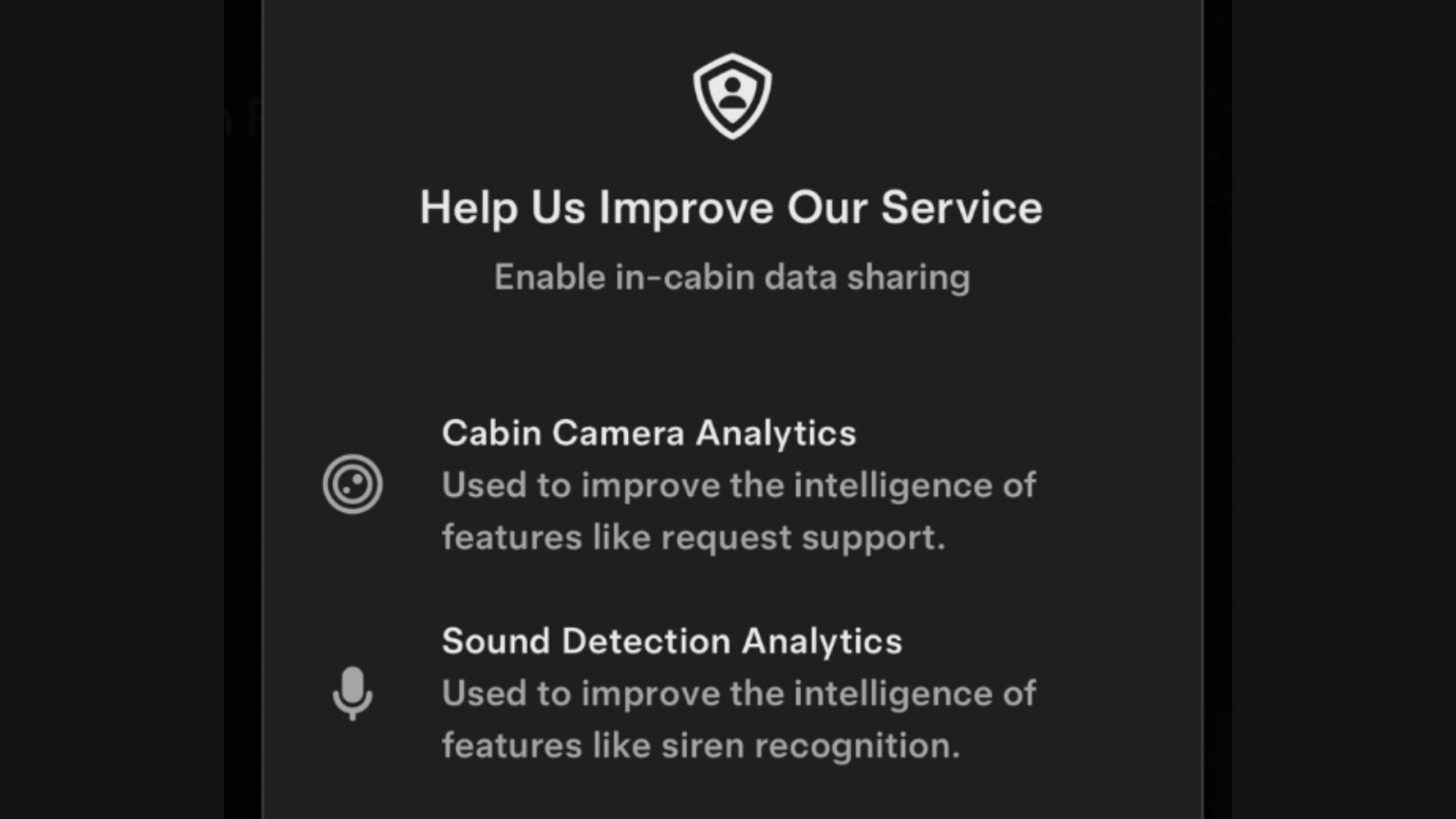

Tesla is reportedly introducing a user consent request in its Robotaxi app for enhanced in-cabin data collection as it prepares to remove the safety drivers in Austin by the year end.
The goal is to use this data to help the AI understand passenger behavior and provide safer experiences on the ride-hailing service, as it advances toward full autonomy.
The X user ‘Tesla App Updates (iOS)’, which tracks App Store changes for Tesla and Robotaxi apps, shared a list of the new features of the v25.11.5 such as Live Screen Share for real-time guidance and In-Cabin Analytics.
According to the company, the data collected in these support features is not linked to the user — unless specifically required for a safety event or an active support request — as analytics are anonymous by default.
Visual and Sound Detection
The consent request indicates that Tesla might access the in-cabin camera — during a support session, for example, when using the ‘Screen Share’ feature — to allow a remote agent to monitor passenger status and provide assistance.
Tesla also plans to use in-cabin sound detection to enhance siren recognition.
This indicates that the vehicle can actively listen for emergency vehicle sirens, helping the autonomous system respond more effectively.
With the user’s consent, the company might collect internal audio data — which would help the system distinguish between sirens heard outside versus sounds inside the cabin.
Robotaxi Expansion Updates
Musk reaffirmed earlier this month that the next cities to receive Tesla‘s Robotaxi service will be Miami (Florida), Dallas (Texas), Phoenix (Arizona) and Las Vegas (Nevada).
A few days after getting Arizona’s approval to launch its Robotaxi there, Tesla completed Nevada’s self-certification and is now waiting for state approval to operate the ride-hailing service.
The information was first shared by Tesla shareholder and X user Sawyer Merritt on Monday.
The company is also expected to launch its Robotaxi in Colorado, where it recently listed several job positions, and in Massachusetts, as a vehicle was spotted undergoing testing in Boston last week.
FSD Improvements
Tesla uses a modified version of its Full Self-Driving (FSD) software in its Robotaxi service.
The regular version of the FSD (Supervised), rolled out to customers across the US, Canada, Puerto Rico, Mexico, Australia, New Zealand and South Korea, provides advanced assisted autonomy.
It corresponds to SAE’s Level 2+ of self-driving, also known as enhanced partial automation.
Despite the vehicle being able to drive itself in certain conditions, a human driver must remain attentive and ready to take control.
The FSD deployed in the ride-hailing service, however, is supposed to offer full autonomy for passenger transport.
If full autonomy is approached, the vehicle operates safely without a human driver, navigating city streets and highways responding to real-world scenarios on its own.
As it continues working together with the regulators, Tesla has safety operators inside the vehicle in both Austin (Texas) and the Bay Area (California).
CEO Elon Musk has repeatedly stated that the company aims to remove them by the year end.