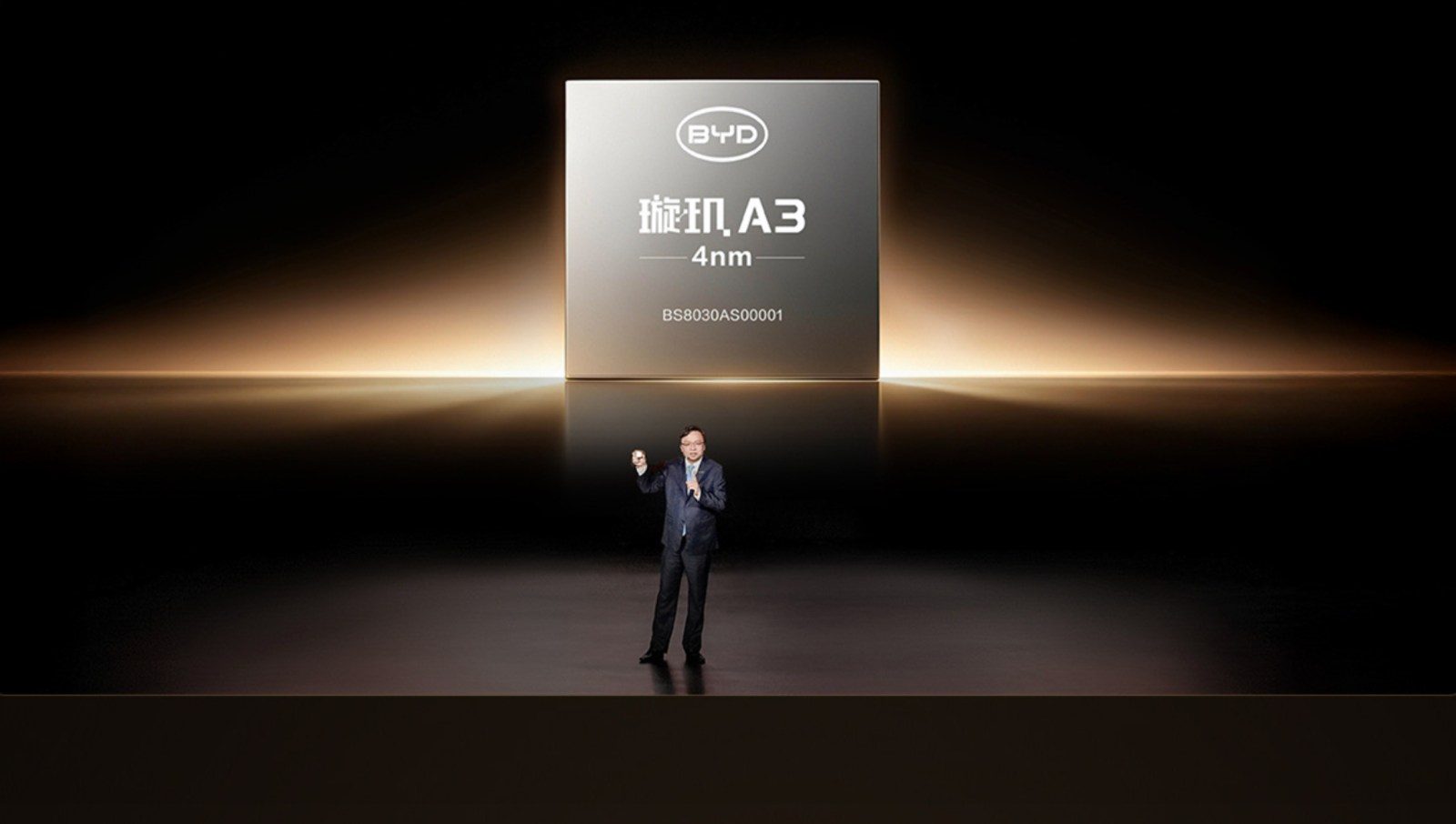

BYD unveiled a self-developed 4-nanometer intelligent-driving chip on Thursday, the Xuanji A3, which the company described as China’s first automotive-grade processor built on the advanced node.
The chip is designed to support Level 3 and Level 4 autonomous driving, BYD said, positioning it as the compute foundation for the latest version of its God’s Eye driver-assistance system.
BYD said the Xuanji A3 offers the lowest power consumption per unit of compute in its class, drawing about 20% less than comparable products, and called its 4nm process the most advanced in the chip-manufacturing industry for automotive applications.
The company founded and led by Wuang Chuanfu said 3.15 million of its vehicles are now equipped with assisted driving, generating 200 million kilometers of data daily, as of May 28.
Racing Tesla in China
The push lands as BYD works to widen its lead over Tesla at home in assisted driving.
Tesla has recently changed the name of its FSD feature to Tesla Assisted Driving, saying the function will be “available later.” The package is still priced at 64,000 yuan in China.
Tesla‘s system remains a limited deployment rather than a blanket rollout.
Full regulatory approval to reach every eligible vehicle has not arrived, with full regulatory approval reportedly targeting Q3.
That leaves an opening BYD is moving to exploit.
While Tesla awaits clearance for a system priced at 64,000 yuan, BYDis fitting LiDAR-based city navigation across its lineup as a 12,000-yuan option, running on its own silicon.
The Specifications
The chip carries 273 gigabytes per second of bandwidth, a 16-core CPU and 420,000 DMIPS of processing performance, according to BYD.
The company said a three-chip configuration delivers more than 2,100 trillion operations per second, or TOPS, of total vehicle compute.
BYD said pairing the chip with deep algorithm optimization doubles compute-utilization efficiency, and that the processor meets ASIL-D, the highest automotive functional-safety rating.
A Vertical-Integration Milestone
The Xuanji A3 extends BYD‘s long push to design its own silicon rather than rely on suppliers such as Nvidia, whose chips power many rival assisted-driving systems in China.
BYD said it has been building out chip operations for 24 years and described itself as the only automaker globally with full-process, full-chain chip-manufacturing capability, spanning product definition, architecture and circuit design, layout, wafer fabrication, packaging and testing.
The company said it offers more than 2,000 chip products across five application areas, including intelligent vehicles, consumer electronics and energy storage, and called itself China’s largest automotive-grade chip company, with 567 automotive-grade products across 13 categories used by 46 domestic and international auto brands.
BYD said its chip effort is backed by a research team of more than 7,000 people, over 100 billion yuan in investment, four R&D bases and five wafer-fabrication plants.
The Driving System It Powers
The chip underpins the upgraded God’s Eye platform, which BYD is using to extend city-navigation assisted driving across its lineup.
The God’s Eye B LiDAR edition is available as a 12,000-yuan option across the range, excluding the Yangwang U9 series and the Fang Cheng Bao 8, where it is standard on some configurations.
BYD said the system runs on its Xuanji Architecture 2.0, which routes raw sensor signals directly to a central brain it said responds with eight-microsecond latency.
The company said the upgraded sensor suite includes LiDAR with 1.6 times the angular resolution of the prior generation, a 4D millimeter-wave radar with 400-meter detection range, and the platform supports what it described as more than 1,000-line LiDAR for higher levels of autonomy.
Bringing City Navigation to the Mass Market
The chip is central to BYD‘s push to make urban assisted driving a volume feature rather than a premium one.
The company framed the launch as ushering in an era of “city navigation for all,” extending LiDAR-based urban driving across its lineup at a price point well below where such capability has typically sat.
To underline its confidence in the system, BYD said it would backstop city-navigation safety for one year, covering both new buyers and existing owners who upgrade over the air to God’s Eye 5.0.
The company described the guarantee as free, with no payout cap, and framed it as a commitment rather than insurance, saying it would compensate and repair directly without affecting owners’ future premiums.