
Rivian‘s in-car AI Assistant will be rolled out to customers “in the coming weeks,” founder and CEO RJ Scaringe said on the company’s first quarter earnings call on Thursday — confirming the launch of a feature that the company had originally promised for early 2026.
The disclosure marks the first concrete timeline Scaringe has put on the rollout since the AI-powered voice assistant was unveiled at Rivian‘s Autonomy & AI Day in Palo Alto in December 2025.
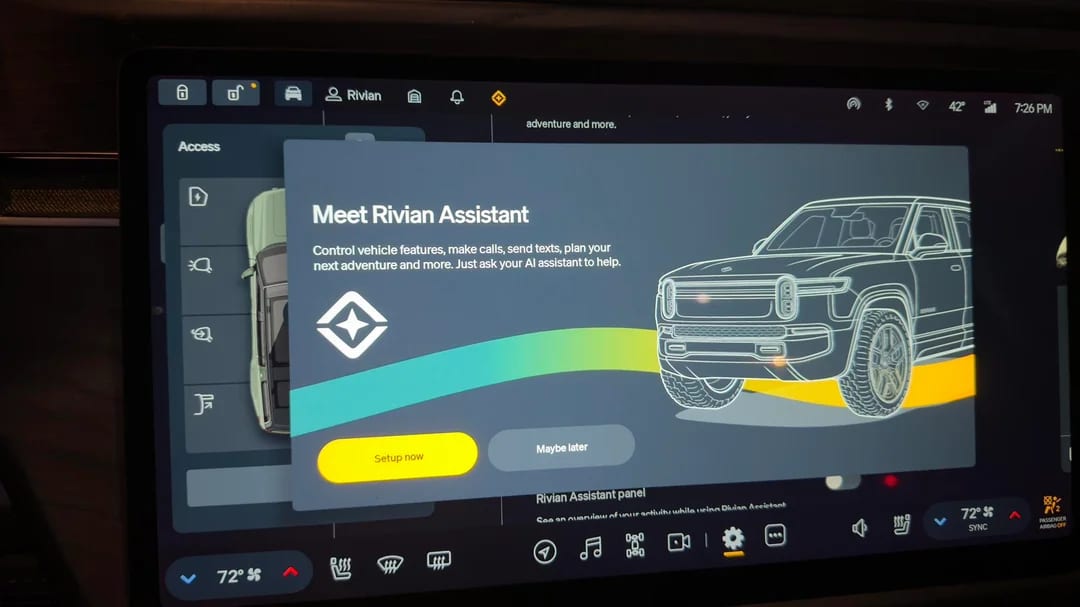
“Finally, in the coming weeks, we are excited to launch the Rivian Assistant on R1 and R2 vehicles,” Scaringe told investors on the earnings call.
The CEO did not provide a specific delivery date for the rollout to begin.
Scaringe described the assistant as a digital copilot for the vehicle ecosystem.
“The Rivian Assistant is our new AI-powered voice assistant that is built to be a digital copilot with integration into the vehicle ecosystem and other external apps,” Scaringe added.
Four Months Behind
The original “early 2026” framing came from chief software officer Wassym Bensaid, who said at the December 11 unveiling that the assistant would launch on every existing Rivian vehicle — not just second-generation R1 models.
The Rivian Assistant connects vehicle systems with third-party apps such as Google Calendar using an in-house agentic framework, with the company describing it as the product of a two-year internal development effort.
The feature has remained absent from Rivian‘s over-the-air software updates through the first four months of 2026, including the most recent version 2026.07 released in April.
RAP1 Chip on Track
Scaringe also addressed the development of the Rivian Autonomy Processor 1 (RAP1), the in-house silicon chip the company unveiled at the December 11 Autonomy & AI Day.
“The development of our RAP1 chip is on track,” Scaringe said on the earnings call. “We are progressing well on validation and reliability testing.”
The custom 5-nanometer chip is designed for vision-centric physical AI and delivers 1,600 sparse INT8 trillion operations per second.
It will power the third-generation Autonomy Compute Module (ACM3), with deployment scheduled to begin on R2 vehicles starting in late 2026.
Scaringe framed Rivian‘s integrated hardware-software approach as the basis for accelerating autonomy development.
“Our integrated approach allows our hardware team to rapidly iterate with our software team, and our autonomy feature development is progressing well, and we continue to expect to begin rolling out point-to-point capabilities by the end of the year,” Scaringe added.
Slower OTA Cadence in 2026
In 2025, Rivian pushed 11 over-the-air updates to its vehicles.
Version 2026.07 in April was only the second public software release of the year, following 2026.03 in February.
The roughly six-week gap between the two updates is slower than the near-monthly pace Rivian maintained in 2025.
The April release brought diagnostic accuracy improvements for the 12-volt battery system on Gen 2 vehicles, while Gen 1 vehicles received separate improvements to 12-volt battery capacity management.
Universal Hands-Free in Parallel
Rivian is also continuing the rollout of its Universal Hands-Free system on second-generation R1 vehicles.
The system enables hands-free assisted driving on 3.5 million miles of roads across the US and Canada — any road with clearly painted lane markings, not just highways.
The feature is being rolled out under the Autonomy+ subscription service that Rivian launched on April 4, priced at $2,500 as a one-time fee or $49.99 per month.
Scaringe used his opening remarks on the earnings call to anchor the Rivian Assistant rollout within the company’s broader autonomy and AI roadmap.
“In closing, this quarter, our team has executed across many fronts, laying a strong foundation for the years ahead,” the CEO said.
“As an American automotive technology company, we’re building for a future that we believe will be fully electric, autonomous, and AI defined,” Scaringe added.