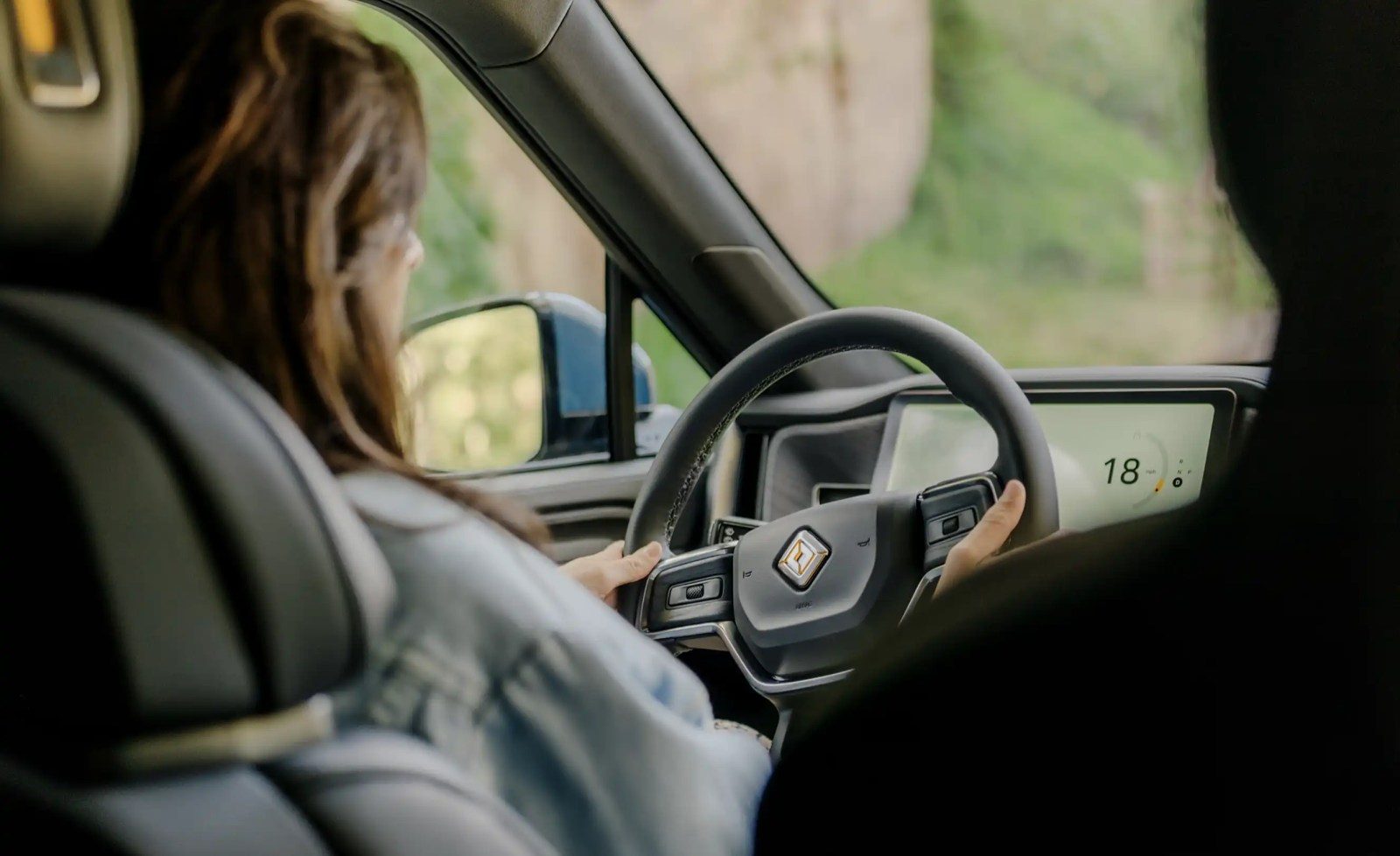

Rivian is recalling 98,828 R1S, R1T and R2 vehicles due to a drive-mode notification that can cover the rearview camera image when a driver shifts into reverse.
The recall, which Rivian submitted to the US National Highway Traffic Safety Administration (NHTSA) on September 16 and the agency published on September 23, affects all three of Rivian’s consumer models and vehicles built over nearly five years, from August 23, 2021 to August 10, 2026.
It is the first recall to include the R2 and Rivian’s largest by vehicle count. Its previous largest covered 34,824 electric delivery vans in December 2025.
According to the company, a software update that fixes the condition is already available for every affected vehicle.
More than 95% of the recalled population already runs the corrected software, according to the filing.
Production Figures
Recalled vehicles include 62,259 R1S SUVs from model years 2022 to 2027, 34,088 R1T pickups from model years 2022 to 2026, and 2,481 R2 SUVs from model year 2027.
Affected R1S units were built between March 30, 2022 and August 6, 2026, and R1T units between August 23, 2021 and July 6, 2026.
R2 units came off the line between April 23 and August 10, 2026.
By early August, Rivian had assigned close to 6,000 R2 vehicle identification numbers, according to EV‘s tracking.
Rivian only reports quarterly production figures and does not distinguish production figures per model.
By the end of the second quarter, Rivian was estimated to have built 789 R2s, according to implied figures published by Cox Automotive.
A Rare Sequence
According to the filing, the fault requires “a very specific set of operations in a specific order.”
Drivers must first turn stability control off in certain drive modes, leave the vehicle for a period of time and return.
On return, a safety alert on the center display tells them stability control is off and asks whether they want to switch back to a mode with stability control on, as federal standard FMVSS 126 requires.
If the driver shifts into reverse without answering, the prompt may overlap the camera image until the vehicle starts moving. At that point, the image appears.
Because the rearview image can be hidden before the vehicle moves, Rivian said the vehicles may not meet FMVSS 111, the federal rear visibility standard.
“A rear-view image that does not display at the start of a backing event may increase the risk of a crash,” the company wrote.
Drivers can restore the image by selecting the camera page on the center display. Moving the vehicle also brings the image back once speed rises above zero.
Fix Already Installed
Affected software covers R1 versions prior to 2026.23 and R2 versions prior to 2026.31.40, the filing shows.
Rivian released 2026.23 to the R1 on August 6, the day the last affected R1S was built, and 2026.31.40 to the R2 on September 4, according to owner-run tracker Rivian Roamer. Both updates went out before the company’s September 10 compliance determination.
As of the filing date, 95.0% of affected R1 vehicles and 96.0% of affected R2 vehicles had received the update. All vehicles built after August 10 carry the corrected software.
Rivian urged owners to install the latest available software. Reuters reported the over-the-air remedy is free of charge.
Owner notification letters will go out on or before November 9, when affected vehicle identification numbers also become searchable in NHTSA’s database.
Found in Internal Testing
Rivian discovered the condition during internal testing, according to its chronology.
From July through September, the company investigated the behavior needed to trigger the fault, determined the affected population and assessed implications for FMVSS 111.
On September 10, Rivian determined that a potential noncompliance “cannot be ruled out.”
As of the filing date, the company said it was not aware of any customer reports, accidents, injuries or fatalities related to the issue in any market.
Owner Complaints
Owners have complained publicly for nearly three years about other warnings appearing over Rivian’s camera views.
None of the posts describes the stability-control prompt covered by the recall.
In November 2023, an owner on Rivian Owners Forum wrote that a “Rear Cross Traffic Warning Unavailable” message on the center screen “blocks a portion of the rear view camera video” when towing a full-height trailer.
The owner asked for the message to time out after 30 seconds or move to the driver display.
A month later, a Sacramento-based R1T owner posting as ‘Claydogg’ on RivianForums asked Rivian to move or remove the same warning from the truck’s Bed View camera.
He wrote that he needed to see the top of his boat while towing.
In August 2025, a commenter on Subreddit r/Rivian said a warning linked to accessory mode appeared in the rear camera view.
Two months later, another owner on the forum asked to switch off a warning so it would not display “across the camera feed.”
A year earlier, an r/Rivian user had contrasted the brand with Tesla, writing that Tesla “pops up notifications OVER the reverse camera when reversing.”
Industry Pattern
Rivian’s recall is one of several this year over software that delays or blocks the rearview image.
In May, Tesla recalled 218,868 vehicles after a software version left the rear camera blank for up to 11 seconds after start-up. Its over-the-air fix had shipped the day after engineers found the problem.
This month, Ram recalled 239,131 1500 pickups over radio software that can stop the rearview image from appearing at all.
Recall Record
In August, Rivian recalled 3,829 additional R1T and R1S vehicles after finding that a turn signal defect first recalled in June 2025 had not been fully contained by its supplier, Myotek.
In January, the company had also recalled 19,641 R1 vehicles after service teams incorrectly reassembled a rear suspension toe link that could separate.
NHTSA opened a preliminary investigation in May into 114,922 R1S and R1T units over the same component.
Rivian said its internal data showed the toe link joints were operating as intended, and that the two owner complaints behind the probe “do not implicate the joint itself.”
In December 2025, Rivian recalled 34,824 electric delivery vans over a seat-belt pretensioner cable that repeated misuse could damage.
At the time, the company said it was not aware of any incidents or injuries linked to the issue.
Recent Software Releases
Version 2026.23, which carries the R1 remedy, shipped in August as the fourth of five R1 feature releases so far in 2026.
Version 2026.31, released on September 4, moved both R1 generations onto RivianOS 2 and put the lineup on a single software stack with the R2 for the first time.
Its release notes listed a Gen 2 fix for a rare fault that locked the doors when a digital key was left inside.
Chief Software Officer Wassym Bensaid wrote on X on September 14 that this year’s Halloween update will arrive “early.”
On Tuesday, an R1T owner said his pickup was driven off from a Las Vegas lot by a woman using a key fob from her own bag. No cause has been established.