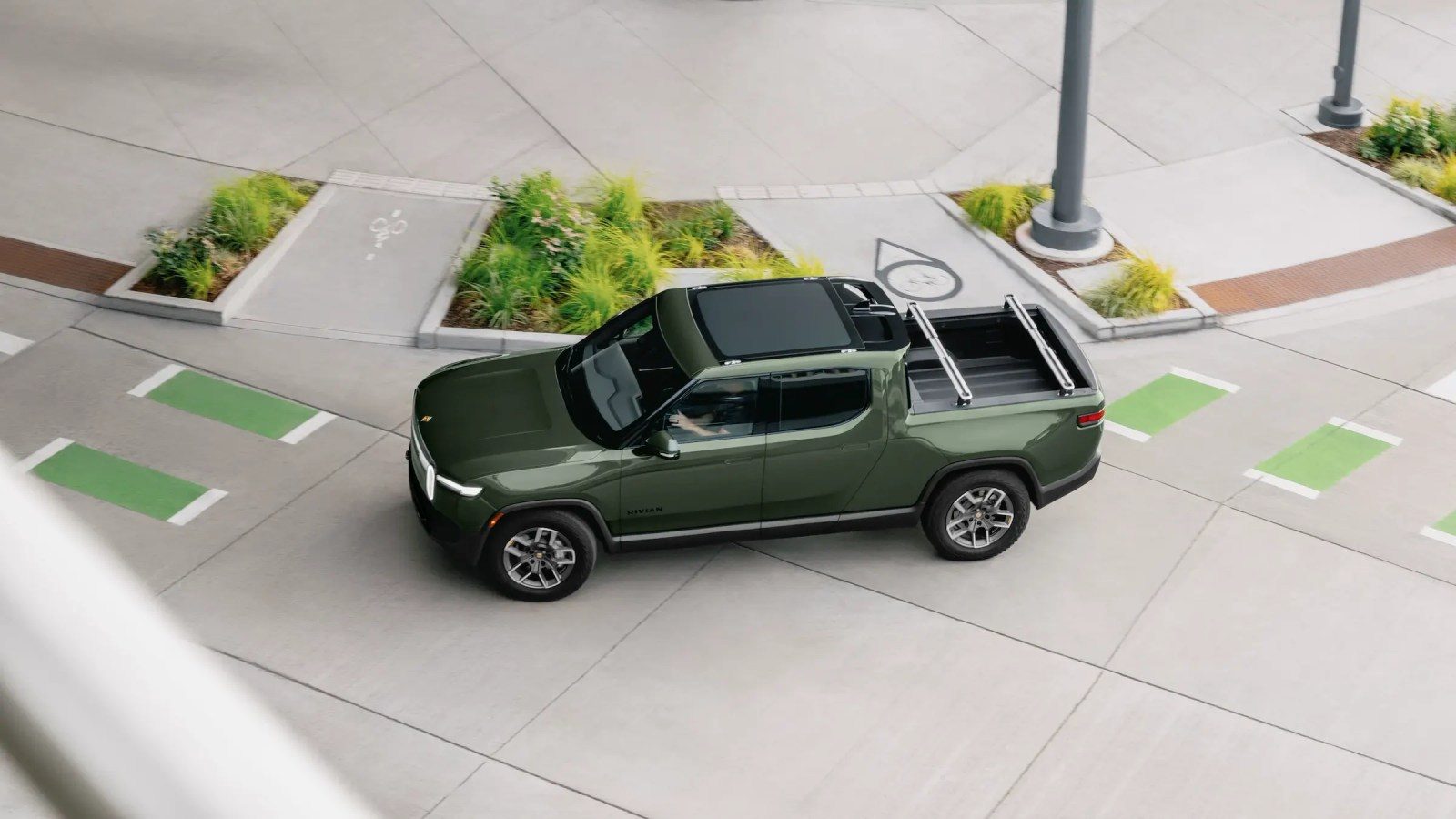

A Rivian R1T owner says a woman unlocked his first-generation pickup and drove it away from a paid lot in downtown Las Vegas. He says she used a key fob taken from her own bag while his fob sat at home in California.
The owner described the theft in a post on the r/Rivian forum early on Tuesday. He attached a Gear Guard clip recorded by the truck’s own cameras.
The post had drawn more than 230 comments by Tuesday afternoon ET.
He wrote that the truck was recovered undamaged about four blocks away, though its contents had been taken. He said the Rivian app showed “No new drivers, no new keys, nothing.”
No cause has been established. The owner’s central question, how a fob he never paired could both open and start his truck, remains unanswered.
The Theft
The owner said he parked the R1T in the public lot in front of El Cortez, a casino on Fremont Street. He paid for parking and after about three hours, the truck was gone.
He assumed it had been towed until the Rivian app placed the vehicle about four blocks away.
He later found a missed phone notification that the truck had been unlocked at 3:30 p.m. local time (6:30 p.m. ET). He said that was the time of the theft.
He was “deep inside the casino, at least 400 ft away” at that moment, he wrote in a comment. Even at the machines closest to the entrance, he said, he was at least 200 feet from the truck.
What the Video Shows
The owner said the footage shows a woman walking up to the R1T and taking a key fob out of her bag.
The next clip, he said, was already recorded at the location where the truck was found.
He filmed the playback on his phone the next day. He later installed a new hard drive, which he said appears to have wiped the original recording. The phone video is the only copy.
The Keys
The owner said he carried only his phone and the key card in his wallet.
He recalled that a past software update had once unpaired his own fob, leaving it useless until he paired it again. That was why, he wrote, a stranger’s fob working on his truck made no sense to him.
On first-generation R1 vehicles, built for the 2021 to 2024 model years, the phone key works only through the Rivian app over Bluetooth. It is not stored natively in the phone’s wallet.
Rivian brought a native digital key under the Car Connectivity Consortium standard to second-generation vehicles with its 2025.46 update in December. The key included ultra-wideband support for precise location ranging. Rivian’s own release notes list it as a Gen 2 feature.
The two generations run different electronics. First-generation R1 vehicles use a domain-based architecture with 17 electronic control units. The second generation consolidated that into seven zonal units.
Gen 1 trucks still receive software. Rivian began pushing Rivian OS 2 to them on September 4.
Relay Attacks
Security researchers have shown that Bluetooth-based keyless systems can be defeated without cloning a key.
In May 2022, NCC Group demonstrated a relay attack on Bluetooth Low Energy at the link layer. The attack unlocked and operated a Tesla Model 3 whose paired iPhone was about 25 meters (82 feet) away. The relaying devices were built from $50 Bluetooth development modules.
A relay attack requires two people working together. One stands near the car and the other near the owner’s key.
Several commenters on the thread suggested his phone key had been relayed in this way. The owner asked in reply whether thieves could have read from his phone, since “I did not have a fob with me.”
Germany’s ADAC motoring club has tested more than 800 keyless vehicles against relay attacks. Around 15.0% were adequately protected, Help Net Security reported in June.
Multi-Factor Drive
After getting the truck back, the owner said he found two security features in the app and switched them on: Multi-factor Drive and a PIN lock. He wrote that he would use them whenever he travels with the vehicle.
Rivian introduced Multi-factor Drive for both generations in its 2025.18 software update in June 2025. The feature is optional, and only the primary owner can turn it on.
“When enabled, drivers will not be able to drive the vehicle using the key fob or NFC device alone,” Rivian says on its support site.
When the driver presses the brake to shift out of Park, the feature requires approval of each drive from the Rivian app or a smartwatch. If no notification arrives, the driver can enter a time-based passcode shown on the phone.
Chief Software Officer Wassym Bensaid promised the feature in May 2025. He wrote on X that the company would first introduce “multi-factor-drive (very soon) and CCC digital keys (soon).”
The feature is Rivian’s equivalent of Tesla‘s PIN to Drive.
In a later comment, the owner said that when he got back in the truck and pressed the brake to shift, the screen required him to type his PIN. Without it, he said, the truck would not drive.
He wrote that he did not know whether the prompt came from Multi-factor Drive, which he had also enabled.
The PIN option Rivian added in its 2026.15 update in May locks the driver profile and personal settings with a four- to six-digit code. According to the release notes, it also limits access to some vehicle features until the driver authenticates.
Two commenters who identified as Rivian owners disputed that the profile PIN blocks driving. They wrote that it only restricts the profile and some app logins.
Rivian’s Response
The owner said he had messaged Rivian through the app and opened a service request before posting, with no reply.
In a second update, he said Rivian service had called him. The team told him it would review the case, pull logs and keep him updated. He wrote that he did not know whether the call’s timing was a coincidence.
The company has not said what the logs show, whether any key other than the owner’s was paired to the truck, or whether it has received similar reports.
Rivian runs a public bug bounty program and asks researchers to report vulnerabilities to a dedicated address.