
Nio’s US-listed shares closed at $3.86 on Thursday after touching $3.71 during the session, a fresh 13-month low, extending a slide that has taken about 46% off the stock in the last four months.
The shares have fallen in every session since the company reported second-quarter results before the US open on Tuesday. They are down 19.8% from the $4.81 close of August 3, and had already reached a 13-month low of $4.36 in the week before the results. They were down a further 1.3% in Friday pre-market trading at $3.81.
Hong Kong-listed stock has fared worse.
Shares under the ticker 9866 closed at HK$29.50 on Friday, down 0.67% on the session, 23.3% below the HK$38.44 close of August 3 and 11.1% below the HK$33.18 of August 31, the last session before earnings.
The stock fell as much as 11.3% on Tuesday alone and touched HK$29.44, its lowest since July 2025. Nio’s market cap stood at $9.67 billion.
Below the Price It Floated At
The stock now trades 38.3% below the $6.26 at which Nio sold 160 million American depositary receipts in its September 2018 initial public offering.
It is 93.9% below the record close of $62.84 in February 2021.
Nio’s largest shareholder is furthest under water.
CYVN Holdings, the Abu Dhabi sovereign investor that holds about 17.9%, paid a combined $3.3 billion across two 2023 transactions at $8.72 and $7.50 an ADR.
Thursday’s close is 55.7% below the higher entry and 48.5% below the lower one.
What the Market Was Reacting To
The results missed on both halves of what Nio had guided.
Revenue of 32.1 billion yuan ($4.8 billion) rose 69.1% year on year and 25.9% sequentially, but landed 2.0% below the floor of management’s own 32.8 billion yuan guidance and 3.8% below a consensus of roughly 33.4 billion.
Margins held. Vehicle margin was 18.5%, against 10.3% a year earlier and 18.8% in the first quarter. Gross margin was 18.4%, up from 10.0% but down from 19.0%.
The guidance did the damage.
Third-quarter deliveries of 108,000 to 111,000 vehicles represent growth of 24.0% to 27.5% on a year earlier but barely move on the 107,658 of the second quarter. Revenue guidance of 33.3 billion to 34.1 billion yuan sits about 7% below a consensus near 36.3 billion.
The delivery arithmetic behind it is harder still. Nio delivered 35,836 vehicles in August, up 14.5% year on year but down 0.27% on July, taking the year to 262,893. Reaching the floor of its 456,000-to-489,000 annual target now requires about 48,277 a month from September through December — more than the 48,135 of December 2025, the best month the company has recorded.
Goldman Cuts
Goldman Sachs lowered its price target on Nio to $6.10 from $7.00 on Friday, a reduction of 12.9%, while keeping a Buy rating on the stock.
Analyst Tina Hou described the second-quarter result itself as broadly in line, and located the problem entirely in the outlook.
On her numbers the third-quarter volume guidance came in 12% below Goldman’s own forecast and 11% below the market’s, and the revenue guidance 8% and 7% below the same two at the midpoint.
Working back from Nio’s 109,500-vehicle midpoint, that implies the market had been expecting roughly 123,000 vehicles — a shortfall of about 13,500 cars in a single quarter. Goldman’s revenue calculation matches the arithmetic independently: the guidance midpoint of 33.7 billion yuan is 7.3% below a consensus near 36.3 billion.
Hou attributed the shortfall to continued weakness in domestic demand and to comparatively low brand recognition for Onvo, the mid-market sub-brand whose August deliveries fell 46.4% year on year.
Goldman still expects sequential improvement in both volume and operating profit through the third and fourth quarters, positive free cash flow, and a run of new and refreshed models into 2027 as Nio entrenches the premium positioning of its main brand and continues building Onvo.
The new target is 58.0% above Thursday’s close.
Li’s Answer
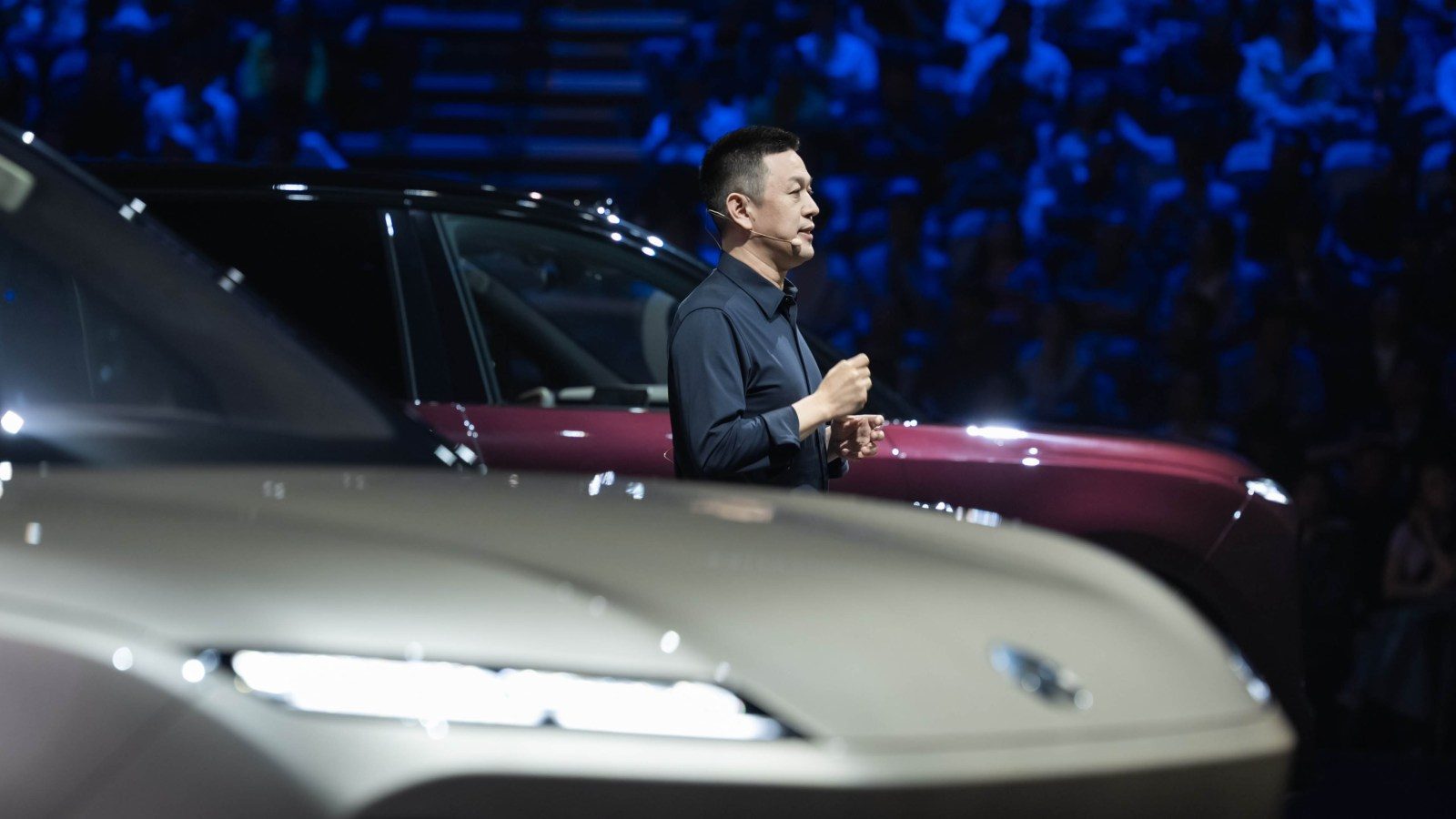
Nio’s founder spoke the same day. At a small media briefing on Friday following the company’s second-quarter earnings communication meeting, founder and chief executive William Li was asked when the market might reassess Nio.
He said it was not something the company could decide, according to Sina Technology News, which reported the session.
“What we can do is continue to focus on doing our own work well, keep investing in our brand, and maintain strategic discipline and a long-term mindset,” he said.
He went further on the difficulty of the task. “I also find it difficult to convince investors,” Li said. “The only thing I can do is convince them through our operating results.”
Li argued the market is missing four things: the company’s full-stack in-house research and artificial intelligence capabilities, the scarcity of its brand assets, the strategic value and profit potential of its energy business, and its services and community operation.
That last one is the only part he put a number on.
It generated more than 10 billion yuan ($1.48 billion) of revenue last year, he said, grew through the first and second quarters of 2026 and is profitable. “This is a source of relatively predictable earnings based on our vehicle ownership base,” he said.
He also rejected the comparison with the stock’s peak. “In 2021, our market capitalisation was very high, but our company is definitely healthier now than it was then,” he said. “The automotive industry is still somewhat undervalued today.”
“Many people simply lack imagination about the business we are in,” Li said, describing Nio as an energy company and an artificial intelligence company operating under manufacturing constraints.
Earnings Results
Nio posted second-quarter revenue of 32.1 billion yuan ($4.8 billion), up 69.1% from a year earlier and 25.9% from the first quarter.
Vehicle sales reached 29.1 billion yuan ($4.3 billion), up 80.1% year on year.
Revenue fell about 2% below the lower end of management’s own guidance range of 32.8 billion yuan ($4.9 billion) and about 3.8% below Wall Street’s consensus estimate of around 33.4 billion yuan ($5.0 billion).
Vehicle margin held at 18.5%, against 10.3% a year earlier and 18.8% in the first quarter.
Gross margin was 18.4%, up from 10.0% a year earlier but down from 19.0% in the prior quarter.
Guidance Disappoints
Third-quarter delivery guidance of 108,000 to 111,000 vehicles implies growth of 24% to 28% from a year earlier but only a marginal sequential increase from the 107,658 units shipped in the second quarter.
Revenue guidance of 33.3 billion to 34.1 billion yuan landed about 7% below Wall Street’s consensus of 36.3 billion yuan.
Nio delivered 35,836 vehicles in August, up 14.5% year on year but down 0.27% from July. Year-to-date deliveries through August reached 262,893, up 57.9%.
Reaching the floor of the full-year target of 456,000 to 489,000 vehicles requires about 48,277 a month from September through December — above the all-time monthly record of 48,135 set in December 2025.