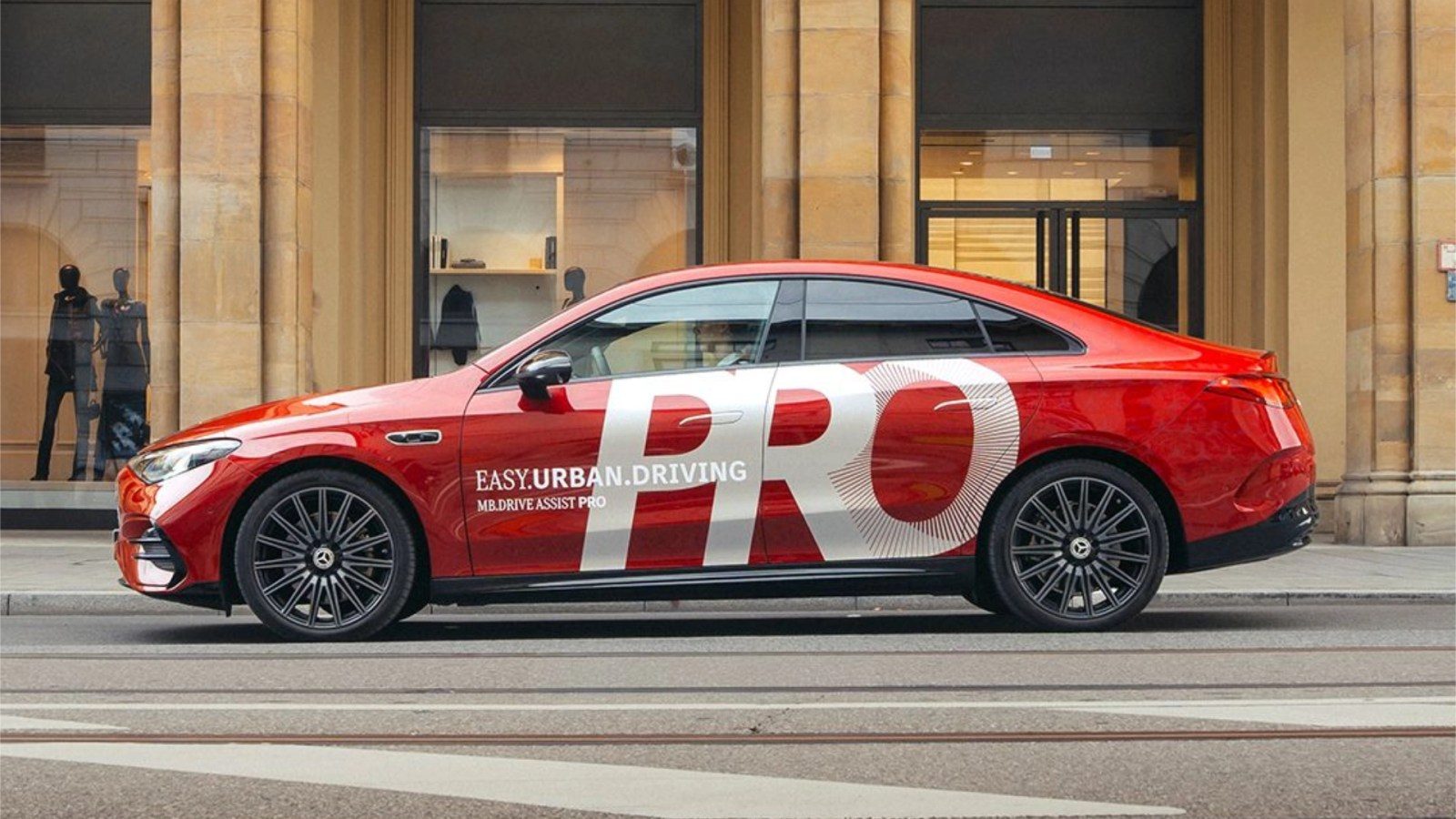

Mercedes-Benz will roll out its urban “point-to-point” navigation system in selected German cities by the end of 2026, with a nationwide expansion planned for early 2027.
The information was revealed by the automaker’s Chief Technology Officer Joerg Burzer on LinkedIn, following a meeting with the German Transport Minister Patrick Schnieder
“Our urban ‘point-to-point’ navigation system is expected to be available in selected German cities by the end of 2026 and rolled out nationwide in early 2027,” he wrote.
The move would make Germany the third market to receive the system, after China and the United States.
“In close coordination with the German Federal Ministry of Transport, Mercedes-Benz is pushing forward assisted and automated driving in Germany with determination,” Burzer wrote on Friday, calling the planned rollout “an important milestone.”
The executive also serves as a member of the Board of Management of Mercedes-Benz Group AG, responsible for Development and Procurement.
The system in question is ‘MB.DRIVE ASSIST PRO,‘ a Level 2++ advanced driver-assistance system first unveiled at CES 2026 in Las Vegas earlier this year.
Developed in partnership with Nvidia — which provides AI software and the DRIVE AGX computing platform — the system merges driving assistance with navigation, allowing a vehicle to handle urban routes from origin to destination with the driver supervising at all times.
Unlike Mercedes‘s existing ‘Drive Pilot’ system — a Level 3 feature available on the S-Class and EQS that allows hands-off, eyes-off driving on motorways at speeds up to 95 km/h — ‘MB.DRIVE ASSIST PRO’ operates at Level 2.
On the SAE Level 2, the driver must remain attentive and ready to intervene. A cooperative steering approach lets occupants make steering adjustments without deactivating the system.
“Our ambition is clear: we want to remain at the forefront of assisted and automated driving in international competition,” Burzer wrote.
According to the executive, that “includes supporting people as effectively as possible in complex traffic situations — from traffic lights and lane changes to dense urban traffic. This is exactly what our urban ‘point-to-point’ navigation enables.”
Burzer also credited the collaborative approach with German regulators, stating that Mercedes‘s teams “are working closely with the Federal Ministry for Transport and Digital Infrastructure and the Federal Motor Transport Authority to bring these and other innovations to the roads quickly and responsibly.”
Live in China, Ramping in the US
The ‘MB.DRIVE ASSIST PRO’ has been available in China since late 2025, where the system was developed in collaboration with Chinese autonomous driving specialist Momenta.
It was launched with the battery-electric CLA sedan.
In the United States, where Nvidia powers the stack rather than Momenta, a limited version of the system — covering steering, lane-change, and parking assist — launched as a $1,950 option on the CLA earlier this year.
The full urban point-to-point capability is expected to activate later in 2026.
Media test drives in San Francisco showed the system navigating complex city streets, handling delivery vehicle obstructions, asserting itself at intersections, and respecting cyclists — all without driver intervention.
In the US, the full ‘MB.DRIVE ASSIST PRO’ subscription costs $3,950 for three years, after which additional fees apply.
For comparison, Tesla‘s Full Self-Driving (Supervised) system cost approximately $8,000 as a one-time purchase up until February 14 — when the company discontinued the option.
The system is now only available through a $99-per-month subscription.
Over the same time period as Mercedes‘s subscription, that would cost about $3,564.
Europe’s ADAS Race Intensifies
The German rollout announcement arrives at a moment when the European advanced driver-assistance landscape is shifting rapidly.
Tesla‘s FSD (Supervised) received its first European type approval in the Netherlands on April 10, with Dutch owners logging 10 million kilometres in under three weeks.
The Dutch regulator RDW has since presented the approval to the European Commission’s Technical Committee on Motor Vehicles, though a broader EU-wide vote remains pending with the next TCMV session scheduled for June 30.
Tesla‘s European FSD push has not been without friction.
Several Nordic regulators have raised concerns about the system’s winter-road performance, while Belgium’s Flemish region has moved toward a separate regional approval.
Denmark has pushed back on reports that it opposed the technology.
Mercedes‘s approach differs from Tesla‘s in both regulatory strategy and system design.
Where Tesla pursued an Article 39 provisional type-approval through a single national regulator, Mercedes is coordinating directly with the German federal government ahead of launch.
At the Level 4 end of the spectrum, Mercedes is separately developing a robotaxi ecosystem around the new S-Class, using Nvidia’s DRIVE Hyperion architecture and full DRIVE AV Level 4 software.
Mercedes is the only manufacturer to hold Level 3 certification in both Germany and the United States through ‘Drive Pilot.’