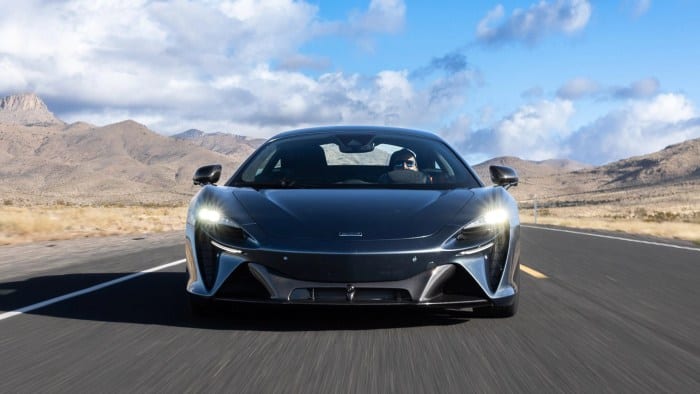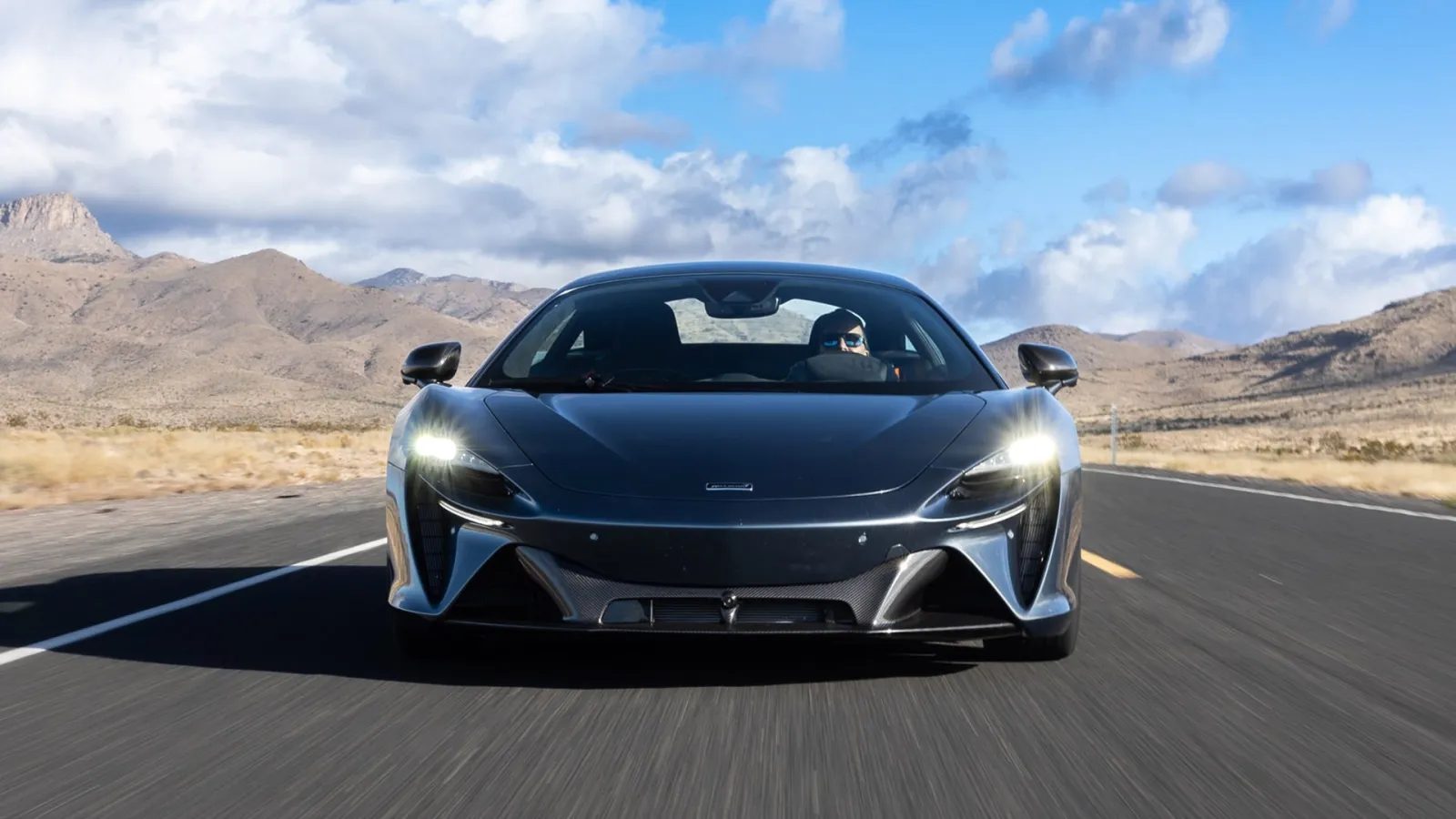

McLaren plans to discontinue the Artura — its first plug-in hybrid supercar — by 2028, Automotive News reported on Monday, citing a person briefed on the company’s product plans.
McLaren launched the Artura in 2022 as its entry-level model, designed to attract younger, tech-oriented buyers.
The car had been announced for a sales start in autumn 2020. Software problems and supply chain delays, including the pandemic-era semiconductor shortage, pushed deliveries to late 2022, more than two years late.
Once production began, quality problems with the oil pump and software plagued early units for years, according to the report.
A McLaren dealer, who asked not to be identified, told Automotive News the troubled rollout damaged buyer confidence from the outset.
McLaren declined to comment to Automotive News.
Faltering US Demand
In the United States, 510 Arturas were registered in 2025, up 15% from the prior year, according to data from Mobility Global cited by Automotive News.
Registrations fell 18% in the first half of 2026, to 205 units.
When McLaren unveiled the Artura, the 671-hp car introduced a new Carbon Lightweight Architecture and paired the brand’s first twin-turbo 3.0-liter V-6 with an electric motor and a 7.4-kilowatt-hour battery.
Power later rose to 690 hp with a 2024 update. Despite the refresh, the model is aging for a segment where buyers gravitate to the newest products.
The dealer told Automotive News that small-displacement hybrid sports cars have broadly failed to resonate with consumers.
Hypercar manufacturers are building them to meet government emissions rules rather than customer demand, the dealer added.
When it was unveiled in 2021, McLaren described the Artura as the pivotal model in its transition to a fully electrified portfolio by 2026.
That date has passed with the V8-powered 750S still on sale, and Chief Executive Nick Collins told Autocar in April that every model in the plan through 2030 would carry a combustion engine.
New Models
A midengine replacement, code-named P34, is expected to become McLaren’s entry offering after the 2027 model year, according to the media outlet.
McLaren is also preparing its first four-door model, a hybrid performance SUV, the Financial Times reported, marking its entry into a segment already occupied by Ferrari, Lamborghini, Bentley and Aston Martin.
Collins declined to give the newspaper details, and the car is expected within the next few years.
“There’s not a region that I can think of where the SUV hasn’t taken very significant market share, particularly in the luxury segments,” Collins told the FT.
McLaren hopes the SUV will lift sales enough to justify a second assembly plant in the United Kingdom, at a location not yet decided, the FT reported.
The company sells more than 2,000 cars a year, less than half its record of 4,800 in 2018, and its only plant, in Woking, has a targeted capacity of roughly 3,000, according to the newspaper.
The Investment
The product plans arrive alongside McLaren’s largest-ever financial commitment to its UK operations.
The Financial Times reported a £500 million ($673 million) investment from McLaren’s Abu Dhabi owner, alongside a balance sheet cleared of debt, aimed at ending years of losses.
In a LinkedIn post on Tuesday, McLaren said the package would fund in-house engine production for the first time in its history, expand vehicle assembly capacity for new models including the performance SUV, build a new paint shop, and double the size of its Composites Technology Centre in South Yorkshire.
A new design and innovation hub, the McLaren Creative Centre, has opened in Bicester, Oxfordshire, alongside a testing and vehicle development site at MIRA in the Midlands.
McLaren said the investment would create a baseline of 1,000 new jobs, safeguard existing roles, and support at least 3,000 positions in the wider UK economy.
CYVN and the Nio Connection
Abu Dhabi-based CYVN Holdings, which acquired McLaren Automotive from Bahrain’s Mumtalakat in December 2024, has committed $2 billion (about £1.5 billion) in total investment to fund McLaren’s expansion through 2030.
CYVN is also the largest shareholder in Chinese EV maker Nio through L’imad Holding, a government-backed entity chaired by Abu Dhabi’s Crown Prince Sheikh Khaled bin Mohamed bin Zayed Al Nahyan.
Nio signed a technology licensing deal with Forseven — a British EV startup folded into McLaren Group Holdings — in February 2025, granting access to Nio’s EV platforms, software, and intellectual property.
In June 2025, Chinese outlet Yiou Auto reported that Nio would supply small battery packs built on its in-house 4680 large cylindrical cells for McLaren’s hybrid models, with low-volume production expected in 2026.
Nio CEO William Li confirmed in March that the company was supplying battery packs to McLaren, without providing further details.
Yet despite the breadth of the technology licensing arrangement, McLaren has ruled out building a fully electric model for the foreseeable future.
CEO Nick Collins — who also sits on Nio‘s board of directors — told Autocar in April that every model in McLaren’s product plan through 2030 would feature a combustion powertrain.
Collins said McLaren would only build an EV when its customers demanded one, adding that the market did not want one yet.
As EV reported at the time, the comments represented the clearest signal that Nio’s EV platforms and software — licensed under the deal with Forseven — would remain largely unused for the foreseeable future, limiting the scope of Nio technology in McLaren vehicles to hybrid battery components rather than full electric powertrains.
Supercar Segment Pulls Back
McLaren is far from alone in retreating from electrification plans.
Across the ultraluxury segment, EV timelines have been pushed back as customer appetite has fallen short of manufacturer projections.
Ferrari is furthest along among McLaren’s direct rivals. Its first electric model, shown as the Elettrica in October 2025,is set for deliveries in late 2026 at a price above $500,000.
Lamborghini cancelled its planned all-electric Lanzador and converted the project to a plug-in hybrid.
Aston Martin scaled back a pure EV project that was to use Lucid’s powertrain technology, pivoting its near-term focus to plug-in hybrids led by the Valhalla supercar.
P34 and the hybrid SUV suggest McLaren’s next chapter will lean on combustion power supplemented by Nio-supplied battery components — not full electrification.
McLaren currently employs about 2,500 people at its headquarters in Woking, Surrey.