Polestar registered more than 3,000 vehicles across its European markets in April, according to data compiled by EV based on national registration agencies and the EU-EVs data platform.
The figures represent a significant decline from the 5,117 units listed in March, though the sequential drop is consistent with broader industry patterns.
March typically marks a registration peak across several key European markets, particularly the UK, where quarterly plate changes drive elevated volumes.
Year-over-year comparisons were mixed.
Several markets posted strong gains, led by France, Ireland and Portugal, while others — including Germany, the Netherlands and Austria — saw registrations fall compared to April 2025.
The Geely-backed brand’s monthly sales continue to show sharp fluctuations, largely due to its dependence on manufacturing and shipping cycles from production facilities in China, the United States and South Korea.
Polestar sold over 10,500 EVs in Europe during the first quarter, a slight increase from the 9,478 units registered in the same period of 2025.
Globally, the company reported a record first-quarter figure of 13,126 retail sales, up 7% year over year.
United Kingdom and Ireland
The United Kingdom was once again Polestar‘s largest European market in April, with 1,076 registrations — a 25% increase year over year, according to data published by the Society of Motor Manufacturers & Traders (SMMT).
The monthly result represents a decline of roughly 1,330 units from March’s 2,406 registrations, a pattern consistent with the seasonal dynamics of the British market.
The UK was Polestar’s best-performing European market in both 2024 and 2025.
Last year, the brand registered 16,959 EVs in the country, doubling the prior year’s figure.
With April data, the year-to-date total reaches approximately 5,227 units.
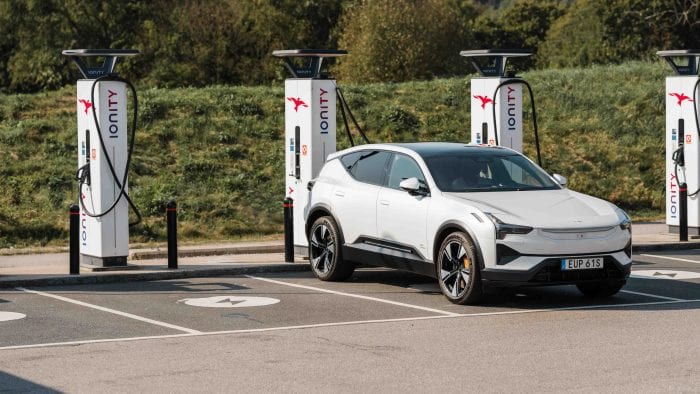
The brand’s UK portfolio includes the Polestar 2 sedan, the Polestar 3 and 4 SUVs, and the most recently launched Polestar 5 grand tourer.
The UK was the first market to receive the upgraded Polestar 3, which introduced a new 800-volt electrical architecture, peak DC charging of up to 350 kW, and an eightfold increase in processing power.
In Ireland, 14 vehicles were registered in April — a jump from the two units registered a year ago.
The country registered just 165 Polestar vehicles in the full year of 2025.
First-quarter registrations had already reached 163 units, nearly matching the prior year’s annual total.
Northern Countries
Sweden remained Polestar‘s second-largest European market in April, with 570 registrations — a 7% increase year over year.
The brand is headquartered in Gothenburg, and sold 1,670 vehicles in Sweden during the first quarter.
Year-to-date, Polestar registered 2,240 EVs in the Swedish market.
Last year, the company registered 7,594 vehicles in Sweden, a 28% increase from 2024.
At the current pace, the brand appears to be tracking broadly in line with the prior year’s trajectory in its home market.
Polestar recently opened orders in Sweden for the revamped Polestar 3 and Polestar 4, with the upgraded Polestar 3 starting at 924,000 SEK and the Polestar 4 coupé from 619,000 SEK.
Norway — the country with the highest EV adoption rate in the world — saw 223 Polestar registrations in April, a 2% decline year over year.
The first-quarter total had reached 516 units, already a drop from the 583 registered in the same period a year ago, as the reduction in Norway’s EV incentives continued to weigh on sales across the broader market.
Polestar‘s year-to-date total in Norway stands at approximately 739 units.
In Denmark, Polestar registered 216 vehicles in April, a 24% increase year over year.
The quarterly total had reached 433 units, with more than half concentrated in March. Combined with April, the brand has now registered around 649 vehicles in Denmark during the first four months of the year.
Finland posted 94 registrations, a 2% increase year over year, while Iceland recorded 16 units — a 433% surge, though from a very low base.
In total, the five Nordic markets accounted for approximately 1,119 units in April, or roughly 37% of the brand’s estimated European total for the month.
Central Europe
In Germany — Europe’s largest auto market — Polestar registered 250 vehicles in April, a 17% decline year over year.
The decrease interrupts the momentum from the first quarter, when the brand’s registrations had jumped 50.2% to 1,284 units.
With the April figures, Polestar‘s year-to-date total in Germany reaches approximately 1,534 units.
The revamped Polestar 3 and 4 were recently made available for order in the market, with the Polestar 3 priced from €78,900 and the Polestar 4 from €61,900.
Germany’s EV purchase incentive scheme, which became retroactive to January 1, is expected to begin processing applications in May — a development that could provide a tailwind for the brand in the coming months.
The Netherlands posted 114 registrations in April, a 33% decline year over year.
The Dutch market has been a weak spot for the brand in 2026 — first-quarter registrations had already fallen to 199 units, less than half of the 439 sold in the same period of 2025.
Scaled-back incentives in the country continue to weigh on EV demand more broadly.
Registration data for Belgium and Luxembourg — tracked together under the Benelux grouping — had not yet been published at the time of writing.
France, where Polestar officially launched last year, recorded 148 registrations in April.
The brand entered the French market in mid-2025 and registered just 210 vehicles by year-end.
With first-quarter figures of 149 units, Polestar‘s year-to-date total in France has now reached approximately 297 vehicles.
Austria registered 38 units, a 33% decline year over year, while Switzerland posted 83 registrations — a 5% increase.
Southern Europe
Polestar‘s three Southern European markets — Portugal, Spain and Italy — continued to grow in April, albeit from low volumes.
Portugal registered 58 units, doubling its registrations year over year. Spain posted 67 registrations, a 40% year-over-year increase. Italy recorded 52 units, up 21%.
The three Southern European markets combined for 177 April registrations — a modest 6% share of the brand’s European total.
Demand and Guidance
The April results arrive at a pivotal moment for Polestar, which has described 2026 as the year of its most aggressive product expansion since the brand was spun off as a standalone entity in 2017.
The company is guiding for low double-digit volume growth in 2026 — implying roughly 66,000 to 69,000 deliveries globally — down from the 30–35% compound annual growth target it had set a year earlier.
Polestar delivered approximately 60,119 vehicles in 2025, of which over 46,000 were registered in Europe, accounting for roughly 77% of the total.
The company currently operates 230 retail sales points globally, up 50% from a year ago, and has been steadily building out its European network.
Model Offensive
The upgraded versions of the Polestar 3 SUV and the Polestar 4, now officially referred to as a coupé, have been rolled out across several key European markets and Canada.
The Polestar 3’s most significant change is the introduction of an 800-volt electrical architecture, which cuts the 10-to-80% charging time to 22 minutes and increases peak DC charging rates to 350 kW.
The Polestar 4 coupé received chassis and ride refinements.
The Polestar 5 grand tourer — the brand’s first model built on its in-house Polestar Performance Architecture — debuted at the IAA Auto Show last September and is expected to begin customer deliveries in the summer.
The model is available in Dual Motor and Performance variants, with up to 650 kW of output and a starting price of £89,500 in the UK and €118,600 in Germany.
A next-generation Polestar 2 sedan is planned for early 2027 as a completely new successor, while the Polestar 7 compact SUV is slated for a 2028 launch — with production set to take place at Volvo’s plant in Košice, Slovakia.
Polestar Within Geely
However, the product push comes amid financial headwinds.
Polestar‘s first-quarter gross margin swung to negative 3.2%, down from positive 10.3% a year earlier, with revenue essentially flat at $633 million despite the 7% volume increase.
The company has raised $1 billion in new equity since December and secured a $600 million loan from parent Geely to shore up its balance sheet.
CEO Michael Lohscheller said on Thursday that Scandinavian design and sustainability remain the brand’s key differentiators from Volvo and Zeekr within the broader Geely Holding umbrella.
“It’s a bit minimalistic, right? We don’t show off. If you look at our interiors, very, very different to the brands you mentioned,” he stated.
The executive was speaking during the Financial Times’ Future of the Car conference in London, which EV attended.