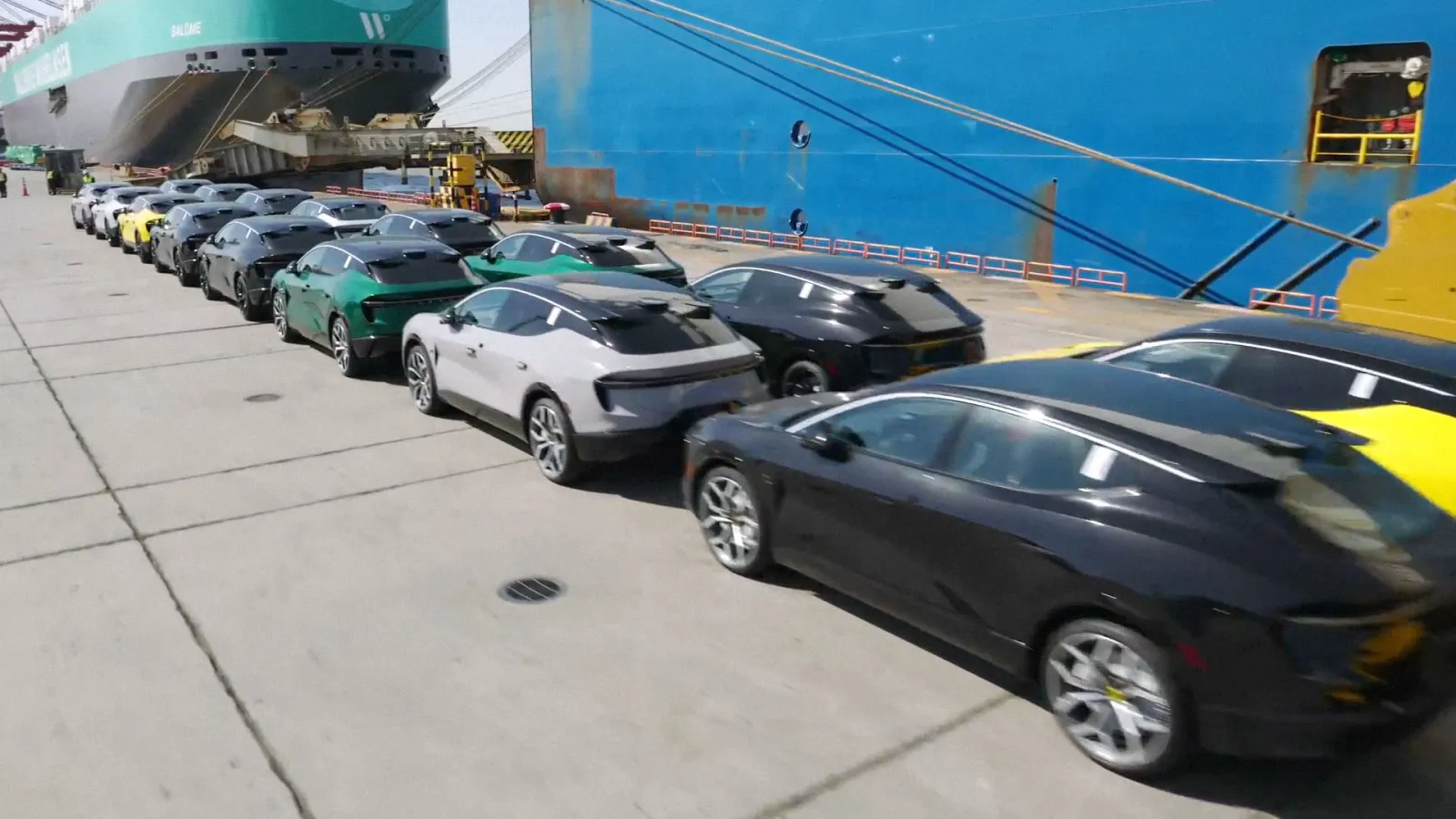
Jetour, the Chery-owned SUV brand, has reached a deal with Rio de Janeiro state to build vehicles at Jaguar Land Rover’s plant in Itatiaia, Reuters reported, making it the ninth Chinese carmaker to commit to production in Brazil as the country’s established manufacturers press the government for protection.
Two state government sources told the news agency on Tuesday that the agreement had been reached, though its terms were not immediately clear. Jetour declined to comment, and the state said it remains in talks with other companies interested in the plant.
That would make Jetour the ninth Chinese brand to build cars in Brazil or name a local plant. Most of them assemble kits shipped from China inside factories that belong to, or were once used by, Western and Japanese automakers.
Chinese brands sold about 460,900 cars and light commercial vehicles in Brazil from January to October, 19.1% of the market and well above the 243,700 they sold in all of 2025, dealers’ association Fenabrave said.
“These new brands are increasing competition, which is positive as long as they operate on an equal footing and within national laws and rules,” Fenabrave President Arcelio Junior said in the association’s November 4 release.
Jetour and the Itatiaia Plant
Jetour said in March that it had started operations in Brazil and intended to produce locally. In August, Jetour Brazil Marketing Director Henrique Sampaio told Reuters the company was weighing options including sharing idle capacity at plants owned by automakers already established in the country, possibly in partnership with another brand.
He said Jetour planned to invest 400 million reais (about $69 million) in Brazil by the end of 2027, excluding any local production.
The brand has sold 7,640 vehicles in Brazil through October, according to dealers’ association Fenabrave, focusing its launches on hybrids. Jaguar Land Rover is working on the “next phase” of the Itatiaia facility, Reuters reported.
The plant has stood idle since JLR reached its planned 2026 volume in the first half, João Henrique de Oliveira, JLR’s Chief Executive Officer for Latin America and the Caribbean, told AutoData in October.
It built the Discovery Sport and Range Rover Evoque, can produce about 25,000 vehicles a year and employs about 400 people. “No decision has been made, either about a future production plan or about any use of the asset,” Oliveira said at the time.
Jetour is not the only Chery brand linked to the site. Omoda & Jaecoo, which sells about 6,000 vehicles a month in Brazil, has officially been negotiating with JLR over the same plant and was waiting for October’s general election to end before moving ahead, with an announcement expected from March 2027, Brazilian outlet Vrum reported in October, citing Motor1.
Chery’s partner CAOA has built Chery models at its plant in Anápolis, Goiás, since 2017.
Guibing Zhang, Executive Vice President of Chery Automobile and President of Chery International, confirmed in late October that the group is evaluating local production for its other brands, but has made no decision on a site, Mecânica Online reported.
“We really need to produce locally. Brazil is a big market and needs to help us with this localization plan,” Zhang told AutoData on October 26, adding that the QQ compact and the Himla pickup would only be viable in Brazil if built there.
CAOA launched a production line in Anápolis for Changan‘s Uni-T flex-fuel SUV on March 26, at a ceremony attended by President Luiz Inácio Lula da Silva and Vice President Geraldo Alckmin.
CAOA began a new R$5 billion (about $870 million) investment cycle that day, taking its commitment to R$8 billion (about $1.4 billion), according to the presidency.
“Here at CAOA we have this great partnership to produce flex vehicles and later also electric vehicles,” Alckmin said.
BYD Leads the Way
BYD‘s complex in Camaçari, Bahia, on the site of a former Ford plant, is the largest Chinese car project in Brazil. It opened on October 9, 2025, with an initial investment of R$5.5 billion (about $950 million), capacity of 150,000 vehicles a year and a long-term target of 600,000.
The plant has so far assembled vehicles from semi-knocked-down kits. Its welding and painting halls are in final testing and the stamping hall is under construction, the company said on October 26, with nationalized production targeted from early 2027. It builds the Dolphin Mini, King, Song Pro and Atto 2.
“The traditional market said BYD in Brazil would only assemble imported parts, and that electrification would take decades to become a reality on a national scale,” said Alexandre Baldy, Senior Vice President of BYD do Brasil. “They were completely wrong.”
BYD said on November 3 that the plant has built more than 150,000 vehicles and employs more than 9,500 people directly. Its total investment has reached R$11.3 billion (about $2 billion), excluding the port next to the factory, Baldy said on October 30, according to AutoData.
A third shift began on November 9 with about 2,000 new hires. The Atto 2 DM-i flex-fuel plug-in hybrid drew 10,329 orders in just over 40 business days.
BYD aims to enter 2027 with more than 50% local content, the level that would see it recognized as a local producer, and is seeking licenses to raise the plant’s capacity to 600,000 vehicles a year, Baldy told Reuters in October.
“For us it is extremely urgent that we start producing locally as soon as possible and use local content,” he said, according to AutoData. BYD registered 24,114 vehicles in Brazil in October, a 9.7% share, the company said.
Baldy said on October 29 that he had asked Lula to negotiate with Beijing so BYD can make lithium battery cells in Brazil. The company assembles battery packs there but imports the cells from China.
“It’s a dream like this that the BYD factory envisions, but it does not depend on a corporate decision,” he told reporters, according to Gazeta do Povo. “It is much more a diplomatic decision.”
Labor Scrutiny
The project has also faced labor scrutiny.
A task force rescued 163 Chinese workers employed by contractor China Jinjiang at the construction site in December 2024, and labor prosecutors say 224 Chinese workers were found in conditions analogous to slavery.
In December 2025, prosecutors reached a R$40 million (about $6.9 million) settlement with BYD Auto do Brasil, China Jinjiang and Tecmonta that still required approval from the Labor Court, Brazilian outlet Bahia Notícias reported.
The Labor Ministry added BYD to its list of employers caught using slave-like labor in April 2026. A court removed it within three days in a provisional ruling that questioned whether BYD, rather than its contractor, was the employer.
BYD has said it was unaware of the irregularities and ended its relationship with the contractor.
Lula has credited the company with shaking up the sector. “BYD’s arrival made the Brazilian auto industry wake up and invest,” he said on July 26 at a metalworkers’ union event in São Bernardo do Campo, according to Mercado&Consumo.
The Camaçari plant also supplies other Latin American markets, including Argentina.
Who Else Is Building
Great Wall Motor opened its first Brazilian plant in Iracemápolis, São Paulo, a former Mercedes-Benz site, and began production in September 2025. It builds the Haval H6 flex-fuel hybrids, the Haval H9 and the Poer P30 pickup, and expects output to reach 32,000 vehicles by December out of capacity of 50,000 a year, the company said in August.
On July 1, it confirmed a second factory in Aracruz, Espírito Santo, with capacity for up to 200,000 vehicles a year, four times Iracemápolis, as part of a R$10 billion (about $1.7 billion) investment plan over ten years. Operations are expected to start in 2029, and the Ora 5 electric SUV is among the models confirmed for the site.
Geely began series production of the EX5 EM-i plug-in hybrid in September at Renault‘s Ayrton Senna complex in São José dos Pinhais, Paraná, through Renault Geely do Brasil, in which Geely holds 26.4%.
The EX2 electric hatchback is due to follow in December at the same plant, as part of a R$5.8 billion (about $1 billion) investment by the venture.
Leapmotor will start building the B10 and C10 at Stellantis‘s plant in Goiana, Pernambuco, in the first quarter of 2027, Stellantis said in April.
“The operation starts with SKD and evolves to CKD as localization advances,” said Herlander Zola, President of Stellantis South America. Goiana will also make a flex-fuel engine for the range-extended versions, replacing imported Chinese engines.
GAC will be assembled by HPE Automotores, Mitsubishi’s Brazilian partner, at its plant in Catalão, Goiás. GAC plans to invest $1.3 billion in Brazil through 2030, the two companies said in March.
“In January 2027 we start production at the HPE plant in Catalão,” GAC Brazil Chief Commercial Officer Gustavo Schmidt told Exame on November 3. The first model, not yet named, will be one GAC already imports from China, he said.
Production will start from kits, with a target of 50,000 units a year at full pace. “We will start in SKD and quickly move to the piece-by-piece system. I believe in a year,” Mauro Correia, President and Chief Executive Officer of HPE, said in September, according to AutoData.
SAIC’s MG said in June it would assemble the MG4 Urban and MGS5 electric models at the Planta Automotiva do Ceará in Horizonte, the former Troller plant, with partners Comexport and PACE. The R$400 million (about $69 million) project will start with semi-knocked-down kits from China. Assembly was expected to begin by the end of 2026, with October given as the likely start, and the plan targets 50,000 vehicles over four years. EV could not find confirmation that assembly has begun.
Industry Wants Limits
The surge is reshaping Brazil’s industrial figures. Vehicle production rose by 179,000 units in January through October, and 146,000 of those came from CKD and SKD kit assembly, about 80% of the increase, manufacturers’ association Anfavea said on November 11.
“Our criticism is about large-scale assembly,” said Igor Calvet, President of Anfavea. “Our challenge is to grow production further.”
Brazil imported about 255,000 fully built vehicles from China in the first nine months of the year, up 106.4% from a year earlier, plus more than 100,000 units as kits, according to figures Anfavea cited.
On October 29, Calvet and 13 Anfavea vice presidents presented Alckmin, who is also Minister of Development, Industry, Trade and Services, with three proposals.
They are a safeguard tariff above the current 35% for importers without local production, a new CIDE levy on imported vehicles, and an annual cap on Chinese imports of 2.5% to 3% of the market, or about 75,000 to 90,000 units.
Kits would be exempt from the safeguard. No measure has been approved.
Calvet said Alckmin “sees this possibility favorably” on quotas, but that the measure needs more time and talks with China through Brazil’s foreign ministry. “We should have something more concrete in November,” he said, according to AutoData.
Stellantis’ Zola has argued that current tariffs are not enough to protect local manufacturing. “Given what we have today, if nothing is done, it is better to produce cars in China, disassemble them and bring them here,” he told AutoData on October 6.
Kit assembly has already divided the sector. In June, Gecex, the executive committee of the Foreign Trade Chamber, recreated a $463 million duty-free quota for knocked-down and semi-knocked-down vehicle kits, valid from July 1 to December 31, under Resolution 927.
BYD had accounted for nearly 85% of the imports used to allocate the quotas, according to InvestNews, citing UOL. Anfavea said it regretted the decision and studied a court challenge. “Fighting with the government is never good,” Baldy said at the time.
That quota ends at year-end. Fully built electrified vehicles and SKD kits already pay the full 35% import tax. CKD kits pay 14% until the end of 2026 and will reach 35% in January 2027.