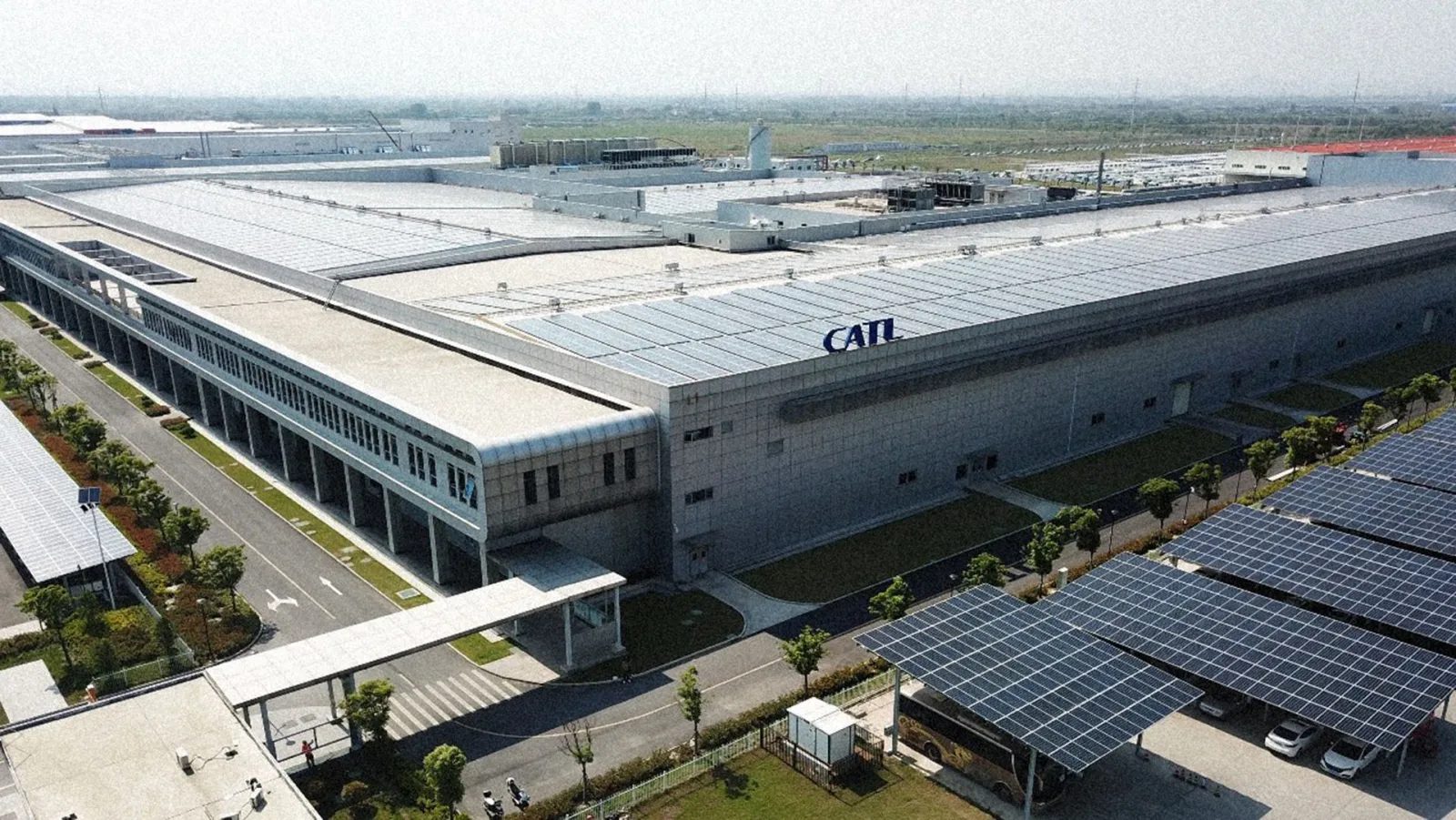

Contemporary Amperex Technology Co. (CATL) has agreed to help build a battery plant in Egypt with a local manufacturer, in a contract signed on Sunday in front of Prime Minister Mostafa Madbouly, less than two weeks after President Xi Jinping’s state visit to the country.
CATL, headquartered in the Chinese city of Ningde and founded by Robin Zheng, is the world’s largest battery manufacturer.
The plant in Egypt is described by the country’s cabinet as an industrial base for battery systems, which is pack assembly rather than cell production.
EnterpriseAM reports that the cells themselves will be supplied by CATL from China, with Egypt handling assembly, battery management integration, thermal management and final system integration.
That is the only account to set out the split, and neither the cabinet statement nor CATL has confirmed it.
The first phase is to produce 1 gigawatt-hour a year for heavy commercial vehicles, at an investment of more than 2 billion Egyptian pounds, about $39 million.
A second phase would raise capacity to 5GWh and add passenger-car batteries and storage systems for solar and wind projects. The project targets 40% local content and both domestic and export markets.
No construction or completion date has been given, and the site has not been named.
Who Signed
Maged Wahib, chairman of BME, and Luo Haining, CATL’s Director of International Investment, signed the contract. Industry Minister Khaled Hashem attended, with BME’s project manager Amin Karim Ghabbour and board member Lotfy Tadros.
BME was established by MCV, an Egyptian commercial vehicle maker, and Auto D for Industry, Trade and Supplies.
MCV was already a CATL customer, using its batteries in the C127 electric bus, and runs a $62 million Volvo electric bus line at New Salheya with capacity for 1,200 vehicles a year for export to Europe.
Madbouly said the government wants to accelerate the project and move to the next executive steps.
The Scale
The figure is small against CATL’s other foreign plants. Its German plant at Arnstadt cost about €1.8 billion for 14GWh. Its Hungarian plant at Debrecen is a €7.3 billion commitment for a planned 100GWh. Its Spanish joint venture with Stellantis at Zaragoza is about €4.04 billion for 50GWh, a figure Stellantis gives as up to €4.1 billion.
Those work out at roughly $85 million to $150 million for each gigawatt-hour of cell capacity. The Egyptian project is $39 million for one gigawatt-hour of pack capacity, which is a different kind of plant rather than a smaller version of the same one.
On the industry’s usual division of value, cells, materials chemistry and control software account for most of a battery’s cost and its intellectual property. If EnterpriseAM’s account of the split is right, none of those is localised in the first phase. The contract has not been published.
The Pattern
The arrangement follows a template CATL uses where a market is too small or too politically difficult for a cell plant of its own.
In the United States it licenses its lithium iron phosphate process to Ford, which owns the plant at Marshall, Michigan, employs the workforce and makes the cells there itself, with CATL supplying know-how and training. In Thailand it supplied pack technology to a subsidiary of the state oil company rather than building anything of its own, and the cells stayed Chinese. Egypt resembles Thailand rather than Michigan.
Against that sits the capacity model in Europe, where CATL owns or co-owns the plants, and the resource model in Indonesia, where it is building an integrated project from nickel mining to recycling.
On what has been announced, Egypt is the lightest of those models. Technology, equipment and technical support, supplied to a local partner that was already a customer.
The Timing
Xi visited Cairo on September 1 and 2, his first trip to Egypt in a decade, marking 70 years since the two countries established diplomatic relations. Egypt was the first Arab and African state to recognise the People’s Republic, in 1956.
Other Chinese battery deals were signed around the visit.
Mansour Group agreed an exploratory memorandum with Tianneng Battery Group to study Egyptian production of lead-acid vehicle batteries and lithium cells.
CATL is not the first Chinese battery company into the country.
Sungrow broke ground in August on a $50 million storage-system plant in the Suez Canal Economic Zone, which the Egyptian government called the first dedicated plant of its kind in the Middle East and Africa. That project assembles systems rather than making cells, as this one does.
Egypt’s National Industrial Strategy for 2026 to 2030 names automotive manufacturing, electrical and engineering industries and electronics among seven priority sectors, and targets $100 billion in non-oil exports by 2030.