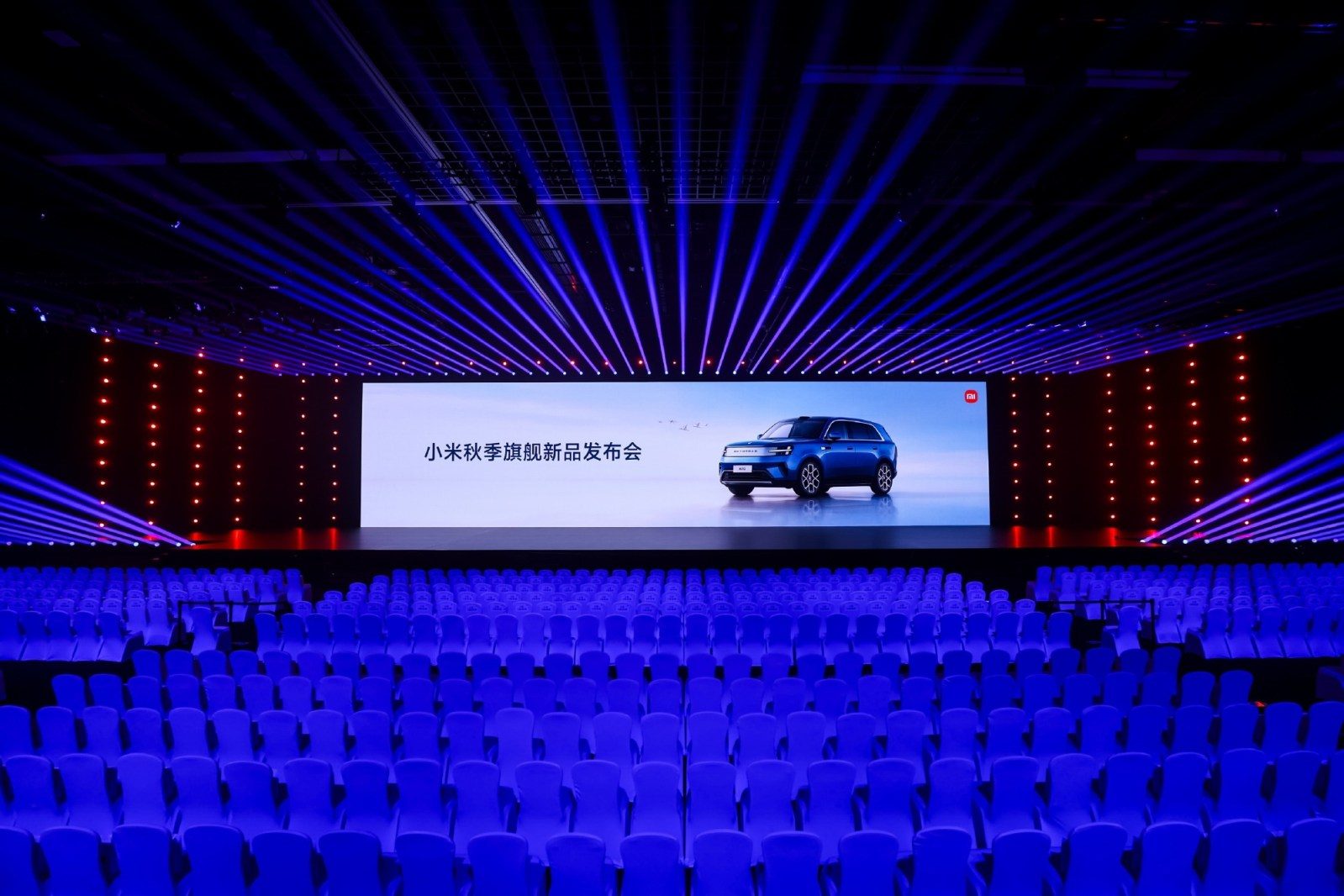

Xiaomi launched its first extended-range vehicles on Monday, pricing the five-seat N70 Pro at 209,900 yuan ($31,300), the AWD N70 Max at 239,900 yuan ($35,700) and the seven-seat N90 Max at 269,900 yuan ($40,200), with the two Max models coming in 20,000 and 30,000 yuan below the presale prices set in July.
Founder and CEO Lei Jun announced the prices at the company’s autumn launch in Beijing, a session of close to three hours that also introduced the Xiaomi 18 Fold phone and Pad 9 Pro Max tablet, and said cumulative deliveries of the SU7 and YU7 had passed 800,000 vehicles.
The new models will help the tech giant to reach its 550,000-vehicle sales target for 2026.
Xiaomi’s first two models — the SU7 sedan and the YU7 SUV — delivered more than 800,000 units in about 29 months, and monthly volume has held above 30,000 since June.
The three models from Skynomad, the company’s second product series after the SU7 sedan and YU7 SUV and its first with a petrol engine on board, a 1.5-litre turbocharged range extender that Xiaomi calls the ‘Kunlun’.
Monday’s event was the commercial launch of a series Xiaomi had already shown on July 30, when it presented the Kunlun architecture and the two Max models, opened refundable 1,000-yuan reservations and set the presale prices it has now cut.
The N70 Pro, the final prices, the colour and cabin detail and the start of sales were the new elements.
Three Cars, Two Batteries
All three share Xiaomi’s ‘Kunlun’ architecture, whose defining feature is a flat floor running 2.9 metres from the front footwell to the tailgate at an incline of 2.95 degrees, achieved by repackaging the rear drive unit, battery and fuel tank, and a set of long seat rails that let the cabin be rearranged in more than a dozen configurations when parked.
The N70 Pro, 4,960 mm long on a 2,950 mm wheelbase, pairs a 52 kWh lithium iron phosphate ‘Dragon Armour’ pack with a single 210 kW rear motor for 351 km of CLTC electric range, 1,351 km combined and fuel consumption of 5.7 litres per 100 km with the battery depleted on the WLTC cycle, the best figure in the range.
It reaches 100 km/h in 7.9 seconds, tops out at 190 km/h, turns in a 5.67-metre radius and wades to 650 mm, and it forgoes the air springs and adaptive dampers of the Max cars but keeps the double-wishbone front and multi-link rear suspension, LiDAR, Xiaomi’s HAD driver-assistance system as standard.
The N70 Max adds a 100 kW front motor for 310 kW combined, a 76 kWh nickel-manganese-cobalt pack with a 45-litre tank, air suspension and continuously variable dampers, for 505 km of electric range, 1,461 km combined, 6.1 litres per 100 km depleted.
It goes from 0 to 100 km/h in 5.5 seconds and has a 190 km/h (118mph) top speed.
The N90 Max stretches to 5,285 mm on a 3,080 mm wheelbase in a 2+2+3 layout with six seat rails up to 1,938 mm long, the same 310 kW drivetrain and 76 kWh pack, 464 km of electric range, 1,705 km combined.
It takes 5.9 seconds from 0 to 100 km/h, features a 577-litre boot expanding to 1,831 litres, and a rear-facing solid-state LiDAR in addition to the front unit.
Every car carries Nvidia’s Drive AGX Thor at 700 TOPS for driver assistance, a Snapdragon 8 Gen 3 for the cabin, 12 ultrasonic sensors and Xiaomi’s XLA cognitive model; the N90 Max charges from 20% to 80% in 18 minutes with up to 285 km added in 15 minutes.
The N70’s cabin, which Xiaomi presented in detail on Monday, offers 4 square metres of usable floor, a standard sliding centre island with a 9-litre fridge and three table options, a second row that reclines to 135 degrees, a 1,203-litre boot expanding to 2,425 litres, rear doors opening to almost 90 degrees, a 21.4-inch 3K rear screen, 14 speakers, 6.14 square metres of UV-filtering glass with a full blackout blind.
The model is available in six exterior colours and three interior colours.
The 76 kWh pack is among the largest fitted to a Chinese extended-range SUV at this price, and the 52 and 76 kWh units are the first under a “Dragon Armour” battery programme in which Xiaomi says it defines the product, leads pack design, participates in cell design and controls quality end to end, with cells supplied by partners it did not name on Monday.
The Price Cuts
The N70 Max’s 239,900 yuan ($35,700) is 20,000 below the 259,900 presale figure of July 30 and the N90 Max’s 269,900 is 30,000 below 299,900, larger reductions than the few thousand yuan Chinese commentators had expected from Xiaomi’s pattern with the SU7 and YU7.
At 209,900 yuan ($31,300) the N70 Pro sits 39,900 below the new-generation Li Auto L6, launched in July at an unchanged 249,800 yuan.
In July, Xiaomi President Lu Weibing had described the pricing task for Skynomad as harder than for the electric cars because the family-SUV segment is already crowded.
Launch-period buyers of the N70 Pro receive a rotating front seat at no charge plus vouchers of 8,000 yuan for wheels and 3,000 yuan for paint.
July’s reservation holders, who paid a refundable 1,000 yuan, keep priority production slots and a 999-yuan table-and-cupholder accessory.
Xiaomi said in August it was “going all out to prepare for the Skynomad launch and deliveries” after a third consecutive month above 30,000 deliveries, and industry reports ahead of the event put tens of thousands of built cars in stock.
Extended-Range
Lei said the decision to bet on extended range hybrid vehicles dates to September 2022, when “many friends urged us to build extended-range cars” and the company chose to “get pure electric right first,” then approved the project in March 2023 as the first electric platform matured.
Extended-range SUVs between 250,000 and 400,000 yuan built Li Auto’s business and now anchor Aito, and Lei cited Li’s new-generation L6 as proof “that extended-range demand is real and strong, and that users are willing to pay for an excellent extended-range product.”