
Porsche delivered 122,306 vehicles worldwide in the first half of 2026, a 16% decline from 146,391 a year earlier, with a collapse in China driving the steepest regional fall and pulling the sports-car maker to its weakest first-half performance in six years.
Deliveries in China dropped 32% to 14,501 vehicles, a slide so severe that Porsche sold fewer cars there than in its home market of Germany, where 14,938 were handed over.
A year earlier the picture was reversed, with China taking 21,302 cars against Germany’s 15,973, an advantage of more than 5,300 units for what had long been one of the company’s most important markets.
Porsche‘s sales total is the lowest first-half figure since 2020.
The China Collapse
Porsche attributed the Chinese decline to what it called a persistently challenging market environment and to its own focus on value-oriented sales, the strategy under which the company deliberately supplies below demand to protect pricing and brand exclusivity.
The retreat has been under way for some time.
Chinese deliveries fell 26.3% in 2025 to 41,938 vehicles, a fourth consecutive annual decline that left volumes roughly half the peak of about 96,000 cars Porsche reached earlier this decade, when China ranked as its largest single market.
The first quarter of 2026 brought a further 21% decline, meaning the second quarter accelerated the slide rather than arresting it.
Alexander Pollich, President and Chief Executive of Porsche China, described the conditions facing the business as a “perfect storm” at a media roundtable in January.
Pollich pointed to younger affluent buyers acutely exposed to the economic climate, to property no longer underpinning expectations of rising wealth, and to domestic rivals advancing at speed on both cost and technology.
China’s premium and luxury segments have shrunk by roughly 28% over three years even as the wider car market grew, according to figures Pollich presented, with models priced above one million yuan down about 23%.
In the C-segment SUV class where the Cayenne competes, he said manufacturers’ suggested retail prices have fallen by more than a third in three years, to the point that such a car now costs roughly what a class-smaller model once did.
Chinese brands, unburdened by legacy platforms, have moved faster on software and connectivity, the terms on which buyers increasingly judge a luxury car.
Policy has compounded the squeeze.
Chinese authorities lowered the threshold for the luxury vehicle consumption tax to 900,000 yuan from 1.3 million, a change that reaches about 30% of Porsche‘s lineup and lifts costs for those buyers by close to 11%.
Pollich has been explicit that Porsche will not answer with discounting, saying the company will not chase sales or market share at any cost, and that pursuing short-term volume would prove ruinous set against long-term brand value.
Porsche is instead shrinking its retail footprint, reducing a network of more than 100 Chinese outlets toward roughly 80, with dealerships in Jining, Huai’an, Nanning and Wuhu among those winding down sales operations this summer.
The company has also decommissioned around 200 direct-current fast chargers in the country, infrastructure built at considerable expense during its expansion years.
Losses Across Every Region
The weakness extended well beyond China.
North America remained Porsche‘s largest sales region with 37,712 deliveries, but the total was 13% below the prior-year period, a decline the company linked to the expiry of US tax incentives for electric and hybrid vehicles and to the end of combustion-engined 718 production.
The US shortfall marks a turn, since North America had held essentially flat through 2025 even as China fell away, making this the first half in which Porsche‘s two largest markets contracted together.
Europe excluding Germany fell 14% to 30,278 vehicles, again on the 718 run-out and a strong prior-year comparison for the electric Macan.
Germany proved the most resilient market, down 6% at 14,938 deliveries.
Overseas and emerging markets declined 18% to 24,877 vehicles, a fall Porsche attributed partly to the end of 718 production and partly to the conflict in the Middle East.
The 911 Stands Apart
Beneath the aggregate decline sits a sharp divergence between Porsche‘s combustion sports cars and the rest of its range.
The 911 was delivered 30,534 times in the first half, an increase of 19%, which the company credited to strong demand and to the staggered introduction of its derivatives during the prior year, with a pronounced mix of GTS, Turbo and GT models.
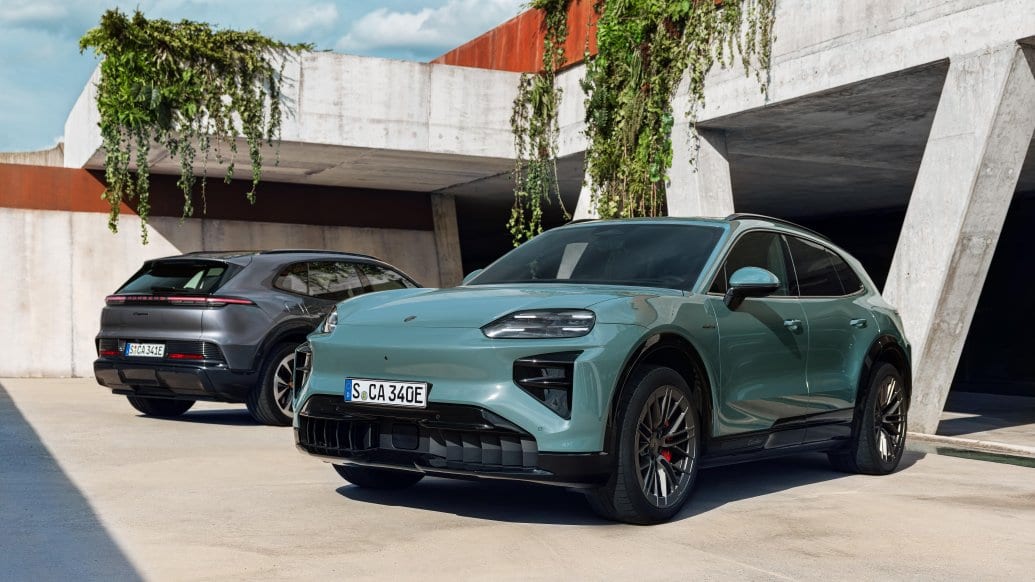
The Cayenne remained the highest-volume line at 38,141 deliveries, down 9%, with customer handovers of the all-electric version beginning at the end of June as the model is introduced market by market.
Macan deliveries fell 22% to 35,315 vehicles, split between 19,695 combustion cars, which Porsche continues to sell in most markets outside the European Union and will build until the end of July 2026, and 15,620 electric versions.
The company blamed the Macan’s decline on a slower ramp-up of electric mobility, a strong prior-year period and the loss of US tax incentives.
Panamera deliveries dropped 38% to 9,308 on a temporary supply gap in China, since closed by the April launch of a Panamera Pure market edition, while the Taycan fell 25% to 6,219.
The 718 Boxster and Cayman recorded 2,789 deliveries, down 73%, production having ended in October last year.
The steepness of that fall matters because the 718’s electric successor is now in doubt.
Bloomberg reported earlier this year that Porsche was weighing shelving the planned battery-electric versions of the Boxster and Cayman to cut costs, with people familiar with the matter citing budget constraints from the slump in China and US import tariffs, alongside rising development expenses and delays.
Leiters has made no final decision, and the company has elsewhere indicated the 718 nameplate will survive, but the hesitation captures a wider retreat from a once-absolute electric plan.
Production of the Cayenne began in February at Volkswagen Group‘s plant in Bratislava, Slovakia, making it Porsche‘s third fully electric model after the Taycan in 2019 and the electric Macan in 2024, with customer deliveries beginning at the end of June.
Management’s Framing
Porsche presented the numbers as anticipated rather than alarming.
Matthias Becker, the board member for sales and marketing, said the roughly 122,000 customer deliveries left the company “below the same period last year but in line with our expectations,” pointing to the start of Cayenne Electric handovers and positive trade feedback.
Becker added that Porsche is aligning supply to customer demand and sharpening its model range, and said further detail on the company’s Strategy 2035 would come at a capital markets day in the autumn.
The phrase the company reaches for repeatedly, value over volume, recasts a demand shortfall as a margin choice, and the strategy is most explicitly applied in China.
The Cost of the Retreat
The delivery slide sits atop a financial reversal.
Porsche‘s 2025 revenue fell to €36.27 billion from €40.08 billion, while operating profit collapsed to €413 million from €5.64 billion, cutting the operating margin to roughly 1%, after about €3.9 billion of exceptional charges tied to a retreat from its electric-vehicle strategy, battery activities and US tariffs.
For 2026 the company guides to revenue of €35 billion to €36 billion and an operating return on sales of 5.5% to 7.5%, absorbing a further €800 million to €900 million of restructuring costs and about €700 million in tariffs.
Chief Executive Michael Leiters, who took over at the start of the year, has moved to cut costs, scrapping his predecessor’s ambition of selling 350,000 to 400,000 cars a year and calling the first restructuring package insufficient.
Porsche has already agreed roughly 1,900 job reductions in the Stuttgart region by 2029 without compulsory redundancies, allowed about 2,000 fixed-term contracts to lapse and closed three subsidiaries affecting a further 500 employees.
Management and employee representatives are negotiating a further savings package, due by the end of July.
Handelsblatt has reported that up to 4,000 additional jobs could go, falling most heavily on management and administration, with about 30% of capacity at the Weissach development centre under review.
A Porsche spokesman declined to confirm that figure, pointing instead to a comprehensive package being prepared to streamline the company.
Porsche also slimmed its executive board in May, folding car software into research and development, and in January replaced its design chief of 22 years, Michael Mauer, with Tobias Sühlmann.