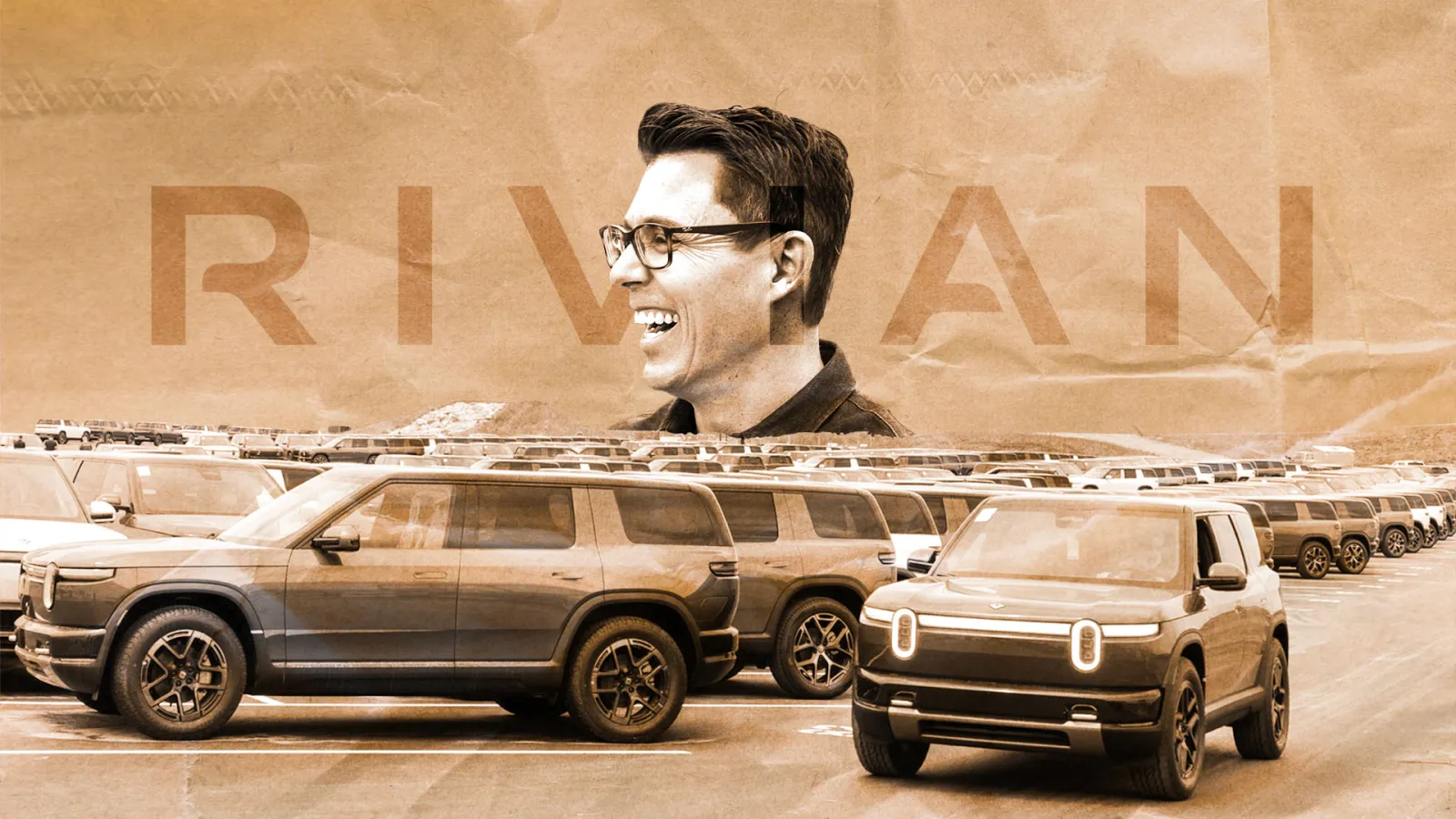
Rivian founder and CEO RJ Scaringe said the company’s autonomy efforts now consume most of its research and development budget — an admission that implies over $229 million spent on autonomy alone in the first quarter of 2026.
Scaringe made the remarks during a conversation with former Salesforce co-CEO and OpenAI chairman Bret Taylor, at CNN’s The 1 on 1 programme.
Rivian‘s R&D spending has climbed steadily over the past year, even as the company works to narrow losses across its automotive segment.
The EV maker spent $458 million on R&D in the first quarter of 2026, up 20% from $381 million a year earlier.
Quarterly R&D ran at $410 million, $453 million and $424 million through the remaining quarters of 2025.
Applying Scaringe’s “vast majority” framing — which in financial-disclosure language typically implies at least half — to the Q1 2026 figure points to roughly $229 million or more flowing into autonomy work in a single three-month window.
System Reset
Taylor opened the exchange with an anecdote about his own bet on autonomy.
“I bet my wife in the hospital with our first child that she wouldn’t get her driver’s license because of autonomous driving and on-demand services like Uber and Lyft, and she just got her driver’s license, so I paid her the $10,” he stated.
He then questioned Scaringe on how Rivian balances adapting to major technological shifts like generative AI and autonomous driving while still maintaining a steady, long-term strategy.
Scaringe’s answer traced an arc that began with Rivian‘s 2021 R1T launch and ended with a full architectural reset of the company’s self-driving stack.
“For us, a big focus initially was building out a technology platform and then scaling it. When we launched what we call our Gen 1 vehicles, what we had in terms of autonomy was very light,” the CEO said.
Scaringe admitted that they “knew that we needed to take a very different approach, and so right around the time we launched the car, this was in 2021, we started work on a complete reset to that system, which ultimately launched in our Gen 2.”
The company rebuilt the system from the ground up, according to its CEO.
“We brought the perception platform in-house, the compute platform in, and rebuilt it around more of a neural net-based approach, or an end-to-end-based approach versus a rules-based environment,” he noted.
Scaringe then added that “so that’s now occupying the vast majority of our R&D dollars.”
To him, “the way that these models are now developed to drive the vehicle actually benefits not having spent a lot of money in 2015 to 2022 just because the approach changed so dramatically in that time frame.”
Rivian has an industry record cash burn rate, with over $24 billion spent. Scaringe has previously defended it, framing it as the cost of building “a very large company.”
AI and Autonomy Plans
Rivian detailed its Gen 2 autonomy at its inaugural AI and Autonomy Day in December.
The Rivian Autonomy Platform (RAP) includes 11 high-resolution exterior cameras with visibility up to 10 seconds ahead at highway speeds, 12 ultrasonic sensors providing 360-degree coverage, five radars and a driver-facing camera.
The Gen 2 autonomy computer delivers 250 trillion operations per second of compute power — 10 times more powerful than the system in Gen 1 vehicles.
At the same event, the company unveiled the RAP1, a custom 5nm processor delivering 1,600 trillion operations per second of AI compute.
Rivian also confirmed LiDAR would be integrated into future R2 models.
SVP of Electrical Hardware Vidya Rajagopalan said at the time the Gen 3 system would represent “the most powerful combination of sensors and inference compute in consumer vehicles in North America.”
Hands-Free Roadmap
Rivian is targeting hands-free point-to-point driving for its Gen 2 vehicles in 2026, with eyes-off capability following in controlled conditions.
Scaringe has outlined a phased approach: hands-free highway driving first, followed by hands-free everywhere, then address-to-address driving where the vehicle handles the full journey.
He has said he hopes “hands-off everywhere” integrated with point-to-point navigation will be available between 2028 and 2030.
Chief Software Officer Wassym Bensaid confirmed last week during a Reddit AMA that point-to-point hands-free driving for the R2 and R1 Gen 2 vehicles is targeted for a limited rollout “later this year.”
“Beyond that, the team is heavily focused on point-to-point hands-free driving. We’ve been training our Large Driving Model rigorously and the goal is to do a limited roll out of address-to-address autonomy later this year,” Bensaid wrote.
The Large Driving Model — first introduced at the December event — is a foundational autonomous model trained similarly to a large language model, using Group-Relative Policy Optimization to distill driving strategies from large datasets.
SVP of Autonomy and AI James Philbin, who joined Bensaid in the same session, framed LiDAR-equipped Gen 3 vehicles arriving in late 2026 not as individually superior but as enablers for the broader fleet.
Software Revenue Target
The autonomy investment is increasingly central to Rivian‘s revenue mix as well as its R&D ledger.
The company expects software and services revenue to grow approximately 60% in 2026, Chief Financial Officer Claire McDonough said at a Morgan Stanley Technology, Media & Telecom Conference in March.
The guidance implies approximately $2.5 billion in software and services revenue this year.
Rivian reported $1.56 billion in software and services revenue in 2025 and just $484 million in 2024.
The segment generated $576 million in gross profit in 2025, up from just $7 million a year earlier.
In April, Rivian began charging for its Autonomy+ subscription, priced at $49.99 per month or $2,500 as a one-time purchase.
R2 Performance Launch Edition buyers receive lifetime access to Autonomy+ included in the $57,990 purchase price.
VW Joint Venture
The bulk of the software revenue continues to flow from the $5.8 billion joint venture with Volkswagen Group, under which Rivian supplies its electrical architecture and software technology stack to the German automaker.
During the CNN exchange, Scaringe reaffirmed the deal’s broad scope, as it involves not only the Volkswagen brand but many others in the group, including Audi and Porsche.
Taylor pressed him on the long-term implications.
“So in 10 years, will the Rivian platform be powering more non-Rivian branded cars than Rivian branded cars?” Taylor asked.
Scaringe did not rule it out.
“Well, it’s an interesting question. I think our hope is that we’d like to support other manufacturers as well. We also want to grow our market share,” he said. “So we have two sides of the business. One is we’re selling the technology platform. And then the other is we’re investing very heavily in the technology platform.”
The framing aligns with comments from CFO Claire McDonough, who has flagged “the opportunity for us to potentially license autonomous hardware and software capabilities in addition to the electrical architecture and software to other OEMs across the industry” as a key growth vector.
McDonough said Rivian expects to receive $2 billion from Volkswagen in 2026 out of $2.5 billion in outstanding payments.
The first tranche was approved earlier this year as the JV successfully completed winter testing of the architecture.
The investment led Volkswagen to surpass Amazon as Rivian’s largest institutional shareholder in the first quarter.
Uber Robotaxi Deal
The spending is also underwriting Rivian‘s commercial autonomy ambitions.
In March, Uber agreed to invest up to $1.25 billion in Rivian to deploy up to 50,000 fully autonomous R2 robotaxis across 25 cities by 2031.
Commercial deployment is scheduled for 2028.
The partnership is built around the Gen 3 autonomy platform and is contingent on Rivian hitting undisclosed performance milestones.