
Nio Inc. applied to register five new trademarks with the China National Intellectual Property Administration (CNIPA), according to filings published on the corporate information platform Tianyancha.
The filings were listed through Shanghai Nio Automobile Co., Ltd. under the names “NOMIBOT,” “NIOBOT,” and “NEOBOT,” with the shared “BOT” suffix strongly implying a connection to the robotics field.
“NOMIBOT” appears to be the most immediately legible, given that NOMI is Nio‘s existing in-car AI voice assistant — first introduced in 2017 and now standard equipment across the brand’s full vehicle lineup.
The trademark would suggest an embodied or robotic extension of the NOMI system.
“NIOBOT” carries the parent brand name, while the company also tries to secure the “NEOBOT” naming variant.
NOMI Trademarks
The filings come roughly eight months after Nio registered separate NOMI trademarks under the “scientific instruments” category, covering humanoid robots, teaching robots, biochip sensors, and integrated circuit chips.
The previous round of filings, disclosed in August 2025 through the corporate platform Qichacha, marked the first time the company extended the NOMI brand explicitly into robotics hardware.
Nio has been building robotics capabilities quietly over the past two years.
In early 2025, the 21st Century Business Herald reported that the company had formed a small internal team of about 20 staff to explore four-legged robot development, led by Xu Kang, a former algorithm expert from autonomous driving startup Momenta.
By September, the company had posted campus recruitment listings seeking specialists in embodied AI and simulation systems, with job descriptions focused on injecting large language model capabilities into physical robots.
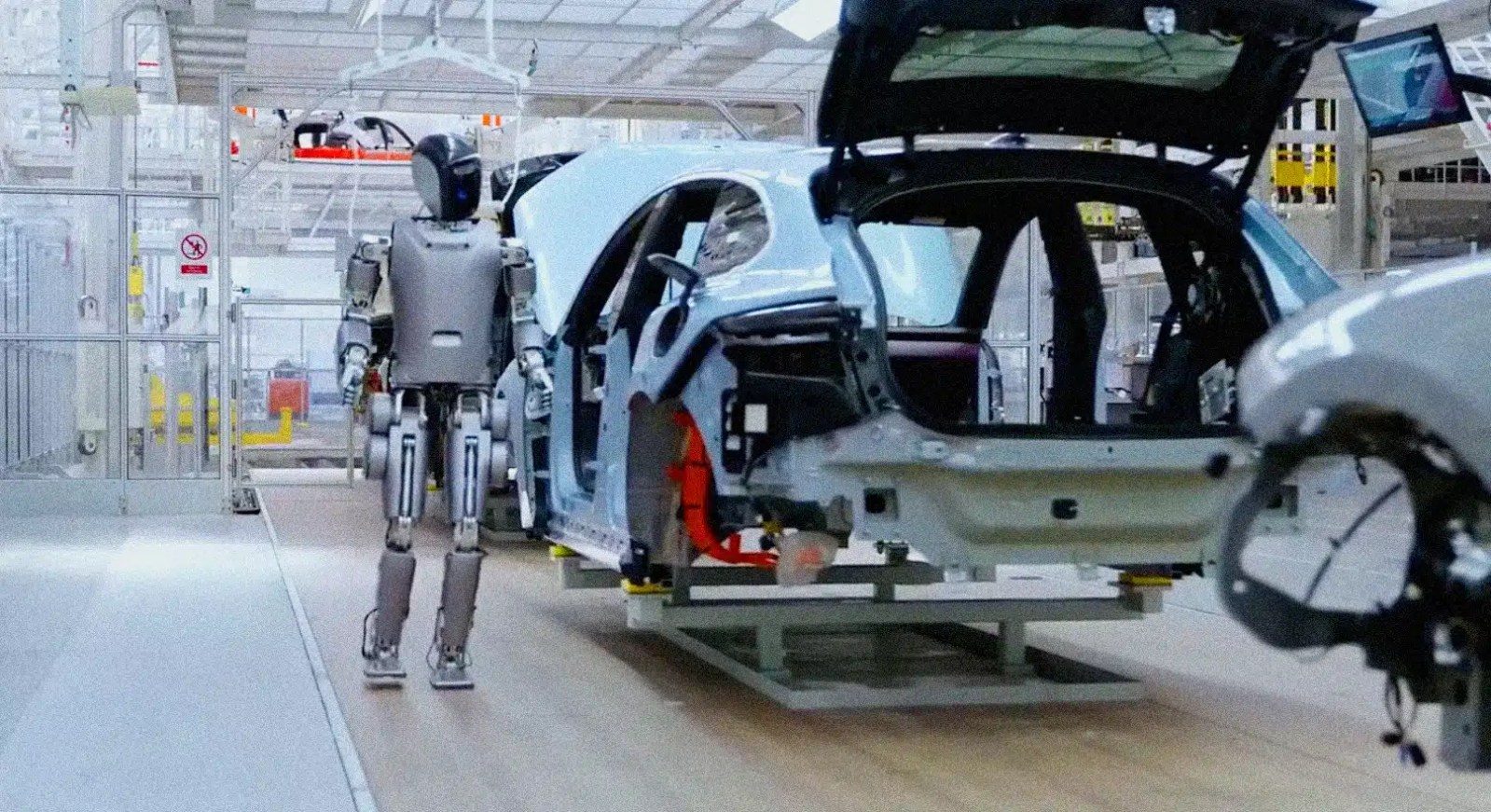
The company’s Hefei-based F2 factory already operates with 310 Automated Guided Vehicle transport robots and an assembly workshop equipped with 941 industrial robots.
During a livestream tour of the facility in July 2024, humanoid robots and robot dogs were seen undergoing training for inspection tasks.
The Late-Comer Strategy
Despite those investments, founder and CEO William Li has repeatedly said the company is not in a hurry to compete head-on with rivals already further along in robotics development.
In January, Li said at a media briefing that Nio would pursue a “late-comer strategy” in the space, letting competitors lead first.
“We shouldn’t rush to do everything at the forefront,” the CEO stated. “In some areas, we should adopt a late-comer strategy and let others take the lead first.”
In a media roundtable last November, Li framed the company’s robotics opportunity through the lens of its existing technology stack rather than a standalone product push.
“I’m more interested in whether any company wants to adopt our chips, or if one day humanoid robots design swappable-battery structures compatible with Nio‘s system,” he said at the time.
The company has developed proprietary chips, including the Shenji NX9031 for autonomous driving, and operates the world’s largest battery swap network with roughly 3,700 stations — with plans to have included 3,000 more by 2028.
Li has also acknowledged that the convergence of automotive and robotics technology makes the move into embodied AI virtually inevitable for any serious automaker.
“I believe that any automotive company today, if it has some ambition, will definitely become an AI company,” he stated in January. “It’s inevitable for automotive companies to get involved in embodied robots because the ability stack is the same.”
Product Expansion
The new trademark filings arrive as Nio navigates a period of aggressive product expansion.
The company showcased all three of its brands — Nio, Onvo, and Firefly — at the 2026 Beijing Auto Show in late April, where it displayed 11 vehicle models and 12 full-stack technologies.
The flagship ES9 SUV begins deliveries on May 27, while the Onvo sub-brand is preparing to launch the L80 on May 15.
A leaked image published last week also suggested that Nio is developing a third-generation companion smartphone that may extend across all three of the Group’s vehicle brands.
Separately, Nio Capital — the investment fund co-founded by Li — and Alibaba Group led a nearly 1 billion yuan ($138 million) funding round last November for Dexmal, a Shenzhen-based startup developing software and hardware for embodied intelligence robots.
Shanghai Nio Automobile Co., Ltd. was established in May 2015. Its legal representative is Qin Lihong, Nio‘s co-founder and President.
The entity has a registered capital of $3 billion and is wholly owned by Nio Holdings Co., Ltd., the Cayman Islands-incorporated parent company.
The company’s total active trademark portfolio stands at 2,748 filings, according to Tianyancha.
Industry Context
Unlike Nio‘s late-comer approach, several Chinese automakers have been accelerating their push into robotics and embodied AI.
XPeng unveiled the humanoid robot IRON at its 2024 AI Day, announcing it featured more than 60 joints and 200 degrees of freedom, with technology shared from its vehicles.
The company revealed it had been working on humanoid robots for five years.
In March, XPeng formally dropped “Motors” from its Chinese name to reflect its expansion into robotics and AI chips.
The company began construction of a dedicated mass production facility for the IRON robot in Guangzhou in the first quarter of 2026, targeting monthly output of more than 1,000 units by year-end.
Founder and CEO He Xiaopeng has said annual robot sales could reach one million units by 2030.
Chery has moved even faster on commercialization.
The state-owned automaker launched its robotics arm AiMOGA and positioned its Mornine M1 humanoid directly against Tesla’s Optimus at its International Business Summit in late April.
Chery is believed to be the first car manufacturer globally to offer a humanoid robot for sale directly to the public, listing the Mornine M1 at 285,800 yuan ($42,000) on JD.com — with deliveries scheduled to begin after May 23.
The company also offers the Argos X1 quadruped robot at 15,800 yuan ($2,300).
BYD has set up a dedicated lab for humanoid robotics, launching a recruitment drive for postgraduate researchers to join its “Embodied Intelligence Research Team” in late 2024.