
Nio Inc. has established a second wholly-owned subsidiary in Anhui province carrying a registered business scope that includes integrated circuit chip manufacturing, according to corporate filings on the Chinese registry platform Qichacha.
The new entity, named Anqing Nio New Energy Technology Co., Ltd., follows the registration of Jieshou Nio New Energy Technology Co., Ltd. less than two weeks earlier.
Both subsidiaries are indirectly wholly owned by Nio Holding Co., Ltd. and have nearly identical scopes of work, covering chip manufacturing, chip design, AI software development, and software sales.
The Anqing entity is registered in a prefecture-level city in southern Anhui province, distinct from Jieshou — which sits in northwestern Anhui under the jurisdiction of Fuyang.
Anhui Province is home not only to the Shanghai-headquartered EV maker’s three vehicle manufacturing plants, but also to XPT — Nio’s powertrain subsidiary — as well as multiple battery-related subsidiaries and autonomous driving-focused R&D centers.
A Pattern, Not a One-Off
The Jieshou filing in late April was the first Nio entity to formally include “integrated circuit chip manufacturing” in its registered scope, as EV reported at the time.
The company’s in-house chip operations were previously design-focused only, with physical fabrication contracted to TSMC.
The Anqing scope mirrors Jieshou almost line-for-line: manufacturing of integrated circuit chips and related products, integrated circuit chip design and related services, development of artificial intelligence application software, and software sales.
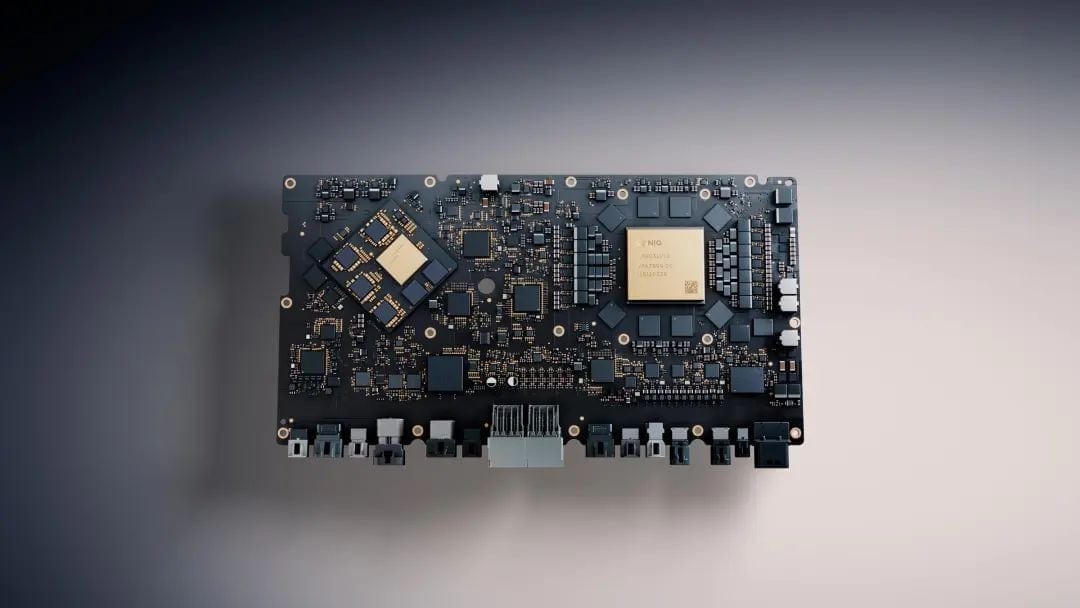
The combination maps directly to the work being done at Anhui Shenji Technology — Nio’s dedicated chip subsidiary known internationally as GeniTech.
Whether the new subsidiaries will host actual fabrication, packaging, and assembly capabilities or whether the manufacturing-scope registration is preparatory remains unclear.
Nio’s founder and CEO William Li has repeatedly highlighted the cost and performance benefits of the company’s in-house designed chips.
The Anhui Chip Geography
The Jieshou and Anqing entities now sit alongside an established Nio chip footprint in the province.
Anhui Shenji Technology — the operating entity behind Nio’s chip business — is itself registered in Anhui.
The unit was spun out from an internal business unit into a separate subsidiary in June 2025, with the new legal entity initially carrying registered capital of 10 million yuan and a business scope covering chip design and sales.
In January, Shenji registered two further subsidiaries in Hangzhou’s Binjiang District, both headed by Nio hardware vice president Bai Jian — marking the unit’s first chip presence outside Beijing, Shanghai, and Hefei.
Anhui province has been the group’s deepest operational and financial anchor since Hefei’s 7 billion yuan municipal rescue saved the company from near-collapse in 2020.
Hefei Construction Investment Holding and Hefei Economic and Technological Development Zone Investment Promotion were among the new state-owned investors in Mirattery’s Series C3 round earlier this year.
Hefei’s local industry fund also participated in Shenji’s 2.257 billion yuan ($331.4 million) first external funding round disclosed in late February.
Shenji’s Commercialisation Push
The new subsidiaries arrive as Nio’s chip business is shifting from in-house support to external commercialisation.
Anhui Shenji formed a Chongqing joint venture with AXera Semiconductor and OmniVision Technologies in November 2025, with AXera holding 36.4% as the largest shareholder.
The arrangement generated “several hundred million yuan” in technology licensing fees for Nio, according to 36Kr — the first material revenue from the company’s multi-year chip investment.
Li disclosed on the Q3 2025 earnings call that Shenji is licensing the NX9031 to automotive and robotics customers.
“We do see a good potential of applying this high computing power chip on different types of devices. For example, on robots,” Li said at the time.
A second Shenji chip — reportedly called M97 — has completed tape-out and is being pitched to Leapmotor and Geely, per 36Kr.
Li described the M97 as “high-end advanced-process” but engineered for a broader client base than the NX9031.
In January, Nio signed a vehicle-chip industrialisation partnership with Lontium Semiconductor Corporation at the company’s F2 plant in Hefei.
“We have been deepening collaboration with local partners,” Nio wrote at the time, announcing the partnership “further fostering an open, collaborative, and win-win industrial ecosystem in Anhui and Hefei.”
Lontium shares reached an eight-month high of HK$78.59 following the announcement.
New Subsidiaries
The Anqing filing brings Nio’s recent subsidiary-registration cadence to six new entities in roughly six months.
The company registered Weineng (Wuhan) Battery Technology in October 2025, Weineng (Chengmai) Battery Technology in October 2025, two Hangzhou Shenji units in January, Weilai Battery Technology (Shanghai) Co., Ltd. on February 26, 2026, Jieshou Nio New Energy Technology in late April, and now Anqing Nio New Energy Technology.
The pattern reflects what Nio has consistently done across its chip, battery, and sub-brand business lines — creating distinct, geographically dispersed operational entities that allow capital to be raised at the subsidiary level while maintaining consolidation control at the group level.
For the chip business specifically, the buildout aligns with Shenji’s transition from cost centre to standalone commercial entity.
The subsidiary closed its first external funding round at a valuation approaching 10 billion yuan ($1.4 billion) in late February.
The capital structure that emerged from that round — a Nio subsidiary retaining 62.7% ownership, external investors taking 27.3% collectively, and 10% reserved for an employee share incentive plan — established the framework for further commercialisation.
Li has previously said the NX9031 R&D cost was equivalent to building 1,000 battery swap stations.
The chip delivers approximately 10,000 yuan ($1,470) in cost optimisation per vehicle for Nio’s own operations, according to the CEO.
“For the long term, we will continue our investments and also efforts in the chip related technologies,” Li said on the November earnings call.