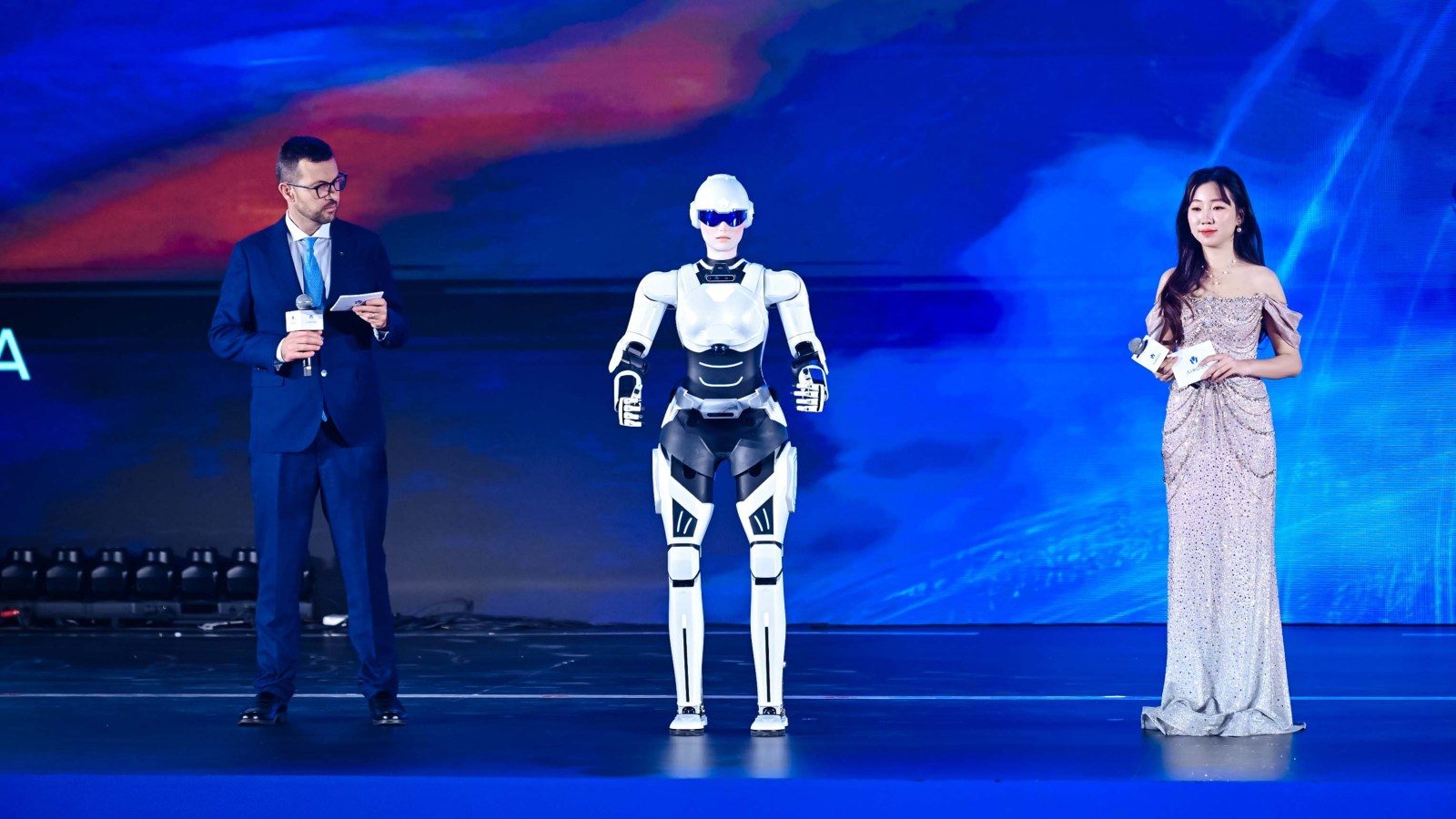

Chery Group founder and Chairman Yin Tongyue used his keynote at the AiMOGA Robotics global launch on Monday to directly position the company’s humanoid robotics ambitions against Tesla‘s Optimus.
Speaking at the Chery International Business Summit in Wuhu, attended by EV, Yin declared that AiMOGA‘s Executive VP would have to benchmark Optimus’s million-unit production target as the standard for Chery‘s own efforts.
The remarks marked the most explicit public framing yet of an automaker-led humanoid robot program as a direct competitor to Elon Musk’s robotics ambitions.
Last week, Musk said that competitors “literally do a frame-by-frame analysis and copy everything we’re doing,” on Tesla’s first-quarter earnings call.
“What we least want is to be defined as a traditional car company,” Chery‘s chairman said. “Rather, we are a future-oriented high-tech embodied innovation company. Tesla makes Robot, Chery makes AiMOGA.”
The Chairman’s framing recasts Chery‘s robotics push not as automotive diversification but as a bet on the same long-horizon thesis Musk has built around Optimus — embodied intelligence as a generational product category in its own right.
Specs of AiMOGA’s Robot
The Mornine M1 is marketed as an “Ultra-realistic AI assistant for humans” and a “worthy AI assistant you can trust.”
Specifications list a 5-foot-5 height, 154-pound weight, and 40 degrees of freedom across the body.
The robot is powered by a 0.7-kilowatt-hour battery delivering approximately two hours of operation after a two-hour charge.
Sensor coverage includes 3D LiDAR, depth cameras, a wide-angle camera, and ultrasonic radar.
Maximum walking speed reaches 1 meter per second, with each arm rated to handle 1.5 kilograms of payload.
The ‘T+T’ Strategy
Yin walked the audience through what he called Chery‘s “T+T” learning strategy.
“Chery has always insisted on learning the ‘T+T’ strategy,” he said. “The first ‘T’ is Toyota — we learn extreme quality and systems from Toyota. The second ‘T’ is Tesla — we learn innovation and disruption from Tesla.”
Yin then directly tied the AiMOGA program to the most-watched milestone in Musk’s compensation structure.
“One of the five conditions in Elon Musk’s trillion-dollar pay package is to achieve one million Optimus units,” Yin said. “Xia Peng must also benchmark Optimus’s million-unit sales and technical level.”
The reference is to AiMOGA Robotics Executive VP Xia Peng, who delivered the technical keynote later in the event.
The framing places a public production-volume target on Xia equivalent to one of the four operational milestones Tesla shareholders approved for Musk’s 2025 CEO Performance Award — a package worth up to $1 trillion if all milestones are met.
Same Origin Architecture
Yin grounded the strategic case in the technical overlap between cars and robots.
“When Chery makes robots, the biggest advantage is that robots and intelligent vehicles share a high degree of common origin in underlying technologies such as perception, planning, and control,” Yin said.
“Smart cars are essentially mobile robots. We use the philosophy of making cars to build robots, pursuing the ultimate in innovation, quality, cost control, and scaling capability.”
The disclosed humanoid architecture spans 8-megapixel cameras, panoramic cameras, 360-degree LiDAR, inertial measurement units, pressure sensors, high-precision RTK positioning, and a high-performance GPU chip — components shared with Chery‘s automotive ADAS stacks.
Tesla’s Optimus V3 Timeline
The benchmarking comes as Tesla finalizes the timeline for its third-generation humanoid robot.
On the company’s first-quarter 2026 earnings call on April 22, Musk said Optimus V3 will be unveiled “somewhere around the late July, August time frame,” declining to set an earlier reveal date because, in his words, “competitors literally do a frame-by-frame analysis and copy everything we’re doing.”
Tesla confirmed in its Q1 shareholder letter that “preparations for our first large-scale Optimus factory will begin shortly in Q2,” with a first-generation production line designed for one million robots per year that will replace the Model S and Model X assembly lines at Fremont.
Last Model S and Model X production runs are scheduled for early May.
A second-generation line at Gigafactory Texas is being designed for long-term annual production capacity of 10 million units.
The 1-million-unit Optimus production target is one of four operational milestones in Musk’s 2025 CEO Performance Award.
The others require Tesla to deliver 20 million vehicles cumulatively, deploy 1 million robotaxis in commercial service, and reach a market capitalization milestone tied to long-term value creation.
JD.com Listing
Chery is believed to be the first car manufacturer globally to offer a humanoid robot for sale directly to the public.
AiMOGA quietly opened its flagship store on JD.com — China’s second-largest e-commerce platform — on April 2, listing the Mornine M1 humanoid at 285,800 yuan ($41,800) with deliveries scheduled to begin after May 23.
The Argos X1 quadruped robot is priced at 15,800 yuan ($2,313), with availability after May 8.
Channel Leverage
Zhang separately presented the company’s distribution architecture, citing Chery’s footprint of more than 130 countries, over 5,800 overseas dealer networks, and 6.35 million existing users as the foundation for AiMOGA‘s global rollout.
The strategy includes a network of AiMOGA Robot Experience Centers built on top of Chery’s existing Omoda & Jaecoo, Exeed, iCAUR, and Lepas dealership infrastructure.
A Crowded Field
China’s humanoid robot industry is projected to grow approximately 94% year-over-year in 2026, according to a recent TrendForce report.
The automaker XPeng plans to begin mass production of its Iron humanoid by the end of 2026 from a new Guangzhou facility.
SAIC Motor‘s first humanoid robot, Nengzai No.1, entered operation in late March on the production line of the Buick Electra E7.
GAC is conducting small-batch production of its third-generation GoMate humanoid.