
Honda Motor Co. has officially placed its C$15 billion EV plant in Ontario on indefinite hold, confirming last week‘s Nikkei report that neither the company nor Canadian officials had been willing to validate at the time.
The announcement came on Thursday, as Japan’s second-largest automaker disclosed its first annual net loss as a publicly listed company — a ¥423.9 billion ($2.7 billion) deficit for the fiscal year ending March 2026.
Honda absorbed roughly $10 billion in charges tied to the unwinding of its EV strategy across the globe.
“Based on our revised strategic objectives, we have determined that an indefinite suspension of the value chain project is appropriate at this stage,” the company said in a statement.
“We will continue reviewing our future procurement and business strategies, while carefully monitoring market conditions,” Honda added.
From Investment to Indefinite Freeze
The planned EV complex, first announced in April 2024, was to be built at Honda‘s existing site in Alliston, Ontario, where the company has manufactured vehicles since 1986.
The project included a new EV assembly plant with a capacity of 240,000 vehicles per year, a 36 GWh battery plant, and cathode material processing facilities through joint ventures with South Korea’s POSCO Future M and Japan’s Asahi Kasei.
It was backed by C$5 billion in federal and provincial subsidies and was expected to create approximately 1,000 manufacturing jobs by 2028.
Honda first paused the project last May, citing tariff uncertainty and slower-than-expected EV demand in North America, saying it would revisit the timeline in 2027.
Last week, Nikkei reported the suspension was now indefinite; however Honda Canada spokesperson Ken Chiu declined to address the report directly, repeating a year-old statement.
Canadian Prime Minister Mark Carney said the same day that the government was in “constant contact” with Honda but that no official pause had been announced.
Thursday’s confirmation removes any remaining ambiguity.
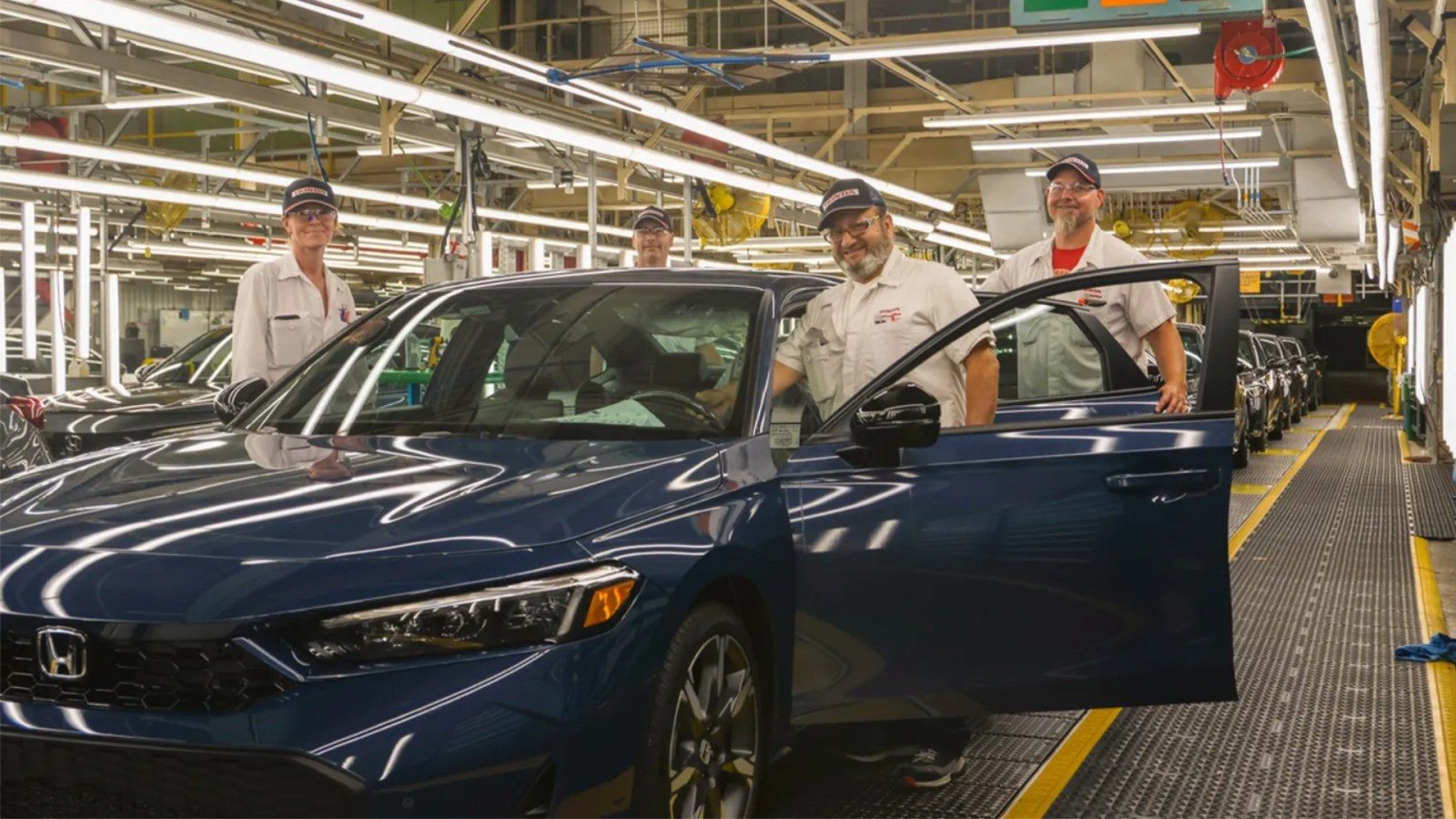
Honda said the pause will not impact current employment or production levels at the Alliston plant, which employs 4,200 workers building gas-powered and hybrid versions of the Civic and CR-V.
EV Bet Drives Historic Loss
The Canada plant freeze is part of a broader retreat from electrification that has resulted in Honda‘s worst financial performance in nearly seven decades as a public company.
Chief Executive Toshihiro Mibe — the architect of an ambitious 2021 vision to invest billions into EVs — acknowledged on Thursday that the challenges run deeper than a cyclical market downturn.
“The fundamental issue facing our automobile business is not simply the slowdown of the EV market,” Mibe stated, citing a loss of competitiveness in cost and vehicle development.
In March, Honda cancelled three EV models planned for production in the United States — two from its flagship 0 Series and the Acura RSX — prompting a warning of a net loss of between ¥360 billion and ¥630 billion, with up to ¥2.5 trillion in losses over two years related to its electrification pullback.
The cancellations also torpedoed the Afeela, the electric sedan developed jointly with Sony, which was scrapped days later after Sony Honda Mobility said it no longer had a viable path to market.
Honda also scrapped its pledge to stop making petrol cars by 2040 — a target that had made it the most radical among Japanese automakers on electrification.
In its place, the company said it would launch 15 new hybrid models by the end of 2030.
The loss is among the clearest examples of how the strategy pursued by major automakers to catch up with best-sellers BYD and Tesla on electrification has backfired.
Honda joins a growing list of legacy automakers that have taken multi-billion-dollar hits from their EV strategies, including Ford ($20 billion), General Motors ($6 billion), and Stellantis ($26 billion) — which have mostly felt the Trump administration’s EV incentive pullback in the US.
Return to Profit Driven by Motorcycles
Despite the scale of the losses, Honda said it expects to return to operating profit in the current financial year, forecasting a gain of ¥500 billion.
The recovery will be driven primarily by its expanding motorcycle business, including strong performance in India. The company kept its dividend policy intact.
That forecast came despite an expected EV-related impact of ¥500 billion this year, down sharply from the ¥1.57 trillion ($9.9 billion) hit absorbed in the year just ended.
Honda‘s lucrative motorcycle division had sheltered the group from large losses until now, even as global car sales slid roughly 30% from a record 5.34 million vehicles in the 2019 financial year to 3.6 million units in fiscal 2025.
Mibe, who was under pressure to step down over the EV missteps, also handled the merger talks with Nissan that collapsed last year after Honda insisted on taking control of its rival.
Impact on Canada’s Auto Sector
The indefinite suspension of Honda‘s EV complex adds to the challenges facing Canada’s auto industry, which has shed thousands of jobs over the past year as US tariffs and retaliatory duties pushed automakers to shift production south of the border.
Honda is one of five major automakers producing vehicles in Canada — alongside GM, Ford, Stellantis, and Toyota — all of which benefit from tariff-free import quotas under Canada’s US Surtax Remission Order.
The quotas are contingent on maintaining domestic production levels and following through on planned investments.
The government has already cut quotas for Stellantis (by 50%) and GM (by 24.2%) after both scaled back their Canadian operations.
Whether Honda faces similar consequences remains to be seen.
Industry Minister Mélanie Joly has previously said the government would reward companies that maintain or increase domestic production, mentioning Honda and Toyota by name.
Honda produced just over 400,000 vehicles in Canada last year, making it the country’s second-largest automaker by volume.
In Canada, vehicle output fell to 1.2 million units in 2025 from 2.3 million in 2016.
The Carney government has responded to the broader decline in Canadian auto manufacturing by pursuing new investment from Asian partners, including a trade deal with China allowing up to 49,000 Chinese-built EVs annually at a reduced tariff.