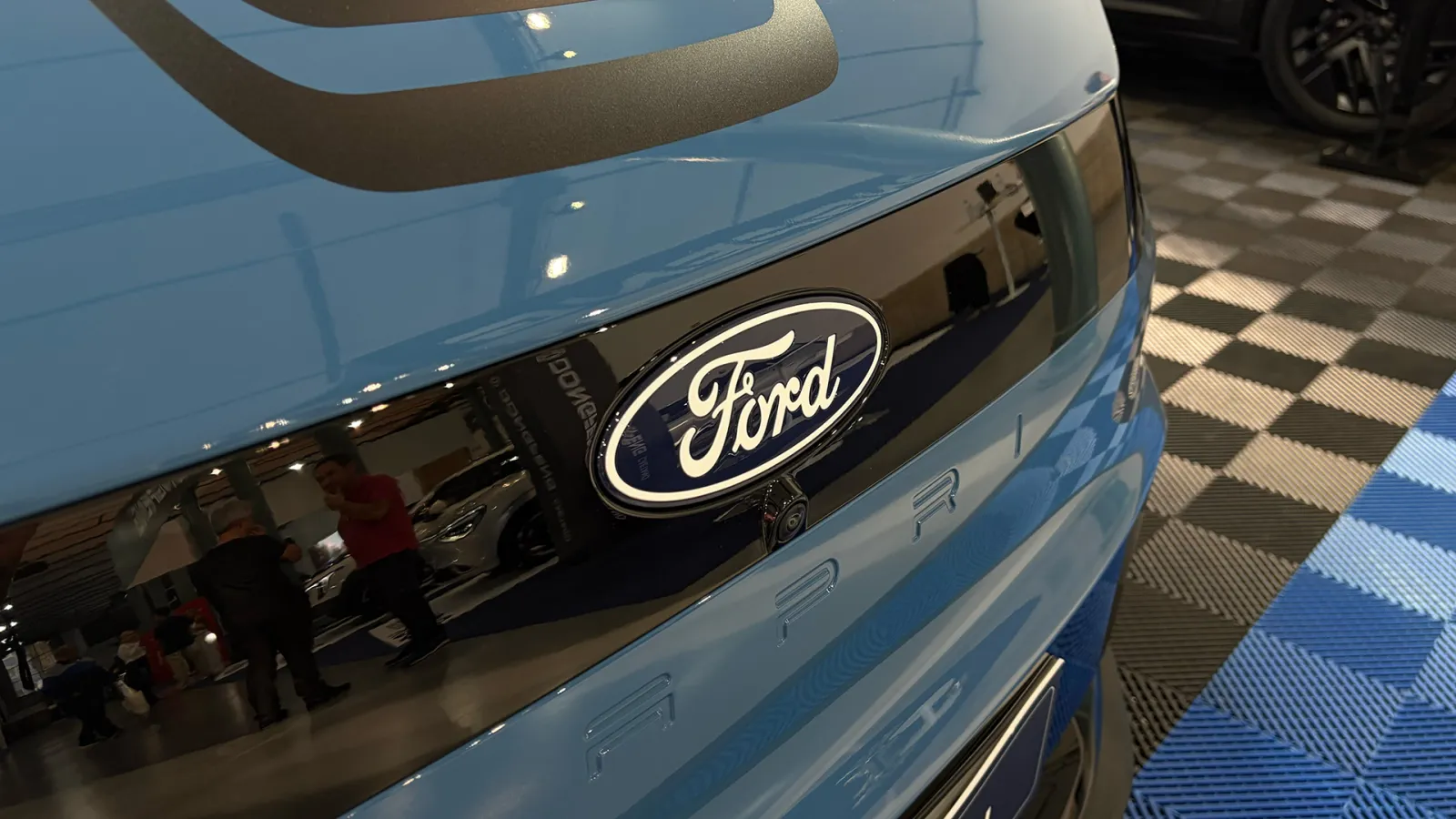
Ford said the batteries in its first-year Mustang Mach-E electric SUVs have kept an average of 92% of their usable capacity after more than five years on the road, citing data from more than 36,000 vehicles in the United States and Canada.
The data cover every 2021 model-year Mach-E sold to retail and fleet customers in both countries, which together have driven about two billion all-electric miles, Ford said on Monday. The figures are as of last August, and the average ownership period is 5.2 years.
About 95% of the vehicles fall between 87% and 97% battery health, according to Kevin Vander Laan, Ford’s Technical Leader of High-Voltage Battery Cells and Systems, who wrote the company’s post.
“The number I look at closely is the spread,” Vander Laan wrote. “Averages can hide variation, so that range matters.”
The figures are Ford’s own. The company said they are drawn from “Ford’s own connected-vehicle fleet data verified through our standard, aggregated, and anonymized vehicle data processes.” They have not been independently verified, and Ford did not publish the underlying distribution beyond the 87% to 97% range.
Ford also did not say how it calculates usable capacity from vehicle data, whether cars that had a battery pack replaced are counted or how many of the vehicles are in Canada.
High-Mileage Drivers
More than 2,000 owners of 2021 Mach-Es have passed 100,000 miles on their original battery, with average battery health of better than 91%, Ford said. More than 30 drivers have passed 200,000 miles and average 88%.
Ford said it went back to the 2021 cohort after one owner, David Blenkle, drove his 2022 Mustang Mach-E past 400,000 miles on the original battery. Blenkle runs a small private car service in Santa Cruz, California, according to an earlier Ford article, which now carries an editor’s note saying he passed 400,000 miles as of October 18.
“He gave us a real-world example of what is possible — and begged the question of whether he’s an outlier or not,” Vander Laan wrote. “David’s mileage remains exceptional, but the broader Class of 2021 data shows he is part of a larger pattern of strong battery health across real-world use.”
Ford did not give a battery health figure for Blenkle’s car. As a 2022 model, it is not part of the 2021 data set.
Ford made a wider claim for its electric lineup. Across the battery-electric models it has released in the U.S. and Canada over the last five years, its packs “are designed to last at least 10 years, and in the wild they’re maintaining, on average, greater than 90% health at 100,000 miles,” Vander Laan wrote, citing a 2026 company field data study.
Ford did not give the study’s sample size or say which models it covered. In its earlier Blenkle article, Ford cited a 2024 study and said Mach-E batteries were designed to last at least 10 years “with 90% battery health at 100,000 miles.”
Ford said it uses the field data to inform future programs, including its Universal Electric Vehicle platform and the Fathom midsize pickup.
Warranty Threshold
Ford’s reported averages are well above the level its warranty treats as a defect.
The 2021 Mach-E warranty guide published by Ford of Canada covers the high-voltage battery against “excessive capacity loss” for eight years or 160,000 kilometers (99,400 miles). It defines excessive loss as capacity below 70% of the battery’s “beginning of life capacity,” as determined by an EV-certified Ford dealer.
“Gradual capacity loss with time and use is considered normal wear and tear,” the guide says. Ford says its U.S. warranty covers the battery and electric drivetrain for eight years or 100,000 miles.
Contactor Recalls
Ford’s post does not mention that the 2021 Mach-E has been recalled several times over its high-voltage battery’s main contactors, according to the National Highway Traffic Safety Administration (NHTSA).
In June 2022, Ford recalled 48,924 2021-2022 Mach-Es because the contactors could overheat, which NHTSA said could cause a loss of drive power and increase the risk of a crash. The fix was a software update.
In October 2023, Ford recalled 34,762 2021-2022 Mach-Es with the extended-range battery to replace the high-voltage battery junction box over the same contactor issue.
Two smaller follow-up campaigns in 2025 covered 626 vehicles that had been repaired incorrectly under the 2022 recall and 239 2022 vehicles with the extended-range battery.
Charging Advice
Ford told owners to charge on Level 2 at home for daily driving and keep DC fast charging for days they need it. It also advised preconditioning while plugged in, parking in the shade in summer when possible and following the charge-level recommendations in the Ford app.
The 2021 Mach-Es in the data set use nickel-cobalt-manganese (NCM) cells, which generally do not need frequent full charges, Ford said. Some newer Ford EVs use lithium iron phosphate (LFP) cells, which benefit from an occasional charge to 100% to keep the battery management system calibrated.
“This is one of the most valuable feedback loops we have had at this scale: more than 36,000 vehicles, five-plus years, and billions of real-world miles,” Vander Laan wrote.
Lower Sales
The battery data arrive as U.S. sales of the Mach-E have fallen sharply since the federal EV tax credit of up to $7,500 expired on September 30, 2025.
Ford sold 1,239 Mach-Es in the U.S. in October, down 57.4% from 2,906 a year earlier. Sales for the first 10 months of 2026 totaled 18,445, down 58.9%.
In the third quarter, Ford sold 5,574 Mach-Es, down 72.4% from a record 20,177 a year earlier, when buyers rushed to claim the credit before it expired. Third-quarter sales were also down 20.7% from 7,032 in the second quarter.
The Mach-E had its best year in 2024, when Ford sold a record 51,745 in the U.S., up 27%. Sales were 51,620 in 2025, a level Ford said was consistent with 2024. Ford sold 27,140 Mach-Es in the U.S. in 2021, its first full year on sale.
Ford builds the Mach-E at its Cuautitlán plant in Mexico. It built 3,037 there in October, bringing production for the year to 29,772, and had about 4,300 in U.S. gross stock at the end of the month.
A Bigger Battery for 2027
Ford has extended its Ford Power Promise offer on the 2026 Mach-E through the fourth quarter, giving buyers a choice of a home charger with standard installation or $1,500 in bonus cash.
For the 2027 model year, Ford made its extended-range battery standard across the Mach-E lineup, with 88 kilowatt-hours of usable capacity on Select and Premium versions and 91 kWh on the GT and Rally. The outgoing standard-range pack had 73 kWh and used lithium iron phosphate cells from CATL.
The 2027 Mach-E starts at $39,995 before destination, $2,200 more than the 2026 model.
Ford’s Model e electric vehicle unit lost $1.06 billion before interest and taxes in the third quarter, and the company expects Model e losses of about $4 billion for the full year.