
CATL, the world’s largest battery maker, unveiled six major battery and infrastructure updates at its annual ‘Super Tech Day’ in Beijing on Tuesday evening.
The Ningde-headquartered company unveiled a flagship 1,500-kilometre-range (932 miles) range battery while announcing sodium-ion mass production and an integrated 4,000-station charging-and-swapping network.
The event — which EV attended — was held three days before the opening of the Beijing Auto Show on April 24.
“Industrial innovation must be driven by a rigorous scientific spirit,” CATL Chairman and CEO Robin Zeng said at the conference.
“For Chinese technology to go global, it relies not just on speed and scale, but on the quality of innovation, the ability to validate, and the credibility of the brand,” Zeng added.
The six innovations unveiled span CATL‘s full material chemistry spectrum — from LFP to NCM, sodium-ion and condensed state — plus a unified charging-and-swapping infrastructure solution.
The BYD Pressure Backdrop
The unveilings arrive as CATL faces its most significant competitive pressure in years from domestic rival BYD.
The Shenzhen-headquartered automaker launched its second-generation Blade Battery and flash-charging technology last month, allowing vehicles to charge from 10% to 90% in 9 minutes — a claim that challenged CATL‘s fast-charging leadership before Tuesday’s third-generation Shenxing unveil.
CATL held a 45.54% share of the Chinese battery market in March by installed volume, compared with BYD’s 17.83%.
Globally, CATL holds 37% of the EV battery market and 22% of the energy storage systems market for power grids and data centres.
The company reported net profit of 20.74 billion yuan ($3.01 billion) in the first quarter, a 48.52% year-on-year increase, in an earnings release last week.
Gen-3 Shenxing
The third-generation ‘Shenxing Superfast Charging Battery’ reached what CATL called “the industry’s strongest capability” with equivalent 10C and peak 15C charging rates.
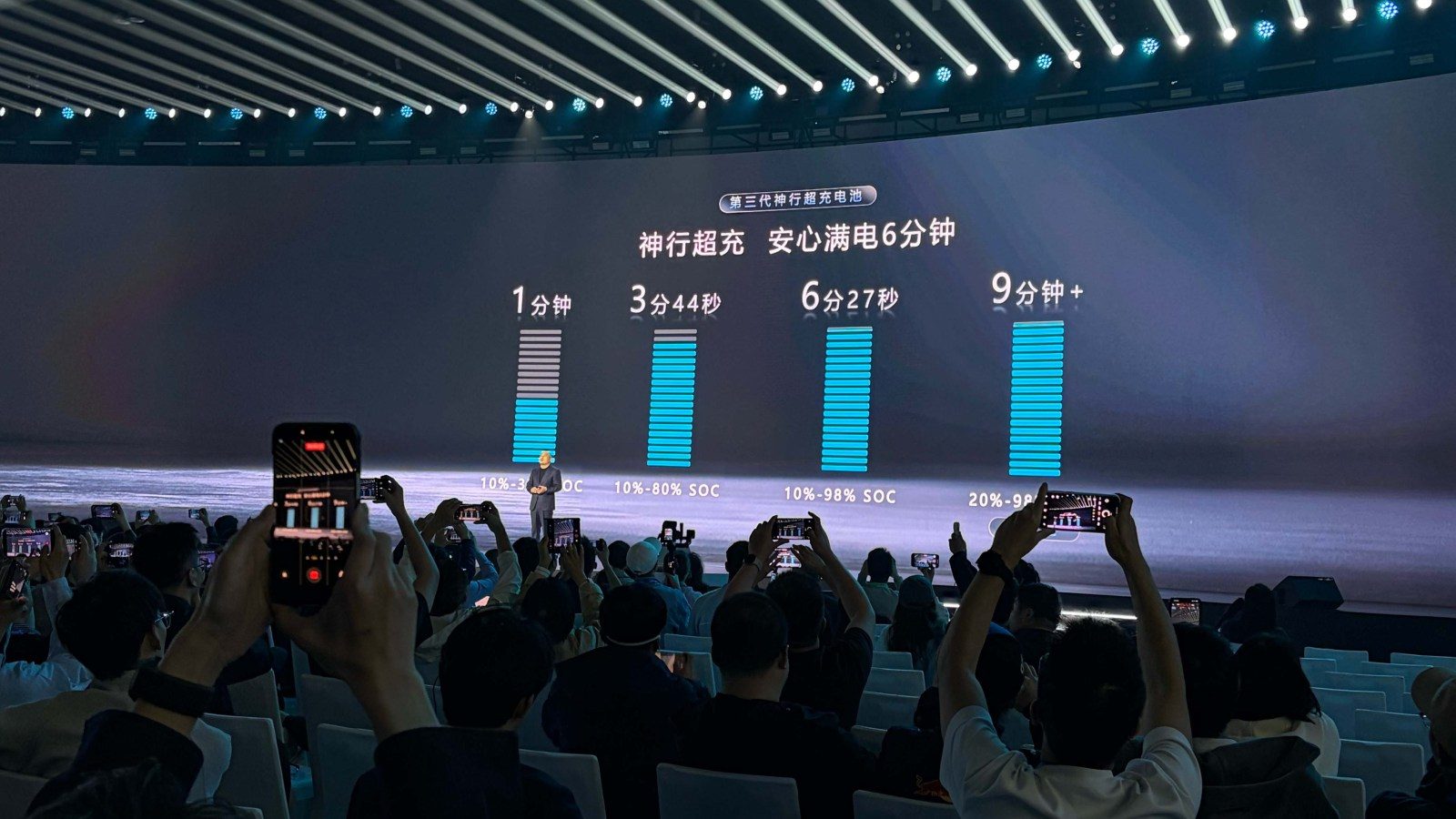
The battery charges from 10% to 35% state of charge in one minute; from 10% to 80% in 3 minutes and 44 seconds; and from 10% to 98% in 6 minutes and 27 seconds.
Even at -30°C in extreme cold conditions, charging from 20% to 98% takes approximately 9 minutes.
The battery retains more than 90% capacity after 1,000 complete cycles, according to CATL.
The new ‘Shenxing’ jumps significantly beyond last year’s second-generation product, which delivered 800 kilometres of range at a 12C peak charge rate.
Gen-3 Qilin
The third-generation ‘Qilin’ Battery achieves a cell energy density of 280 Wh/kg and enables 1,000 kilometres of range while supporting 10C superfast charging.
The battery delivers 3 megawatts of peak power — doubling the output of the second-generation Qilin track battery that competed on the Nürburgring at 1,330 kilowatts.
The entire pack weighs 625 kilograms, representing a weight reduction of 255 kilograms and space savings of 112 litres compared with equivalent LFP systems, CATL said.
CATL translated those savings into specific performance claims: a 0.6-second reduction in 0-to-100 km/h acceleration, a 12% shorter overtaking risk window, an 8% higher moose-test speed, and approximately 1.44 metres shorter braking distance.
Energy consumption per 100 kilometres decreases by more than 6%, saving approximately 0.78 kWh per 100 kilometres, according to CATL.
Safety is strengthened through “thermal-electrical separation,” with each cell incorporating an independent sealed exhaust channel to isolate thermal events.
Qilin Condensed Battery
The ‘Qilin Condensed Battery’ applies what CATL described as aviation-grade technology to passenger vehicles for the first time, achieving 350 Wh/kg cell energy density and 760 Wh/L volumetric energy density.
The specifications enable 1,500 kilometres (932 miles) of range for sedans and over 1,000 kilometres for large SUVs, with pack weight controlled within 650 kilograms, CATL said.
The condensed battery features a high-nickel cathode and low-expansion silicon-carbon anode, boosting energy density by 50 Wh/kg.
Its aviation-grade titanium alloy case reduced thickness by 60% and weight by 30% compared with conventional housings, while tripling unit strength and contributing an additional 20 Wh/kg.
Gen-2 Freevoy
The second-generation ‘Freevoy Super Hybrid Battery’ extends all-electric range to up to 600 kilometres and standardises 10C superfast charging on hybrids — a category that has traditionally lagged pure-electric vehicles in charging speed.
The battery integrates LFP and NCM materials through gradient-uniform mixing, with the olivine crystal structure of LFP serving as the core backbone.
The LFP version delivers up to 500 kilometres of pure-electric range, enabling what CATL called a “once-a-week charging” experience for daily commuting.
The NCM version extends pure-electric range beyond 600 kilometres, with total vehicle range exceeding 2,000 kilometres.
The system delivers 1.5 megawatts of instantaneous power at full charge and maintains 1.2 megawatts at 20% state of charge.
Safety specifications include a reinforced bottom coating capable of withstanding 1,500 joules of impact energy — ten times the national standard — and waterproof sealing that allows continuous immersion in two metres of water for more than 200 hours.
Naxtra Sodium-ion
The ‘Naxtra Sodium-ion Battery’ — launched as a brand at last year’s inaugural Super Tech Day — will enter full-scale mass production by the end of 2026, CATL confirmed.
The company said it had resolved four key industry bottlenecks for sodium-ion mass production during 2026: extreme water control, gas generation in hard carbon, aluminium foil adhesion, and self-forming anode systems.
Mass production at GWh scale places CATL‘s sodium-ion ahead of every global peer on industrialisation timing.
Dr. Wu Kai, CATL‘s chief scientist, laid out the company’s multi-chemistry rationale at the event.
“LFP is nearing its theoretical energy density limit, making it better suited for a technology roadmap centered on extreme fast charging to achieve optimal balance,” Wu said.
“NCM’s high energy density keeps it at the forefront of global competition — underscoring that energy density remains the core metric for leadership.”
Sodium-ion batteries offer broad potential for extreme temperatures and energy storage applications, Wu added.
CATL said it will continue to invest in advanced research, large-scale manufacturing, and ecosystem collaboration to accelerate the transition from single-point innovation to full-scenario energy solutions.
The company did not disclose specific customer orders or vehicle-program integration timelines for the newly unveiled products at the event.