
Chinese battery manufacturer CALB has formally launched Phase 1 construction of its Sines gigafactory in southern Portugal, injecting €48 million into its Portuguese subsidiary and awarding a €207.3 million build contract to local contractor Mota-Engil in late May.
The move signals acceleration toward full commercial battery production by 2028 and cements Portugal’s position as Europe’s fastest-growing Chinese battery manufacturing hub.
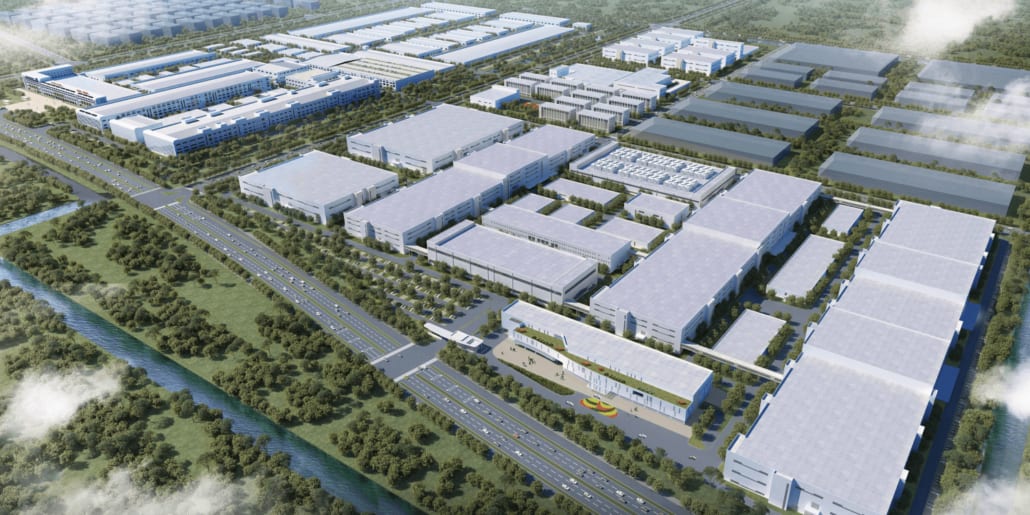
The Phase 1 construction contract, formally announced via regulatory filing to Portugal’s CMVM on Monday, covers approximately 62,000 square meters of manufacturing infrastructure across a 17-hectare site and is scheduled for completion within 22 months — in July 2028.
Phase 1 encompasses electrode and cell production buildings, power plant infrastructure, chemical and NMP storage facilities, waste management stations, and integrated electrical systems.
The facility is expected to produce 15 gigawatt-hours of lithium-ion batteries annually—equivalent to roughly 187,000 EV battery packs per year.
CALB’s Background
CALB, a Hong Kong Stock Exchange-listed battery manufacturer, is a subsidiary of China’s state-owned Aviation Industry Corporation.
It operates production bases across China’s major industrial centers (Changzhou, Xiamen, Chengdu, Wuhan) and runs a module-assembly facility in Thailand.
The Sines gigafactory marks its first full European manufacturing footprint.
Over the last few months and years, several Chinese carmakers such as BYD, Leapmotor, Dongfeng, Chery, and XPeng have announced the expansion of their European production and assembly operations.
Accelerating Toward 2028 Production
CALB announced the Sines project in 2022 as its first full-scale European manufacturing facility with a groundbreaking ceremony that took place in February 2025.
The Portuguese government formalized €350 million in investment incentives in January 2026 during a broader battery-sector investment ceremony that included six contracts totaling €3.077 billion across multiple projects.
The facility holds “Project of National Interest” (PIN) status, granting expedited environmental and grid approvals. Portugal’s Environment Agency (APA) issued a favorable Environmental Impact Assessment in 2024 with approximately 90 mitigation measures, including compensation for roughly 5.3 hectares of cork oak habitat loss and a compensatory solar park.
Last March, Portugal’s regional development authority (CCDR Alentejo) issued the formal installation title, clearing the path for physical construction.
The 22-month build timeline aligns with CALB‘s target for initial production in 2027 and full commercial operations in 2028.
CALB markets the facility as a “Zero-Carbon AI Gigafactory,” emphasizing highly automated, intelligent manufacturing with low-carbon operations and world-leading battery energy storage system (BESS) integration, according to Sherry Wei, CALB Europe General Manager.
Output will target both automotive EVs and stationary energy storage systems for European customers, with an expected mix of high-performance NCM and cost-effective LFP chemistries tailored to regional demand.
Strategic Hub and Job Creation
The facility sits in the Sines Industrial and Logistics Zone, approximately 92 hectares reserved, with the factory footprint occupying roughly 45 hectares and featuring five main production buildings.
The location offers immediate adjacency to Port of Sines — a deep-water facility operating 24/7 with major rail connections — positioning the site as a logistics nexus for raw-material imports and pan-European battery distribution.
CALB is expected to create 1,800 direct jobs, including approximately 497 to 600 highly skilled technical positions.
Portuguese media estimates the project’s GDP impact at full capacity could exceed 4% of national output — potentially larger than Volkswagen‘s Autoeuropa manufacturing plant.
The investment synergizes with Portugal’s emerging lithium resources (including the Barroso mine expected online circa 2027) and positions Sines as a new European battery supply hub.
CALB has joined Battery Cluster Portugal and committed to “global plus local” supply-chain sourcing, with Portuguese engineering and construction firms including Mota-Engil and COBA already embedded in the project.