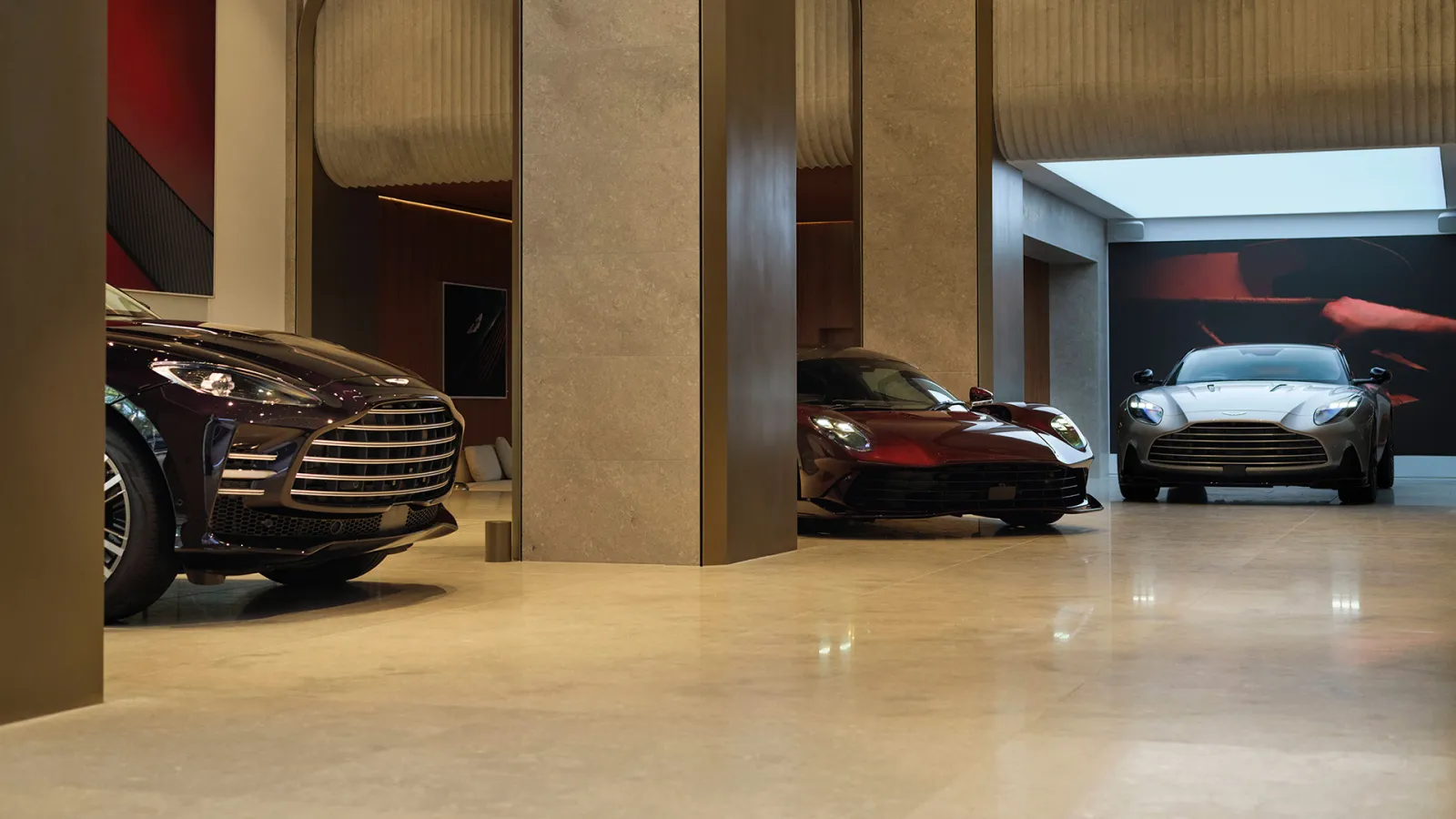
Aston Martin narrowed its third-quarter loss and kept its 2026 guidance on Wednesday, as deliveries of its Valhalla plug-in hybrid supercar lifted revenue and margins while sales of its core sports cars and SUVs declined and its first electric car remains years away.
Revenue rose 36% to £388.7 million ($516.5 million) in the three months to September 30, and the gross margin widened to 37.4% from 29.0%, the British carmaker said. The loss before tax narrowed to £77.1 million ($102.5 million) from £111.9 million ($148.7 million).
The adjusted operating loss, which excludes one-off items, improved to £24.9 million ($33.1 million) from £50.6 million ($67.2 million).
“Valhalla deliveries, and the benefits of our transformation programme, have lifted gross margin to 35%, while free cash outflow almost halved as we move towards our goal of cash generation,” Chief Executive Officer Adrian Hallmark said, referring to the first nine months.
The heavy lifting
Total wholesale shipments were flat at 1,431 vehicles in the quarter, including 127 Valhallas. Shipments of core models, excluding limited-run Specials, fell 9% to 1,304, which Aston Martin attributed to a more balanced production cadence from the second quarter.
Sport and GT models fell 7%, and the DBX SUV range 14%. By region, shipments rose 26% in the UK and 11% in the Americas, but fell 20% in Europe, the Middle East and Africa and 5% in Asia Pacific.
The Valhalla, Aston Martin’s first mid-engined plug-in hybrid, pairs a twin-turbo 4.0-liter V8 with three electric motors and a 6.1 kWh battery. About 350 were delivered in the first nine months, and Aston Martin expects about 500 for the full year, with nearly all remaining coupes ordered and due by the end of the first half of 2027.
The car pushed the average selling price across all models up 39% in the quarter to £247,000 ($328,200). The core average rose 7% to £190,000 ($252,500).
On Wednesday, Aston Martin unveiled the Valhalla Spider, an open-top version with 1,064 horsepower and a top speed of 217 mph with its optional hardtop. Deliveries begin in the third quarter of 2027, and the order book already stretches into the fourth quarter. Most Spiders have been allocated.
The company also launched the Valen in the third quarter, a V12 special it calls the world’s most powerful front-engined production car, with deliveries from the second quarter of 2027.
An EV pushed back again
The results came weeks after Hallmark said the company’s first battery-electric car would not arrive before 2033.
“It could be 2035, it might be 2033, but it’s in that three-year window. It’s not 2031,” he told reporters including Autocarat the start of October, describing Aston Martin as “not BEV deniers but BEV delayers.” Electric cars are needed “for legislative reasons [in certain markets] just before 2035,” he said, according to Autocar India.
Aston Martin had planned in 2022 to launch its first battery-electric car in 2025 and to fully electrify its core sports cars and SUVs by 2030. In February 2024, it moved the first EV to 2026 and said it would launch plug-in hybrids first.
A year later, Hallmark dropped a plan for up to four electric models by 2030 and committed to “at least one electric car” by the end of the decade.
He now says Aston Martin will use some form of hybridization but probably not plug-in hybrids in its core models, citing a weight penalty of about 200 kilograms. The company plans to keep its V8 and V12 engines compliant with emissions rules through at least 2035, he said.
A new platform
Instead of plug-ins, Aston Martin is developing a new generation of sports cars and SUVs on a clean-sheet modular architecture that will use mild-hybrid petrol engines, Hallmark told Auto Express in July. The models are due before the end of the decade, and the platform is being designed to take battery-electric power in the 2030s, the magazine reported.
“We also looked at how much electrification is needed to remain compliant – and we don’t need plug-in hybrids,” Hallmark said. “We’re not delusional, we’re pragmatic.”
A 48-volt electrical system will power the air conditioning and turbochargers, which should add a little power, improve fuel economy and let the cars coast with the engine off, according to Auto Express.
The V12 can also survive. “If we keep our V12 sales under 1,000 per year, then we’re exempt from legislation until 2035 at least,” Hallmark said.
About a third of today’s Aston Martin components come from Mercedes-Benz, a share that will rise with the new generation, Hallmark said, though “more than 50 per cent will be down to us.” Greater commonality should allow sports cars and SUVs to be built on the same line in the future, he said.
Lucid deal on hold
The delay has left Aston Martin’s 2023 technology deal with Lucid largely unused.
Aston Martin agreed to pay Lucid a $232 million access fee, $100 million in shares and $132 million in cash, and committed to a minimum spend of $225 million on Lucid powertrain components. It still owed £73.3 million ($97.4 million) under the arrangement at the end of 2025, all due in 2026 or later.
By the time Aston Martin activates the deal, “the technology that we will get is totally different to what we signed up the original contract for,” Hallmark said. The company also relies on Mercedes-Benz, which owns a stake, for engines and electrical architecture.
Its results statement still says Aston Martin is developing alternatives to combustion engines “through a blended drivetrain approach” and plans “a line-up of electrified sports cars and SUVs.”
Debt and spending
Free cash outflow fell to £27.6 million ($36.7 million) in the quarter from £94 million, and to £225.2 million ($299.3 million) in the first nine months from £415 million.
Net debt rose to £1.57 billion ($2.09 billion) after a £550 million ($731 million) debt financing in July, and liquidity stood at £321.6 million ($427.4 million).
The improvement follows a cost overhaul. Aston Martin said in February it would cut up to 20% of its workforce, about 600 jobs, to save about £40 million ($53 million) a year.
In April, a consortium led by Executive Chairman Lawrence Stroll injected another £50 million ($66 million). Adjusted net leverage improved to 6.7 times earnings before interest, tax, depreciation and amortization from 12.8 times at the end of 2025.
Aston Martin expects capital investment of about £300 million ($399 million) this year as part of a reduced program of about £1.7 billion ($2.26 billion) from 2026 to 2030, down from about £2 billion.
It expects full-year wholesale volumes similar to 2025’s 5,448, a gross margin in the high 30s and an adjusted operating margin approaching breakeven.
The company cited risks including possible new US tariffs, changes to China’s taxes on ultra-luxury cars and the conflict in the Middle East. The US tariff quota for UK-built cars, introduced in 2025, limits its ability to forecast quarterly results, it said.
Rival McLaren is also leaning on hybrids, with plans for a hybrid SUV.