
Aston Martin has received another £50 million ($67.5 million) cash injection from a group of investors led by major shareholder and chairman Lawrence Stroll, as losses amount for the fifth consecutive quarter.
The British luxury automaker reported its first-quarter results on Wednesday, flagging ongoing uncertainty tied to global trade tensions.
The consortium — which includes Stroll, China’s Geely Holding Group, and Saudi Arabia’s Public Investment Fund (PIF) — has repeatedly stepped in to prop up Aston Martin‘s balance sheet in recent years.
Stroll’s group raised £52.5 million ($70.8 million) through a share sale last year, lifting its stake to 33% from 28%.
First Quarter Earnings
Aston Martin posted an adjusted pre-tax, pre-interest loss of £56.9 million for the first three months of 2026.
The results were narrower than the £64.5 million loss recorded in the same period last year and came in ahead of analyst forecasts of £63.7 million.
Net debt rose to £1.5 billion, up from £1.3 billion a year earlier.
The company’s free cash outflow stood at £117 million, a marginal improvement from £120 million in the same period a year ago.
However, part of the quarter’s cash position was supported by the £50 million sale of Formula 1 naming rights to AMR GP Holdings — the racing team’s holding company indirectly controlled by Stroll.
Background
The results follow a turbulent start to 2026.
In February, Aston Martin issued a profit warning and announced plans to cut up to 20% of its global workforce — roughly 600 jobs — in a restructuring expected to save around £40 million annually.
The move came after full-year 2025 figures showed an operating loss of £259.2 million, a 161% year-on-year increase, on revenue of £1.3 billion, down about 21%.
Wholesale volumes declined 9.7% to 5,448 vehicles. The Asia-Pacific region saw the sharpest drop, with deliveries falling 20.7%.
CEO Adrian Hallmark said on Wednesday that he expects the company’s performance to improve through the remainder of 2026, citing the expanding model range and ongoing Valhalla deliveries, the FT reported.
The company kept its full-year guidance unchanged: wholesale volumes of approximately 5,450 units — roughly in line with 2025 — and a gross margin in the upper 30% range, up from 29% in 2025.
Electrification Plans
Aston Martin is counting on a refreshed product lineup to support the margin recovery.
The Valhalla — the company’s first electrified series-production model — started reaching customers in late 2025.
The mid-engined plug-in hybrid pairs a twin-turbo V8 with three electric motors for a combined output of 1,064 horsepower.
The third-generation Vanquish, powered by an 835-horsepower twin-turbo V12, debuted in 2024 as the flagship of the front-engined range. A Volante convertible variant has since been added.
The DB12 S, introduced for the 2026 model year, upgrades the DB12 platform to 690 horsepower with standard carbon-ceramic brakes and retuned chassis and suspension settings.
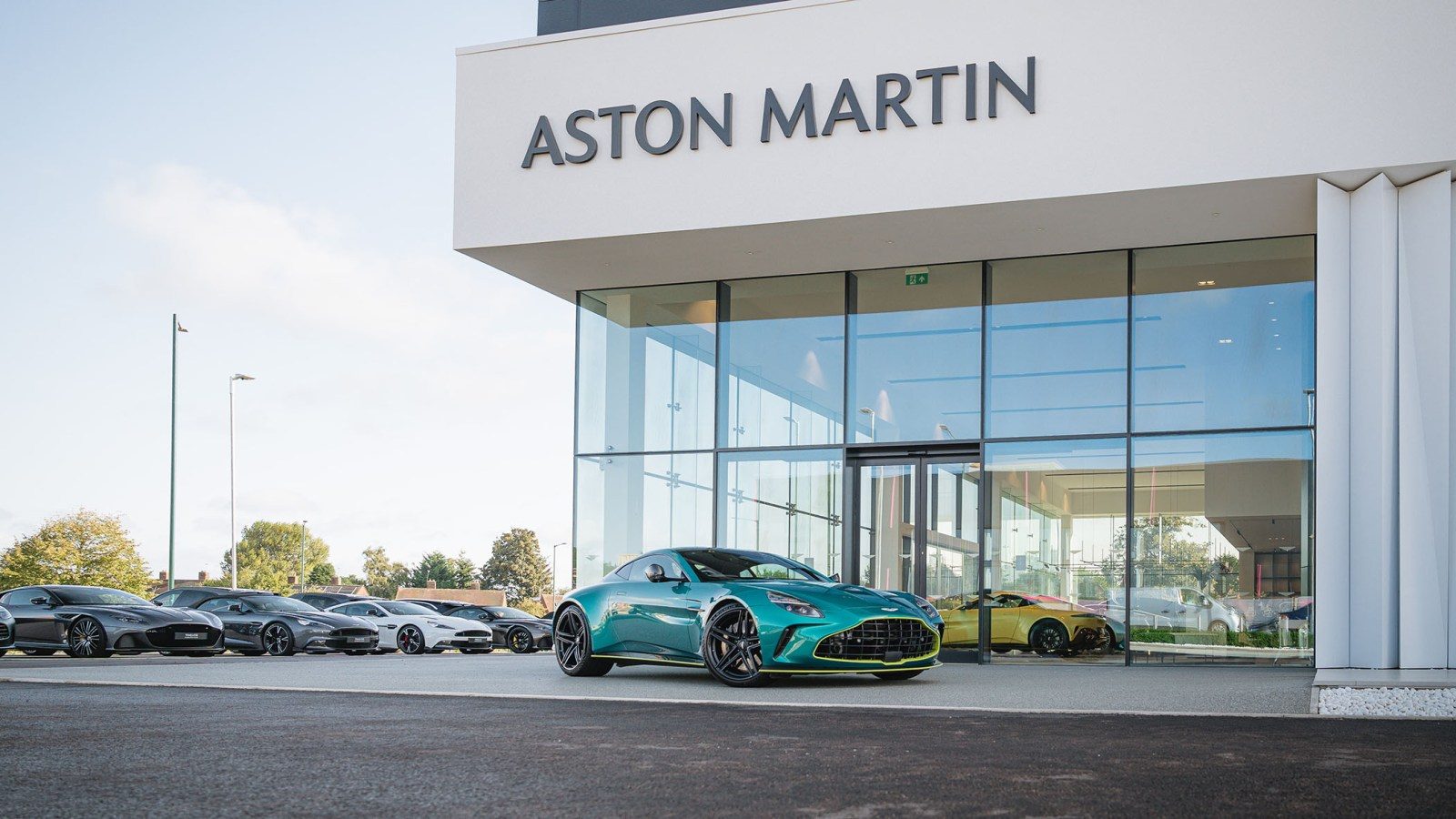
The broader lineup also includes the Vantage sports car and DBX707 SUV.
Aston Martin‘s electrification timeline has slipped repeatedly, however.
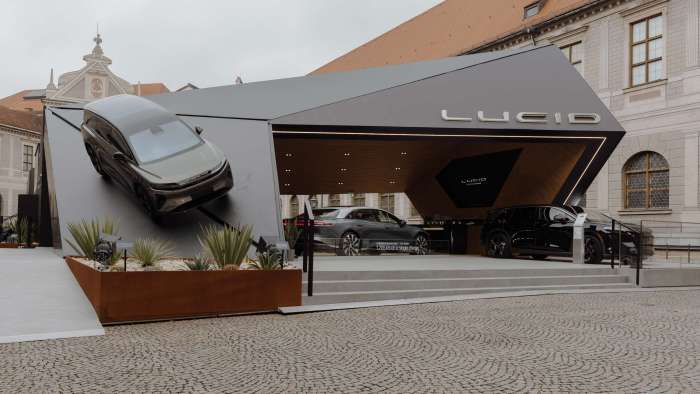
The company originally planned to launch its first fully electric model in 2025, backed by a technology partnership with Lucid worth more than $450 million for motors, batteries, and Lucid’s integrated charging unit, known as the ‘Wunderbox.’
That target was pushed to 2026, then 2027.
Most recently, Hallmark said the first battery-electric Aston Martin would arrive before the end of the decade, without committing to a specific year.
As part of the February restructuring, the company trimmed its five-year capital expenditure plan by 15% — from £2 billion to £1.7 billion — by deferring EV investment.
Lucid Deal Uncertain
Cantor Fitzgerald removed the projected revenue from the Aston Martin technology deal from its Lucid Motors’ financial model earlier this year, signalling growing doubt that the partnership will generate near-term returns.
The two companies share a common backer in PIF.
The Saudi sovereign wealth fund holds more than 20% of Aston Martin — a stake that was increased in late 2023 through shares awarded to Lucid, which received a 3.4% holding in the British carmaker as part of the agreement.
PIF also controls more than 50% of Lucid, having committed roughly $9.5 billion to the EV maker since 2018.
Both PIF-backed companies are under financial pressure.
Lucid’s market capitalisation has fallen to about $2.5 billion — roughly a quarter of the fund’s cumulative investment — and the company has said it will need to raise additional capital before reaching profitability.
Peter Rawlinson, the former Lucid CEO who spearheaded the Aston Martin deal, left the company in February 2025.
Hallmark has said plug-in hybrids using Mercedes-AMG V8 engines will serve as the bridge to full electrification.
Stroll, in the meantime, has indicated the company intends to sell combustion, hybrid, and electric models into the 2030s.