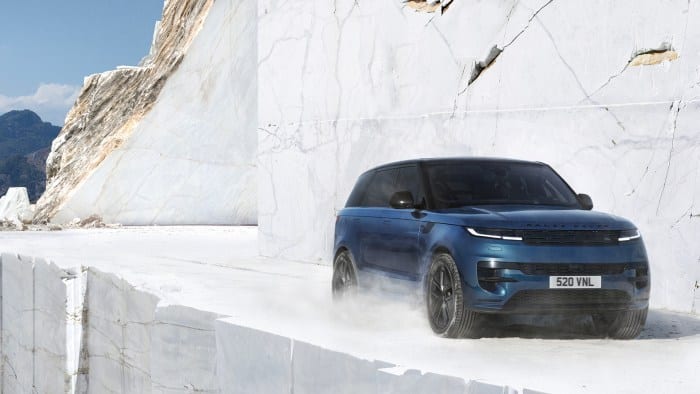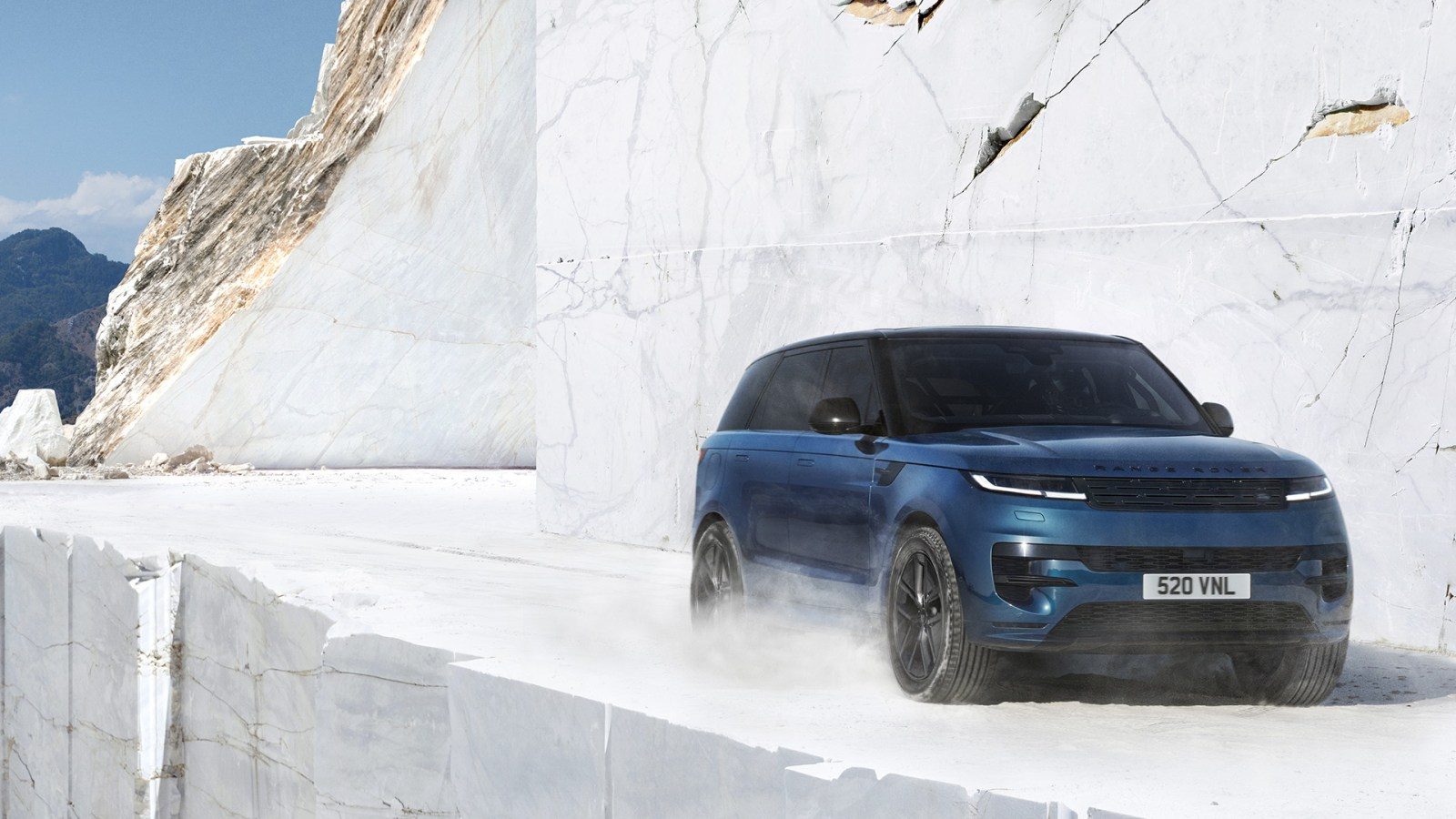

Jaguar Land Rover opened orders for the Range Rover Sport Electric on Wednesday, four weeks after it began taking orders for the larger Range Rover Electric, the brand’s first fully electric model.
The Sport Electric uses the same 118.5 kWh lithium-ion battery, two 260 kW motors and 800-volt architecture as the Range Rover Electric, with up to 550PS and 850Nm of torque.
JLR quotes a WLTP range of up to 378 miles, or 609 km, six miles more than the Range Rover Electric’s 372 miles.
The two SUVs arrive two years behind the timetable JLR set in 2021, when it said the first of six all-electric Land Rover variants would arrive in 2024.
Priced Below the Petrol V8
The Sport Electric starts at £109,810 ($146,000) in the UK for the Dynamic SE. The Autobiography costs £122,780 ($163,300) and the First Edition £126,290 ($168,000).
That puts the entry model £44,260 below the £154,070 ($204,900) Range Rover Electric and £11,460 below the petrol P540 Range Rover Sport, which PistonHeads put at £121,270 ($161,300).
JLR’s release did not give prices. It lists four versions, Dynamic SE, Dynamic HSE, Autobiography and First Edition.
The First Edition comes in Zadar Grey with a satin wrap, a black contrast roof and 22-inch wheels.
Same Pack, Different Tune
The Sport’s torque “ramps up 50 per cent faster than Range Rover Electric,” JLR said.
Its body structure is 61% stiffer and its centre of gravity 73 mm lower than the plug-in hybrid Range Rover Sport, according to the company.
In Dynamic Launch Mode it reaches 60 mph in as little as 4.3 seconds, matching the V8-powered P540 Range Rover Sport.
It comes with electronic Active Roll Control, which JLR says can apply up to 1,400Nm of force on each axle, as well as twin-valve dampers and all-wheel steering.
JLR quotes the same real-world range of up to 333 miles as for the Range Rover Electric.
It can add 220 km of range in as little as 10 minutes on a DC charger, or go from 10% to 80% in around 22 minutes, the company said.
The SUV can wade through up to 900 mm of water and climb 45-degree slopes, JLR said. JLR finished the test program in the Carrara marble quarries in Italy, after work at the Magarigawa Club track near Tokyo.
Built in Solihull
The Sport Electric will be built at Solihull on the same lines as the plug-in hybrid, petrol and diesel versions.
The Range Rover Electric’s battery packs and drive units come from JLR’s Electric Propulsion Manufacturing Centre in Wolverhampton.
JLR said it developed the two electric models in parallel.
Building both EVs on the MLA-Flex architecture alongside combustion models is what JLR calls its “flexible propulsion strategy,” which lets it shift output between powertrains on the same lines.
A Slower Electric Timetable
The launches come more than five years after JLR set out its “Reimagine” plan in February 2021.
That plan said Jaguar would become “a pure electric luxury brand” by the middle of the decade and that Land Rover would introduce “six pure electric variants” within five years, the first in 2024.
JLR expected around 60% of Land Rovers sold by 2030 to have “zero tailpipe powertrains,” alongside 100% of Jaguars.
In April 2023 it committed to invest £15 billion ($20 billion) over five years and said pre-orders for the first electric Range Rover would open later that year.
It also said the first model on its new all-electric EMA platform would come “from the Range Rover family, launching in 2025 and built at Halewood.”
That model is now the Range Rover GT, due in 2027.
JLR’s current wording is narrower.
“Before the end of the decade our brands will each have a pure electric model, while Jaguar will be entirely electric,” it said around its investor day in June, adding that it will “continue to offer hybrid and ICE vehicles.”
Jaguar’s first model under the relaunch, the Type 01 four-door GT, was also scheduled to be unveiled this year.
A Year Late
The electric Range Rover reached order books about a year later than JLR had planned.
A cyberattack halted JLR’s global production for about five weeks in autumn 2025, and US import tariffs added to the pressure.
The program also went through an “18-month re-engineering” after JLR replaced the original front induction motor, which was “prone to overheating” in desert testing, with a permanent-magnet unit, Auto Express reported.
The launches come as the Tata Motors-owned carmaker runs a voluntary redundancy program for salaried staff that reports put at up to 4,000 jobs.
Range Rover plans a third electric model, a GT on JLR’s new Electrified Modular Architecture, to be built at Halewood from 2027.