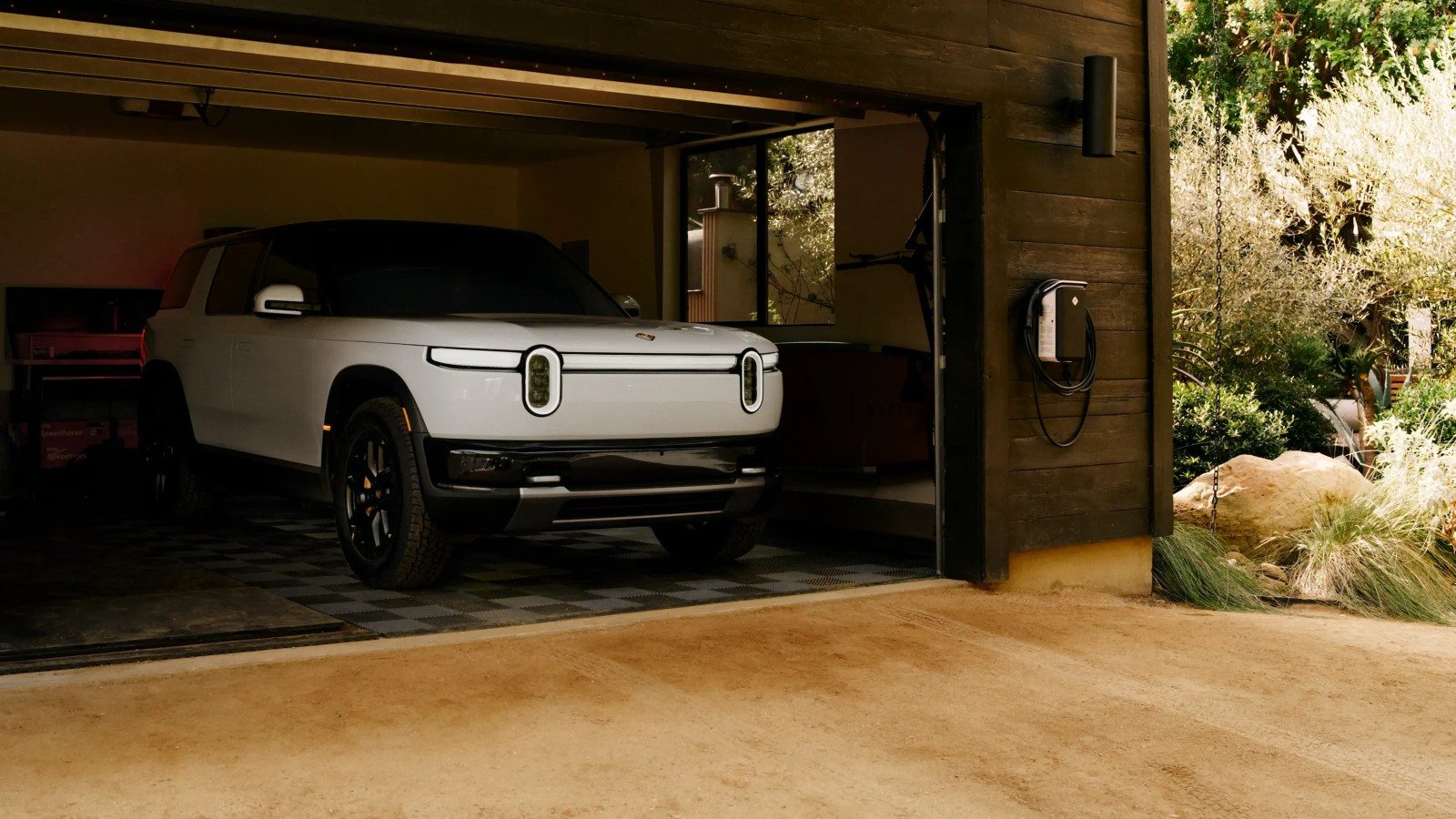

Rivian‘s R2 has half the lifecycle carbon intensity per mile of the original R1S, the company said on Tuesday, adding that it had met a target set for 2030 four years early.
The R2 Performance with Launch Package accounts for 211 grams of carbon dioxide equivalent per mile over an assumed life of 200,000 miles and 10 years, according to Rivian’s first carbon footprint report for the midsize SUV.
That is 50% below the R1S Launch Edition, the baseline Rivian set when it announced the goal in its 2022 Impact Report.
The goal is measured per mile, not in total emissions.
“In our 2022 Impact Report, we set an ambitious benchmark: to launch a vehicle by 2030 with half the life cycle carbon footprint of our R1 Launch Edition,” the EV maker says in the report. “The R2 Performance with Launch Package meets that goal four years early. “
The comparison is not on equal terms. The R1 Launch Edition was assessed over 155,000 miles. Measured over that distance, the R2 comes in at 242 grams per mile, a 43% reduction, according to a footnote in the report.
Assuming a longer life spreads the emissions from building the car over more miles, which lowers the per-mile figure.
Rivian lists the “extended durability target” among the drivers of the reduction. The others are energy efficiency, aerodynamics and rolling resistance, in-house drive units, software updates, and more recycled content with better material use.
“While some of the carbon footprint reduction stems from the smaller size, R2 boasts a number of design and supply chain optimizations that account for the majority of this improvement,” Rivian said in the report.
The company published the report alongside its 2025 Impact Report.
Where the Emissions Come From
Over its assumed life, the R2 accounts for 42.2 metric tons of carbon dioxide equivalent, according to the report’s detailed breakdown.
Charging makes up 21.2 tons, or half the total. Materials other than battery cells account for about 9.2 tons and battery cells for 5.2 tons.
Factory production adds 3 tons, maintenance 2 tons, logistics 1.3 tons and end-of-life processing 0.3 tons.
The charging figure assumes the average US grid, improving 3% a year. It also counts Rivian’s renewable matching programs as zero-carbon.
Those programs cover the first charge at the factory, the first 10,000 miles of driving, and charging on the Rivian Adventure Network. The network accounts for nearly 3% of owners’ charging, the report said.
The resulting carbon intensity of the R2’s charging electricity is 317 grams per kilowatt-hour.
Charged only with renewable electricity, the R2’s footprint falls to 111 grams per mile, 47% below its grid-charged figure.
Where an owner charges matters more than any other variable. Depending on the regional grid, the footprint can vary by nearly 50%, Rivian said.
Rivian also estimates that moving home charging to cleaner off-peak hours can cut charging emissions by as much as 28%. That benefit is not in the 211-gram figure, because the model uses annual average grid factors.
The R2 becomes cleaner than the average 2023 gasoline vehicle after 20,000 to 25,000 miles, based on a study Rivian conducted with the University of California, Davis.
Battery Details
Battery cells are the largest single source of the R2’s production emissions, Rivian said.
The report’s disclosure section lists nickel-cobalt-manganese-aluminum cells with 92 kilowatt-hours of gross capacity and 87 kilowatt-hours usable.
The cells carry a production footprint of 60 kilograms of carbon dioxide equivalent per kilowatt-hour. Rivian called that “a significant reduction” from the cells in its R1 Launch Edition vehicles.
It said it targeted three emission hotspots: lithium production, synthetic graphite production and cell manufacturing.
The cells weigh about 350 kilograms, 16% of the 2,240 kilograms of material listed in the disclosure.
The assessed version has 656 horsepower and 609 lb-ft of torque, and accelerates from 0 to 60 mph in as little as 3.6 seconds.
On 21-inch all-season tires it has an EPA-estimated range of 330 miles and an efficiency of 268 watt-hours per mile. Other wheel and tire setups are rated from 307 miles.
Over 200,000 miles, the R2 uses about 67 megawatt-hours of electricity, according to the disclosure. The main text of the report puts it at roughly 70.
A Quarter Recycled
More than 550 kilograms (1,200 pounds) of the R2, a quarter of its mass, is recycled or bio-based material.
Steel makes up 42% of the vehicle’s mass, with 36% recycled content. Aluminum makes up 12%, with 44% recycled content. Polymers are 20% of the mass, with 21% recycled or bio-based content.
Those levels remain well short of Rivian’s 2030 targets of 70% recycled content in steel and aluminum and 40% in polymers.
Rivian said its figures are conservative. Polymer parts without supplier data are counted as 0% recycled.
Some parts go much further. The main flooring face is 99% recycled ocean waste, and the interior textiles are 99% recycled content.
The front trunk trim and wheel arch liners are 85% post-consumer recycled material. The brake calipers are 93% recycled steel and iron, and the roof applique is 93% post-industrial waste.
The drive units contain 68% recycled aluminum and 41% recycled steel, and the tires are 40% bio-based and recycled material.
A New Metric
Rivian also introduced a measure it calls Raw Material Extracted (RME), which estimates how much material is dug or drilled out of the ground to make the car.
For the R2’s steel, aluminum and polymer parts, the figure is 13.1 metric tons. A hypothetical R2 made only from virgin materials would require 19.9 tons, so the difference is close to 7 tons, or 34%.
That works out to eight kilograms extracted for each kilogram of material, against 12 for an all-virgin supply chain. Rivian said it sees a path to four.
The company described the all-virgin case as a reference point, not a realistic industry baseline. The metric does not yet cover copper, glass or lithium.
Factory Ramp
The factory emissions in the report are based on 2025 data from Rivian’s plant in Normal, Illinois, when it was building R1 models and commercial vans.
Rivian said it cut on-site production overhead per vehicle by more than half compared with its R1 Launch Edition products. The plant generated nearly 10 million kilowatt-hours of on-site solar and wind power in 2025.
The company warned that the R2’s new platform and assembly process will raise energy overhead during the 2026 ramp-up, before volume brings it down.
Separately, Rivian’s Chief Executive Officer has said the pace of R2 output is gated by Tier 2 and Tier 3 suppliers.The R2 VIN count, tracked by owners, has passed 12,100.
Rivian is also installing more than 100 retired Rivian battery packs at Normal with Redwood Materials. They are expected to provide an initial 10 megawatt-hours of storage.
A New Disclosure Standard
Rivian said the report is the first vehicle lifecycle assessment to adopt SAE International’s new J3341 disclosure format. The report used the latest work-in-progress version of that standard.
Under SAE’s standardized scenario, which assumes a grid that is half fossil and half renewable and a 15-year life, the R2’s footprint rises to 148 grams per kilometer from 131.
Choices in methods and data can change the footprint of an electric vehicle by 50% or more, Rivian said, which is why it pushed for the standard.
In a post summarizing the 2025 Impact Report, Rivian also highlighted a 1.1 million-square-foot expansion of the Normal plant, its nearly 2,000-acre site in Georgia and 45 college and trade school partnerships.