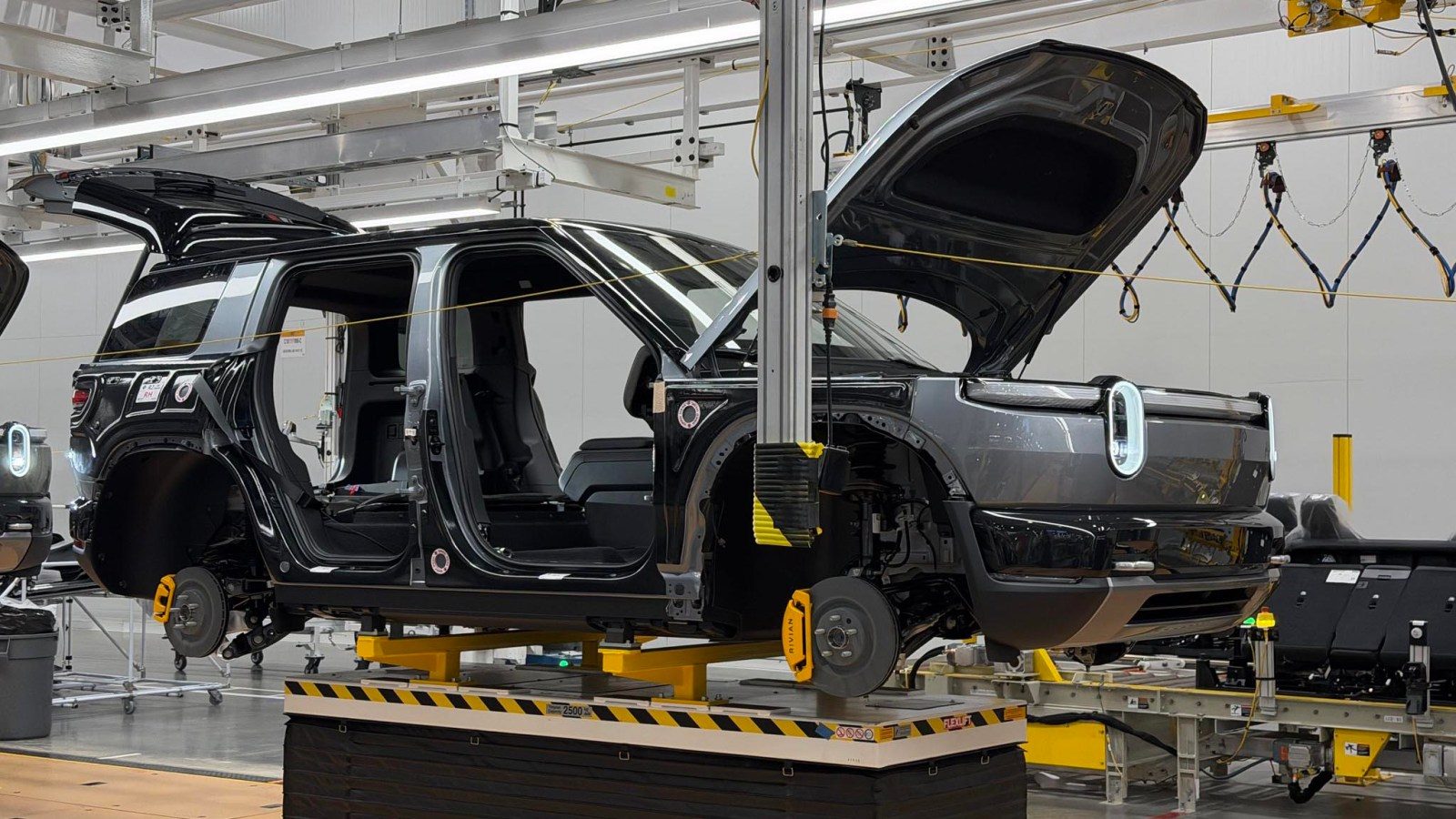

Recycled content in Rivian‘s sheet steel has fallen to 30% from 35%, a comparison of its last two vehicle carbon reports shows, even as the company said the R2 has met a 2030 goal to halve its per-mile lifecycle carbon footprint.
The R2 report, published on Tuesday, puts recycled content at 30% for sheet steel and 40% for sheet aluminum, based on feedback from suppliers.
Rivian’s Gen 2 R1S report of September 2024 gave 35% for sheet steel and 33% for sheet aluminum, from the same kind of supplier feedback.
The R2 report compares its figures only with the R1 Launch Edition, whose sheet steel and aluminum were estimated at 23% and 18%. It does not mention the fall in steel since 2024.
A 70% Target
“As outlined in our first corporate impact report, we are committed to reaching 70% recycled content in steel and aluminum and 40% recycled or bio-based content in polymers by 2030,” Rivian said in the R2 report.
“The improvements in our Gen 2 R1 lineup represent a significant step toward achieving this goal,” Rivian said in the 2024 report.
Two years later, the R2 report calls the vehicle “a significant milestone toward those goals, with high-recycled content integrated across every major system.”
“We have taken a rigorous approach to tracking and increasing the recycled content across our steel, aluminum, and polymer supply chains,” the R2 report says.
By 2030, the RJ Scaringe-founded company is expected to be selling two new passenger EV models: the R3 and the R4. Currently, Rivian offers the R1S, the R1T, and the midsize SUV R2.
Across all the steel and aluminum in the R2, weighted recycled content is 36% and 44%. The 2024 report did not publish weighted averages, so those figures cannot be compared.
The two vehicles also have different suppliers and parts, since the R2 sits on an all-new midsize platform. Rivian does not say whether the lower steel figure reflects a new supplier mix or a change at existing suppliers.
Steel Is the R2’s Biggest Material
Steel accounts for 930 kilograms, or 42%, of the R2’s mass, according to the report’s disclosure section. It is the vehicle’s largest material by weight.
Aluminum accounts for 265 kilograms, or 12%, and polymers for 445 kilograms, or 20%.
In total, more than 550 kilograms of the R2, or 25% of its mass, is recycled or bio-based material, the report says.
Rivian treats its figures as conservative. It counts recycled content only where suppliers have confirmed it, and says actual recycled content in steel and aluminum is likely higher than the report assumes. It made the same statement in 2024.
The R2 report’s assumptions for other steel and aluminum are unchanged from 2024: 12% recycled content for steel beyond sheet, 40% for cast aluminum and 35% for extruded aluminum.
Some R2 parts go well beyond the averages. The brake calipers are 93% recycled steel and iron, and the drive units contain 41% recycled steel and 68% recycled aluminum.
The hood, fenders and wheels contain at least 30% recycled content, according to the report.
Polymers moved in the opposite direction to steel. The 2024 report published no recycled-content figure for polymers, and its default table listed 0% for every polymer type. The R2 report puts recycled and bio-based content at 21%, against the 40% target.
The Headline Claim
Rivian said on Tuesday that the R2 Performance with Launch Package produces 211 grams of carbon dioxide equivalent per mile, 50% below the R1S Launch Edition, meeting its 2030 target four years early.
Rivian said some of that reduction comes from the R2’s smaller size, but “the majority” from design and supply chain changes.
That figure assumes the R2 is driven 200,000 miles. The R1 Launch Edition was assessed over 155,000 miles, and the Gen 2 R1S in 2024 over the same distance.
Over 155,000 miles, the R2 comes in at 242 grams per mile, a 43% reduction, according to a footnote in the report. On Rivian’s own figures, seven of the 50 percentage points come from assuming a longer life.
The R2 report also counts the first 10,000 miles of every vehicle as renewable, through certificates Rivian buys under a program launched in November 2024. The 2024 calculation did not include them.
The grid basis changed too. The 2024 report weighted grid emissions by where Rivian sold its vehicles, while the R2 report uses the average US grid. The report does not say how much either change lowered the result.
What Did Improve
Most of the reduction comes from the vehicle itself.
The R2’s battery cells produce 60 kilograms of carbon dioxide equivalent per kilowatt-hour, 18% less than the 73 kilograms of the Gen 2 R1S Max Pack. Cell emissions per vehicle fell to 5.2 tons, from 10.9.
The R2 uses 268 watt-hours per mile, 23% less than the R1S. It is also much smaller, with a gross vehicle weight rating of 2,800 kilograms against 3,870.
Materials other than battery cells fell to about 9.2 tons per vehicle, from 15.8.
Factory Emissions Flat
Factory emissions per vehicle barely changed, despite a fivefold increase in on-site renewable power.
Production and logistics came to 4.3 tons per vehicle in the R2 report, based on 2025 plant data, against 4.4 tons in the 2024 report, based on 2023 data.
The Normal, Illinois, plant generated nearly 10 million kilowatt-hours of on-site solar and wind power in 2025, against nearly 2 million in 2023.
The R2 report says overhead per vehicle has been cut by more than half, measured against R1 Launch Edition production in 2022.
Rivian expects the figure to rise during the 2026 R2 ramp-up, as the new platform and assembly process bring higher initial energy use.
Fewer Scenarios
The R2 report also drops the transparency matrix that anchored the 2024 report.
That table showed the R1S’s footprint ranging from 156 to 609 grams per mile, depending on test cycle, electricity grid, scope and assumed lifetime.
In its place, the R2 report uses the SAE J3341 disclosure format, which is standardized across carmakers but shows a single alternative scenario. Under that scenario, the R2’s footprint rises to 148 grams per kilometer from 131.
Both reports say choices in methods and data can change a vehicle’s footprint by 50% or more.