


Wuhan Weineng Battery Asset Co., Ltd. — the Nio Inc.-affiliated battery asset operator known internationally as Mirattery — has raised its registered capital from approximately 2.64 billion yuan to 2.81 billion yuan.
The increase of roughly 170 million yuan ($24 million) represents the latest in a series of registered capital expansions stretching back to the company’s founding,
The company is the strategic center of Nio’s Battery as a Service (BaaS) business and has recently been under focus due to a US securities fraud lawsuit filed by Singapore sovereign wealth fund GIC.
The company was established in August 2020 with founding shareholders Nio, CATL, Guotai Junan International Holdings, and Hubei Science and Technology Investment, each holding a 25% stake at launch.
The current shareholder structure, per the Tianyancha filing, includes Nio Holdings Co., Ltd., Wuhan Optics Valley Industrial Investment Co., Ltd., and CATL, among others.
Nio is the largest shareholder with 19.4%, while CATL and Hubei Science and Technology Investment each hold 10.68%.
The business scope covers electric vehicle charging infrastructure operations, battery leasing, and the recycling and cascade utilisation of used power batteries from new energy vehicles.
A Year of Capital Build-Up
When Mirattery was established in August 2020, it carried registered capital of 800 million yuan, with Nio, CATL, Guotai Junan, and Hubei Science and Technology Investment each holding 25%.
Four months later, in December 2020, the company received its first capital increase, with Shandong Weida Machinery and other investors injecting 150 million yuan to acquire 8.88% of equity.
A B-round capital expansion in 2021 lifted registered capital from approximately 1.512 billion yuan to roughly 1.833 billion yuan, with 321 million yuan in fresh capital from a syndicate that included Nio, Paradise Silicon Valley, and the Yangtze River Optics Valley New Energy Industry Investment Fund.
By the time Wednesday’s increase pushed registered capital to approximately 2.81 billion yuan, the entity had crossed three-and-a-half-fold expansion from its 2020 starting point.
Last February, Mirattery completed a 1 billion yuan ($137 million) Series C3 equity financing round, bringing total Series C funding to 2 billion yuan ($274 million) and cumulative funding to over 3 billion yuan ($411 million) across six rounds since founding.
Founding shareholders Nio and CATL both increased their investments in the round, alongside two new state-owned shareholders from Hefei — Hefei Construction Investment Holding and HETDZ Investment Promotion — and continued backing from Haining Economic Development Zone, Hainan Chengmai, and Meishan Dongpo.
The same week, Mirattery completed a 501 million yuan ($73.3 million) asset-backed securities issuance — described as the world’s first holding-type power battery REITs — through CITIC Securities and the Shanghai Stock Exchange.
In November last year, the company completed a 670 million yuan ($98.1 million) Series C round, expanding to nearly 1 billion yuan one month later as additional state-owned enterprises joined as shareholders.
In March, Mirattery’s Hainan-based subsidiary Weineng (Chengmai) Battery Technology Co., Ltd. raised its registered capital by approximately 733%, moving from 60 million yuan to 500 million yuan ($72.7 million).
That subsidiary is wholly owned by Wuhan Weineng and benefits from Hainan’s free trade port designation, which provides favourable tax and regulatory treatment.
In May 2025, Weilan (Shanghai) Battery Technology Co., Ltd. — wholly owned by Wuhan Weineng — tripled its registered capital from 500 million yuan to 1.5 billion yuan ($219.6 million).
In October 2025, Mirattery established a new subsidiary, Weineng (Wuhan) Battery Technology Co., Ltd., with 100 million yuan in registered capital, focused on battery leasing, recycling, secondary utilization of retired power batteries, and EV charging operations.
The cumulative effect of these moves has been to build out a multi-tier corporate structure with Wuhan Weineng as the holding entity, multiple operational subsidiaries across mainland China, and accelerating capital flows from both Nio and CATL at every level.
The Operating Backbone of BaaS
Mirattery aims to support Nio’s Battery-as-a-Service model, launched in August 2020.
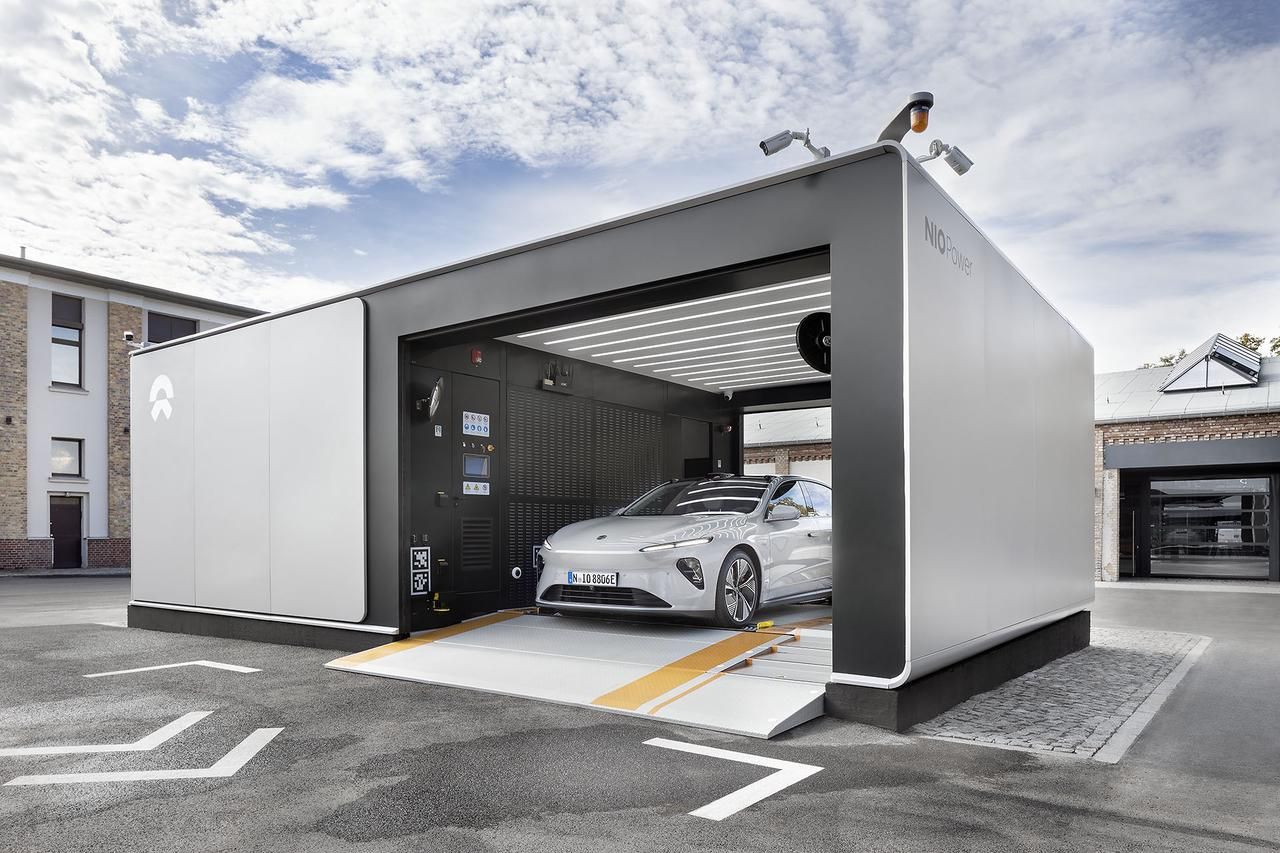
Under BaaS, customers can purchase a Nio vehicle without the battery pack and lease it separately from Mirattery for a monthly fee, with access to charging, swapping, and battery upgrades.
Nio sells the battery packs to Mirattery, which then leases them to end customers.
The operational scale has grown rapidly.
Mirattery surpassed 20 GWh in managed battery assets in late 2023 and 30 GWh by November 2025.
As of the February Series C3 announcement, operational capacity exceeded 42 GWh, serving more than 550,000 users in China.
By the end of January, the company had filed 181 patent applications, with over 85% related to battery technology.
Nio’s battery swap network now comprises nearly 3,900 swap stations across China, alongside roughly 5,000 charging stations and access to 1.57 million third-party charging piles.
The company set a single-day battery swap record of 146,649 swaps earlier this year.
In March, Wuhan Weineng signed a 9.8 billion yuan ($1.4 billion) battery infrastructure project agreement in Wuhan’s Optics Valley, aimed at scaling battery asset management, application technologies, and commercialization to support BaaS users.
The CATL Deepening
The structural relationship between Nio and CATL has deepened materially over the past year.
In March 2025, CATL committed to invest up to 2.5 billion yuan ($362 million) in Nio Power, Nio’s energy and battery-swap business, with a stated goal of building a unified national swap network and developing shared industry standards.
A Reuters report in April 2025 indicated CATL was in talks to acquire a controlling stake in Nio Power, prompting Nio to respond that the two companies would “deepen collaboration on capital and business” while declining to confirm the controlling-stake claim.
In July 2025, Mirattery signed a new strategic cooperation agreement with CATL covering equity investment, battery rental services, user operations, co-construction of battery swap networks, and battery recycling.
The companies did not disclose how much CATL increased its stake under that agreement.
CATL has separately been pushing its proprietary battery swap technology, branded “Chocolate Swap,” with standardized 20# and 25# modules introduced in December 2024 to enable cross-brand compatibility.
The Mirattery vehicle gives CATL direct exposure to the operational economics of swap-station-based battery management, sitting alongside its consumer-facing Chocolate Swap effort.
The GIC Lawsuit
Mirattery sits at the center of the most significant active legal challenge facing Nio.
In August 2025, GIC filed a securities fraud lawsuit against Nio, Chief Executive William Li, and former Chief Financial Officer Steven Feng in the US District Court for the Southern District of New York.
The complaint alleges that Nio “unlawfully” recognized over $600 million in leased battery revenue through Mirattery in fiscal year 2021 alone, and that the practice extended over the 2020-2022 period.
The lawsuit became public late last year, sending Nio’s Hong Kong-listed shares down more than 9% on the disclosure.
GIC’s complaint argues that Mirattery — described as “superficially independent” — was effectively under Nio’s control, with Nio installing senior managers at the affiliate to ensure it acted in Nio’s interests.
The complaint claims Nio booked the full sale price of batteries transferred to Mirattery as immediate revenue, despite GAAP requiring revenue recognition over the five-to-six-year lease term.
GIC also notes Mirattery’s asset-to-liability ratio was 0.36 as of December 31, 2021, arguing the affiliate was financially incapable of paying Nio yet Nio still booked the revenue.
The allegations echo claims first raised by short-seller Grizzly Research in June 2022.
Nio has rejected the lawsuit.
The company stated that the allegations “are not new events” and had previously been investigated and clarified.
A source close to Nio cited by Yicai noted that the company’s accounting treatments and disclosures, as a triple-listed entity in New York, Hong Kong, and Singapore, have been reviewed by regulators in all three jurisdictions, with comprehensive BaaS disclosures during the Hong Kong listing process.
Nio confirmed the lawsuit in a Form 6-K filing with the US Securities and Exchange Commission in September 2025, noting the GIC case is related to the pending class action.
GIC was an early Nio backer, participating in the company’s Series C round in March 2017 alongside Tencent, Baidu, TPG, and Hillhouse Capital.
The fund alleges it suffered losses on 54.5 million American Depositary Shares purchased between August 2020 and July 2022.


