
Citi raised its price target on Nio on Friday, extending its bullish stance on the Chinese EV maker even as the stock fell in the wake of its first-quarter results.
Analyst Jeff Chung lifted the target on the US-listed shares to $8.20 from $7.60 and on the Hong Kong-listed shares to HK$62.90 from HK$58.60, maintaining a Buy rating.
The new US target implies upside of about 46% from Thursday’s closing price of $5.60.
The raise did little to support the stock.
Nio‘s US-listed shares were trading 6.07% lower at $5.27 as of publication time in Friday’s pre-market session.
The Hong Kong-listed shares edged 0.4% lower on Friday, closing at HK$42.78.
The decline followed a volatile session on Thursday, when the stock reversed sharply during the earnings call after management warned of rising raw-material costs.
Trading volume was heavy. More than 101 million US-listed shares changed hands on Thursday, around 249% of the 65-day average of roughly 40.55 million.
A Pattern of Conviction
Citi is one of the most consistently bullish major banks covering Nio.
Chung has held a Buy rating since upgrading the stock from Neutral in June 2021, nearly five years of uninterrupted conviction through a stock-price decline of more than 90%.
Nio‘s U.S.-listed shares reached their all-time high in January 2021 at $66.99.
Friday’s raise builds on a move in mid-April, when Citi lifted its target for the first time in nearly seven months.
That revision took the Hong Kong target up 23.9% to HK$58.60 from HK$47.30, the first upward move since September 2025 and a reversal of three consecutive cuts.
The April raise came days after Nio pre-launched its new flagship ES9 SUV and filed an annual report disclosing it had cut more than 10,000 jobs in 2025.
What Changed
The latest raise follows a stretch of improving fundamentals.
Nio posted its first-ever quarterly GAAP profit in the fourth quarter of 2025 and reported revenue growth of 76% year over year that period.
In the first quarter of 2026, the company posted a narrow loss while staying profitable on an adjusted basis, with deliveries of 83,465 vehicles, a record for the period.
Vehicle margin reached 18.8%, improving for a fourth consecutive quarter, and the average selling price climbed on a richer product mix.
Net current assets turned positive as cash rose to $7 billion.
The workforce shrank by more than 10,000 people in 2025, the annual report showed, ending the year with 35,032 full-time employees, down from 45,635 a year earlier.
Cost discipline, product-mix improvement and the digestion of prior battery and semiconductor inventories have all contributed to margin expansion.
Nio was not the only bank to move.
On Friday, China International Capital Corporation raised its Nio target by 23% to HK$61.5 and $8.00 for the US-listed shares, citing a robust pipeline following the pre-launch and pre-order opening for the ES9.
Citi’s Core Thesis
Across more than a dozen notes over the past two years, Chung’s thesis has rested on volume growth through Nio‘s multi-brand strategy.
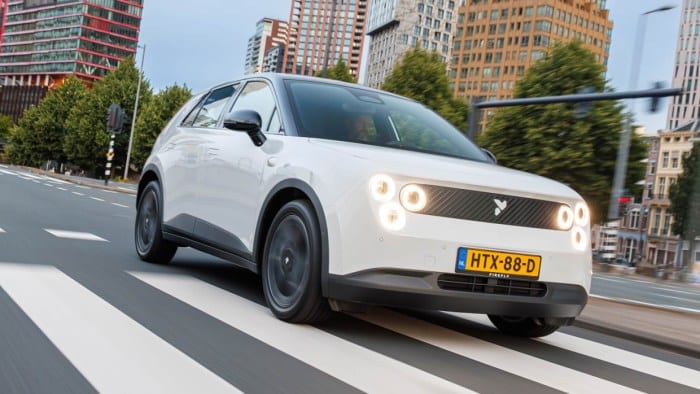
The company operates three brands, the premium Nio line, the mass-market Onvo and the compact Firefly, spanning price segments from roughly 100,000 yuan to above 700,000 yuan.
Chung’s 2026 sales estimates have ranged from 456,000 to 600,000 units, depending on launch timing and order momentum.
Nio‘s official full-year target ranges between 456,000 and 489,000 units, representing growth of 40% to 50% from 2025.
On the call this week, management voiced confidence in ES9 demand as pre-orders accelerated ahead of the model’s May 27 launch.
The ES9 begins deliveries that day, the first of several launches Nio expects to drive a steep second-quarter ramp.
The company guided second-quarter deliveries to between 110,000 and 115,000 vehicles, up 52.7% to 59.6% year over year.