
Written by Cláudio Afonso | LinkedIn | X
U.S.-listed electric vehicle (EV) stocks continued to decline early Monday morning following a much weaker-than-expected U.S. jobs report that sank the stock market on Friday.
On Monday morning, and as of the time of writing, Dow Jones Industrial Average futures are falling 663 points, or 1.66%. S&P 500 futures and Nasdaq-100 futures are falling 2.91% and 5%, respectively. Japan’s benchmark index Nikkei is having its worst day since 1987 loosing 12.40%.
On Friday, the 10-year Treasury yield tumbled 3.79% to its lowest point since December, and the Nasdaq capped a third straight week of losses, bringing the tech-heavy index down more than 10%.
Friday’s sell-off pushed the Nasdaq into correction territory, down more than 10% from an all-time high set in mid-July.
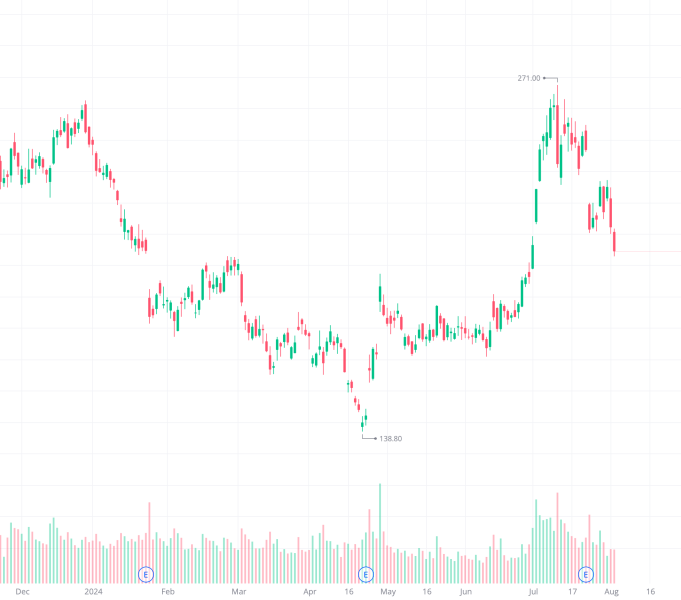
Tesla shares closed 4.24% lower on Friday at $207.67, while Ford’s stock dipped 6.17% to $10.03 per share. The stock of the EV leader, which has been very volatile this year, declined 5.52% last week and 17.43% over the past month.
Also, shares of the U.S. EV startups such as Rivian, Lucid declined 3.41% and 4.59%, respectively.
Both companies will report their second quarter earnings results over the next 48 hours with Lucid reporting on Monday afternoon and Rivian following 24 hours later.
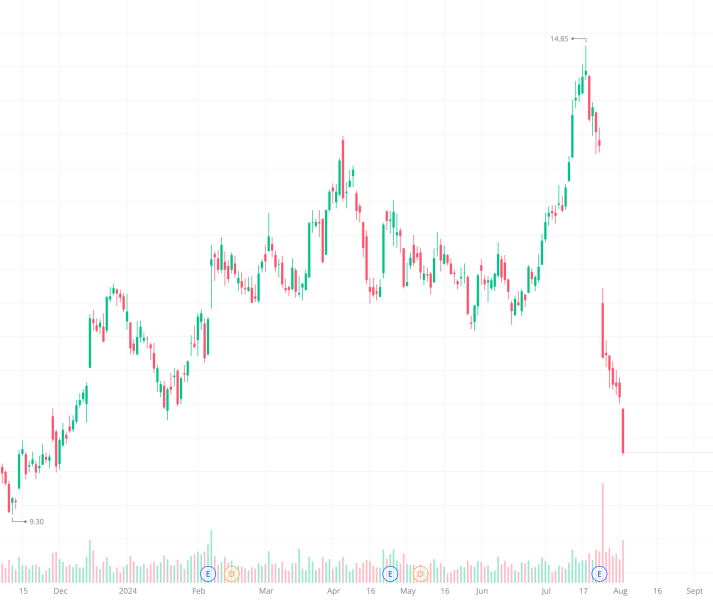
Ford’s stock experienced a steep decline of 32% from recent highs of $14.85 per share after reporting a second-quarter operating profit of $2.8 billion, down 26% year over year from $3.8 billion.
On the day after reporting its earnings, the stock plunged nearly 20%, the worst single-day stock decline since 2008.
Polestar, the EV brand backed by China’s Geely Holding Group, reached on Friday a new all time low at $0.642 per share resulting in a market cap of just $1.46 billion.
The company led by Thomas Ingenlath has been under big pressure as it recently announced accounting errors in its financial reports causing a further decline on the stock to non-compliance values — under the Nasdaq listing threshold of $1 per share.

Additionally, earlier this year, Volvo decreased its stake in the company. Polestar delivered “approximately 13,000 cars” in the second quarter of the year shortly before switching the business model from direct sales to a dealership model which allows the company to reduce costs.
Among the Chinese EV makers, Nio saw its stock decline by 8.58% last week and 12.34% over the past month, according to data from MarketWatch.
The Shanghai-based company will deliver the first vehicles under its sub-brand Onvo between the last days of September and the first days of October.
Here’s the recent performance of some of the US listed EV stocks.
| Company | Last Week Performance | 1 Month Performance |
|---|---|---|
| Tesla | -5.52% | -17.43% |
| Ford | -10.37% | -21.88% |
| Rivian | -9.19% | -0.47% |
| Lucid Motors | -7.69% | 6.48% |
| Polestar | -8.91% | -29.06% |
| Nio | -8.58% | -12.34% |
| XPeng | -11.16% | -4.55% |
| Zeekr | -11.30% | -14.76% |
Priced below the Tesla Model Y in China, investors see it as a major catalyst to allow Nio to surpass 30,000 monthly deliveries. In July, the company delivered over 20,000 units for the third consecutive month.
XPeng’s stock dropped by 11.16% last week and 4.55% over the past month as it prepares to start delivering its recently unveiled new entry-level model M03. The company deliveries continued to rebound last month with 11,145 units after a weaker than expected start of the year.
The recently IPOed Zeekr, another Chinese EV manufacturer, posted the steepest declines among its peers, with an 11.30% droplets week and a 14.76% decline over the past month.
Written by Cláudio Afonso | LinkedIn | X