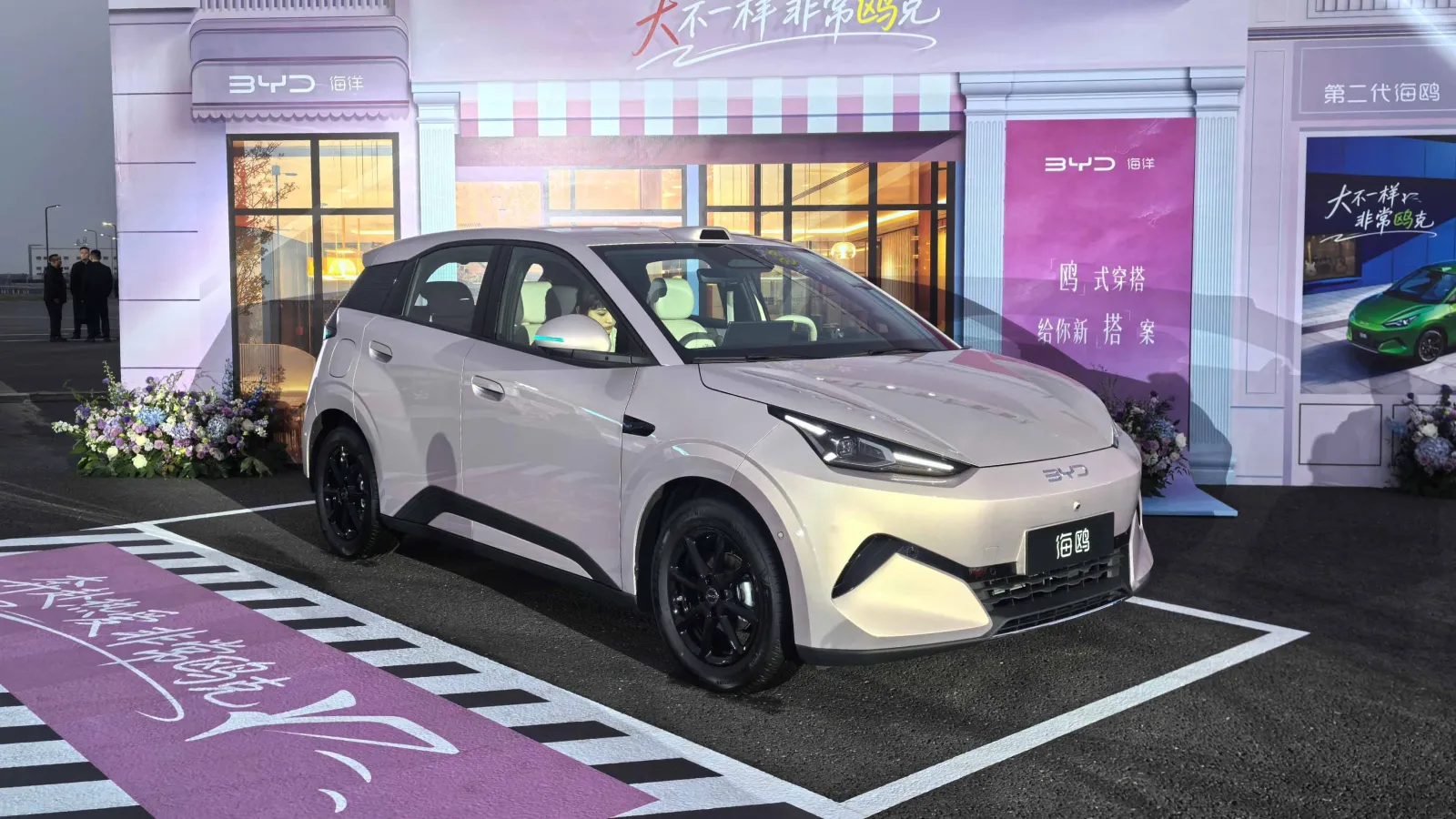
China’s Commerce Minister Wang Wentao discussed EVs with UK Business Secretary Jonathan Reynolds in a video call on Wednesday, Beijing said, weeks after it warned London of “firm countermeasures” if Britain restricts Chinese EVs.
The call was held at Reynolds’ request, China’s Ministry of Commerce said in a one-sentence statement on Thursday. The two sides “exchanged views on economic and trade issues of mutual concern, such as electric vehicles,” it said.
The ministry gave no details of either side’s position on EVs and did not mention tariffs, policy changes or any agreement. The Department for Business and Trade had not published its own account of the call on its website as of Thursday.
The brevity contrasts with the ministry’s account of the two men’s first call on July 28, shortly after Reynolds took up his post. That readout set out both sides’ positions, including Wang’s concern over Britain’s nationalization of Chinese-owned British Steel and Reynolds’ pledge that London would abide by an independent valuation and pay reasonable compensation.
The call comes nine days before Britain and the European Union hold a summit in Brussels on November 20, where London is seeking access to the bloc’s “Made in Europe” program and the EU has pressed it to align with its duties on Chinese EVs.
Beijing’s Warning
China’s Ministry of Commerce warned Britain on October 19 that it would retaliate if London restricted Chinese EVs.
“China urges the UK to abide by World Trade Organization rules, think twice before acting, and not dance to the EU’s tune,” a ministry spokesperson said in response to a reporter’s question.
“China will closely monitor the UK’s moves, and if the UK insists on taking restrictive measures against Chinese electric vehicles, China will take firm countermeasures to safeguard the legitimate rights and interests of China’s industry,” the spokesperson added.
The statement followed remarks by Anas Sarwar, a Minister of State at the Department for Business and Trade, who told Politico on October 15 that “the more that the UK and the EU work together and act in lockstep, the better it is for both.”
China’s embassy in London had earlier said it “has expressed serious concern to the UK side” about reports that Britain was considering tariffs, and that it “consistently and firmly opposes” discriminatory tariffs or restrictions on Chinese products.
Reynolds Open to Talks
Reynolds has said the decision will rest on British interests, not on pressure from Brussels.
Speaking to Parliament’s business committee on October 20, he said he was open to discussing tariffs on Chinese-made vehicles with European counterparts. “I’m certainly willing to talk,” he said, adding that any trade defense decision would be taken “because I deem that to be in the interests of the UK.”
Earlier in October, he told The Guardian during a trade visit to India that such a decision was “based on the UK interest, it’s not based on any other country asking for that.” He also noted that the British auto industry is “an export-led sector, so that’s what I’ve got to take into account.”
The Times reported on October 4 that Reynolds was drawing up a package of potential tariffs and that ministers were prepared to match the EU’s levy. The government said only that it continued “to engage closely with industry” and that no tariffs had been imposed.
The EU Lever
The Financial Times reported in September that the EU had asked Britain to raise its tariffs on Chinese EVs as a condition of closer trade coordination, linking the request to the Industrial Accelerator Act.
Its “Made in Europe” rules would reserve some public procurement and subsidies for products with 70% of their content from inside the bloc. Prime Minister Andy Burnham has said he would argue for Britain to be treated as a “trusted partner” under those rules.
France and Germany agreed on October 16 on a plan that would open the scheme to non-EU partners such as Britain only if they accepted “dynamic alignment” with EU conditions for third-country investment and with EU trade protection measures, according to reports of the deal. Those measures include the bloc’s duties on Chinese EVs.
London faces a second deadline. Stricter battery rules of origin under the EU-UK trade agreement take effect on the first day of 2027 and would put a 10% tariff on most electric cars traded between the two sides unless they are delayed.
The EU has applied countervailing duties on Chinese-built battery-electric cars since October 30, 2024, ranging from 7.8% for Tesla to 35.3% for SAIC, on top of the standard 10% import duty. That takes the highest combined rate to 45.3%.
Britain’s Open Market
Britain did not follow the EU in 2024 and has since become the fastest-growing European market for Chinese brands.
Chinese brands accounted for 81,776 of the 350,536 cars registered in the UK in September, or 23.3%, up from 12.4% a year earlier, according to a tally of SMMT data. BYD ranked second among all brands that month, and the Chery group third.
The trend continued in October. BYD registered 6,065 cars in the UK, up 73.3% from a year earlier, and Chery’s Jaecoo brand 6,089, up 113.6%, SMMT data show. SAIC’s MG added 7,837, up 85.1%, Chery-badged cars 3,707 and Omoda 3,137.
Together, the five brands took 17.6% of a market that grew 5.4% to 152,730 cars, with battery-electric models at 32.0%. BYD has registered 74,470 cars in Britain this year, up 90.5%.
Chery’s Jaecoo 7 was again Britain’s best-selling car in October, with 3,412 registrations. The model is sold with petrol and plug-in hybrid powertrains, so a copy of the EU’s measure, which applies only to battery-electric cars, would not affect it.
On the other side of the ledger, Britain exported about 35,000 cars to China in 2025, or 6.3% of its car exports, SMMT data show. The exposure that most concerns London is Jaguar Land Rover, which sold 62,400 cars in China in its last financial year.
China opened investigations into European brandy, pork and dairy after the EU imposed its EV duties in 2024.
Reform UK has called for tariffs. “We need a 100% tariff on Chinese electric vehicles and a government that puts British jobs, workers and manufacturers first,” Deputy Leader Richard Tice wrote on X on September 15.
Reform’s Robert Jenrick wrote on October 5 that the party would “use tariffs in the short run to protect against Chinese dumping, while reforming energy policy and abolishing electric car mandates.”