
Entry-level EVs in Canada have crossed below the C$30,000 threshold for the first time, as established automakers stack their own discounts atop Ottawa’s revived federal rebate to fortify the segment ahead of Chinese arrivals expected later this year.
Factory incentives — both cash and non-cash — averaged C$11,000 to C$13,000 per Canadian EV between January and March, according to J.D. Power Canada figures cited by Automotive News Canada.
The manufacturer discounts come on top of Ottawa’s federal rebate of up to C$5,000, which returned in February under the Electric Vehicle Affordability Program for vehicles transacting below C$50,000.
Quebec residents pick up an additional C$2,000 through the provincial Roulez vert programme.
The combined effect has produced a tier of EVs starting between C$35,000 and C$40,000 — and one model now available for under C$30,000 before tax.
Robert Karwel, who heads OEM solutions at J.D. Power Canada, told Automotive News Canada that automaker incentive spending surged after Ottawa’s previous rebate scheme exhausted its funding in January 2025.
The reintroduced federal programme has not prompted manufacturers to scale back their own support.
“It’s creating a situation where we’re pricing down and the Chinese are going to have to react to that when they get to the marketplace,” Karwel said.
The Sub-C$30,000 Anchor
The vehicle-level pricing figures below were compiled by Automotive News Canada using J.D. Power Canada incentive data.
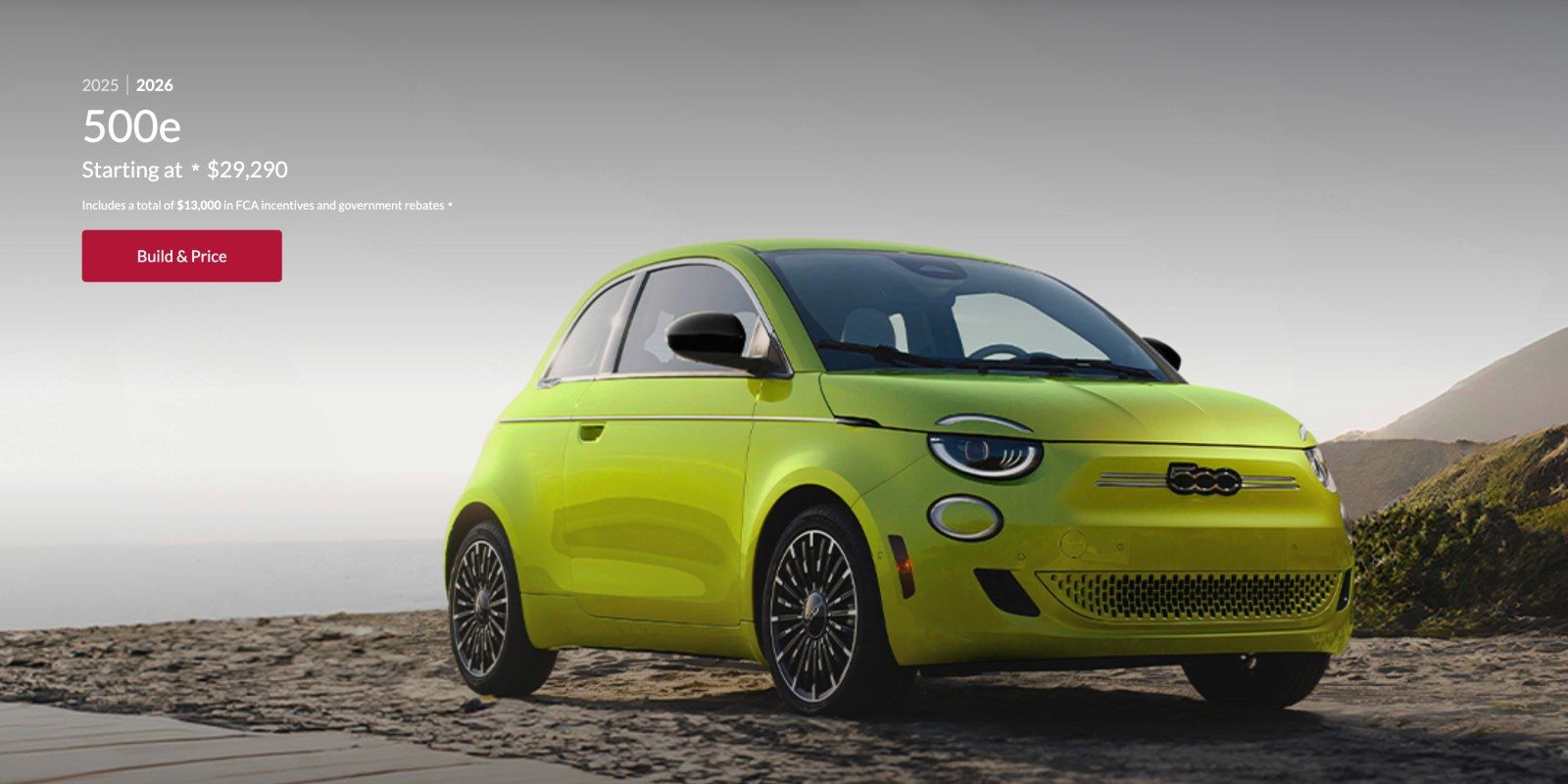
The Fiat 500e currently leads the Canadian price chart at C$29,865 with C$2,195 in delivery included.
The compact city car carries C$8,000 in factory support alongside the federal rebate.
A short-range version of the 2026 model is scheduled for Canadian launch this summer, with leases available below C$300 monthly.
The federal rebate functions differently from the manufacturer discount: it applies to the post-tax purchase price, producing an effective pre-tax reduction of C$4,425.
Four additional models have starting prices below C$40,000.
The Chevrolet Bolt comes in at C$35,019 with C$2,600 in delivery, supported by C$4,000 from General Motors and the federal rebate.
The Subaru Uncharted lands at C$36,403 — including C$2,832 in delivery and other fees — drawing on a C$5,000 manufacturer cut paired with the federal incentive.
The Kia EV4 carries a C$36,861 starting price with C$2,150 in delivery, helped by the rebate.
Toyota‘s bZ pairs C$5,000 in factory support with the federal rebate to land at C$39,681, including C$3,115 in delivery and additional fees.
The Hyundai Kona Electric and Chevrolet Equinox EV both sit just above the C$40,000 threshold, at C$40,115 and C$40,219 respectively, with similar mixed-incentive structures.
The Tesla Outlier
Tesla introduced a new GigaShanghai-made Model 3 variant last week.
The Premium Rear-Wheel Drive trim — produced at the Shanghai Gigafactory and imported into Canada under the new China-Canada tariff framework — falls outside the federal rebate’s eligibility rules because Canada has no free-trade agreement with China.
The variant lists at C$42,132 once delivery and other fees are included.
The C$39,490 base price (excluding delivery and fees) makes the Model 3 Premium RWD the cheapest Tesla vehicle ever sold in North America.
Tesla has pulled US-built Model 3 inventory from its Canadian website in early March, signalling a deliberate supply chain pivot to Shanghai.
The 6.1% Chinese EV tariff sits well below the 25% Section 232 national security tariff currently applied to US-built vehicles entering Canada, giving Tesla a clear financial incentive to source from China rather than its Fremont, California plant.
The Canadian Model 3 launch makes Tesla the first Western automaker to operationalise the China-Canada tariff framework — beating BYD, Chery, Geely, and Geely-controlled Lotus, Volvo, and Polestar to the punch despite none of those brands being headquartered in the United States.
The Chinese Threat Calculation
Karwel anticipates that Chinese entrants will undercut existing offers by a modest margin to gain a foothold, intensifying competition further.
With most Canadian EVs now landing in the mid- to high-C$30,000 bracket, he expects Chinese brands to position themselves slightly below — in the low- to mid-C$30,000 range.
The incumbents retain a meaningful structural advantage, however.
EVs imported under Canada’s quota for Chinese-built vehicles are excluded from the federal rebate, which is reserved for models built domestically or in countries with which Canada has a free-trade agreement.
That C$5,000 differential effectively gives both Western automakers and Tesla — even as it imports from Shanghai — a margin cushion that pure Chinese brands will struggle to neutralise.
Initial deliveries from BYD, Chery, and Geely to Canadian buyers are not expected before the final months of 2026.
Quota Allocation Debate
The pricing pressure intensifies as Canadian officials weigh whether to cap how much of the country’s 49,000-vehicle annual Chinese EV quota can be claimed by any single automaker.
Bloomberg reported on Thursday that Ottawa is examining the introduction of sub-allocations within the broader quota — a quota-within-a-quota mechanism — to prevent any one company from dominating access.
The trade framework has faced sustained criticism from Washington and from domestic opponents since Prime Minister Mark Carney and Chinese President Xi Jinping agreed in January to swap the previous 100% surtax on Chinese-built EVs for a 6.1% tariff.
Ottawa began processing import permit applications on March 1.
The framework allocates the first 24,500 slots on a first-come basis through August 31, with a second tranche running from September into February 2027.
As of earlier this week, none of those permits had been used, Global Affairs Canada confirmed.
Polestar’s Quota Calculation
Polestar — like Tesla, with a mature Canadian dealer footprint and prior experience selling Chinese-manufactured vehicles in the country — has been widely expected to be among the earliest beneficiaries of the lower tariff.
Polestar moved thousands of China-built Polestar 2 sedans through Canadian dealers between 2020 and late 2024 before the prior surtax forced the model out.
The brand told Automotive News Canada it is “still evaluating” whether to bring the Polestar 2 back under the new arrangement.
Polestar recently consolidated all global Polestar 3 production at Volvo Cars’ South Carolina plant, ending Chinese manufacturing of that model.
Volvo, also owned by Geely, is reportedly weighing whether to redirect Canadian sourcing of the EX90 SUV back to China.
Lotus became the first Chinese-built passenger EV brand to formally launch in Canada under the trade deal, introducing the Eletre SUV at C$119,900 — roughly half the price the model would have carried under the previous surtax.
The Geely-controlled brand shipped its first batch of 18 Eletre SUVs from Shanghai to Canada earlier this week.
Chinese Brand Entry Timing
BYD became the first Chinese-headquartered automaker to register passenger car plants — its Shenzhen and Xi’an facilities — with Transport Canada’s Appendix G preclearance registry in early March.
Chery has been the most active in pre-entry groundwork.
The Wuhu-based group has been recruiting Canadian staff since January, has filed several sub-brand trademark applications, and has confirmed it is “closely studying” the market.
Vehicles from Chery’s export-focused Omoda and Jaecoo brands appeared on Toronto streets earlier this month — the first Chinese-headquartered brand vehicles physically present in Canada under the new framework.
Geely is also recruiting senior staff in Toronto through its Zeekr International division, ahead of launching the Geely Auto nameplate.
The federal government has committed that within five years, half the Chinese EV quota will be reserved for vehicles priced below C$35,000 — a threshold that may ultimately favour Chinese brands with cheaper lineups over Western automakers using the quota to import their China-made models.
That C$35,000 affordability threshold, however, will not apply during the first year of the quota, according to final regulations published in the Canada Gazette.
The provision — framed by the government as a measure to expand the availability of affordable EVs — does not take effect until the 2027 quota year.
The carve-out gives Tesla and Geely-controlled brands an effective head start: any Shanghai-built Model 3 or China-manufactured Polestar or Volvo entering under the 2026 allocation can qualify regardless of price point.
Industry Minister Mélanie Joly said this week that the government is also developing a regulatory framework to address personal data collected by EVs, citing concerns about surveillance risks tied to Chinese-built connected vehicles.