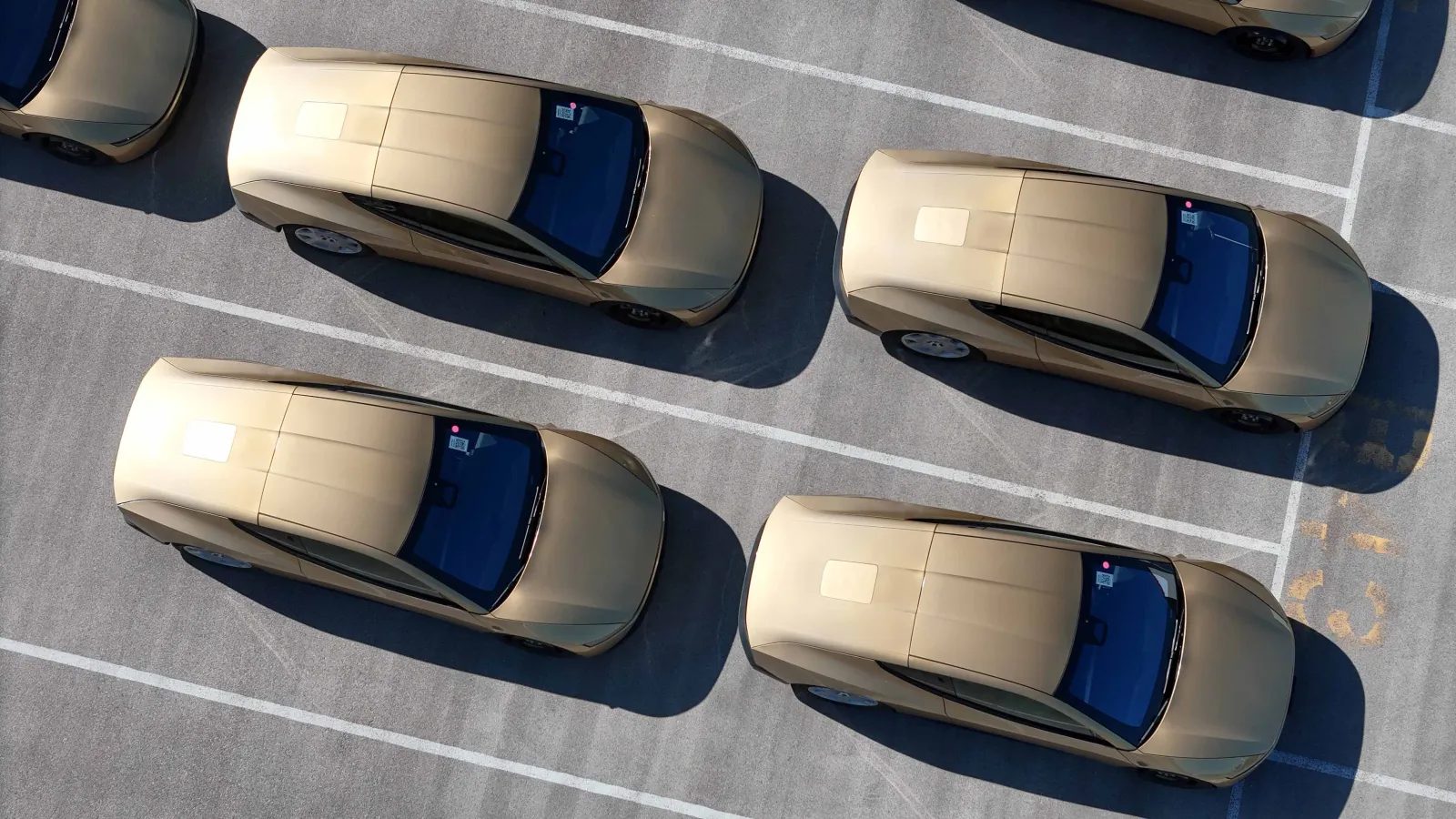

Tesla’s Cybercab is now coming off the line at Giga Texas with its Starlink satellite terminal fitted at the factory, drone footage of the plant’s outbound lot showed on Tuesday, a week after the two-seater began carrying paying passengers in Austin and a month after Tesla showed the first car with the antenna built in.
The footage, shot on Tuesday morning by Joe Tegtmeyer, who has flown the Austin plant for years, shows rows of gold Cybercabs each carrying a lighter rectangular panel on the rear hatch above the taillights.
“Many more Cybercabs and for the 1st time equipped with the Starlink module on the hatch in big numbers,” Tegtmeyer wrote, alongside hundreds of Model Y L units as the plant restarted after the Labor Day weekend.
He read the change as a manufacturing one: with the cars “starting to be produced off the production line with the Starlink addition to the hatch,” the feature “may have moved from the conceptual and testing phase to more of a production phase with the appropriate tooling and die changes rather than being retrofitted.”
Tesla has not said how many Cybercabs carry the hardware or whether the terminals are active.
The cars that opened service did not have it working.
David Moss, who rode about an hour at the September 3 launch event, reported that “there was no available Starlink connection during any of my rides. That feature simply does not appear to be ready yet,” with video streaming running over cellular.
Tesla’s own launch-day post described the cabin as “soon to be equipped with V5 Starlink hardware,” and Starlink said on September 4 that the terminal “will soon be integrated directly into Cybercab.”
The 45 Cybercabs registered in Texas before launch would need retrofits to match the cars now leaving the plant.
Tesla has meanwhile added four other Cybercabs, taking its fleet to 49 units of the purpose-built autonomous model.
What Riders Would Get
Starlink’s September 4 post described connectivity “for vehicle operations and passenger entertainment even in locations with poor or high traffic cellular service.”
Musk wrote on August 10 that riders could “watch live sports in 4k or movies or games or productivity” on the 22-inch cabin screen.
The terminal is Starlink’s V5 dish, unveiled by SpaceX on July 14 and rated at 375 Mbps or more, chosen over the portable Mini that Tesla bolted to test cars in May.
SpaceX’s own residential documentation for V5 says it is not intended for in-motion use, and neither company has published in-motion performance for the Cybercab installation.
What It Is Not For
Ashok Elluswamy, Tesla’s AI chief, wrote on July 20, the day the integration was announced: “It is still not required for safe operation of the vehicle. Connectivity is primarily meant for navigation, customer service and, in general, fleet management.”
Musk gave the operational case on the second-quarter call on July 22. “For a robotaxi situation, you need to have coverage everywhere,” he said, citing dead zones on his own commute in Silicon Valley.
“We can’t have robotaxis getting stuck in these like Bermuda triangles of lack of cellular connectivity. So Starlink with its ability to do connectivity anywhere is actually quite important, so we don’t have robotaxis missing in action.”
He added that Starlink “will be integrated into all of our vehicles, at least for markets that Starlink is active,” and wrote on X on August 9 that “all cars will have Starlink in the future. It’s the only way to get super high bandwidth to billions of vehicles.”
The cars keep their 5G and LTE modems. Starlink is a third path, not a replacement.
The Sequence
Test Cybercabs were first photographed in Austin in mid-May with a Starlink Mini bolted to the liftgate.
Tesla and Starlink announced the integration on July 20 with a cutaway diagram and no explanation, and a production car went on display in San Jose the same day.
The first finished installation, under a gold cover, was photographed in Dallas on August 8, and Tesla posted its own photos of the “first Cybercab with Starlink integration” outside Giga Texas on August 10.
An owner’s close-up on August 12 showed the panel held by four rivets and no visible Wi-Fi network.
Public rides began on September 4.