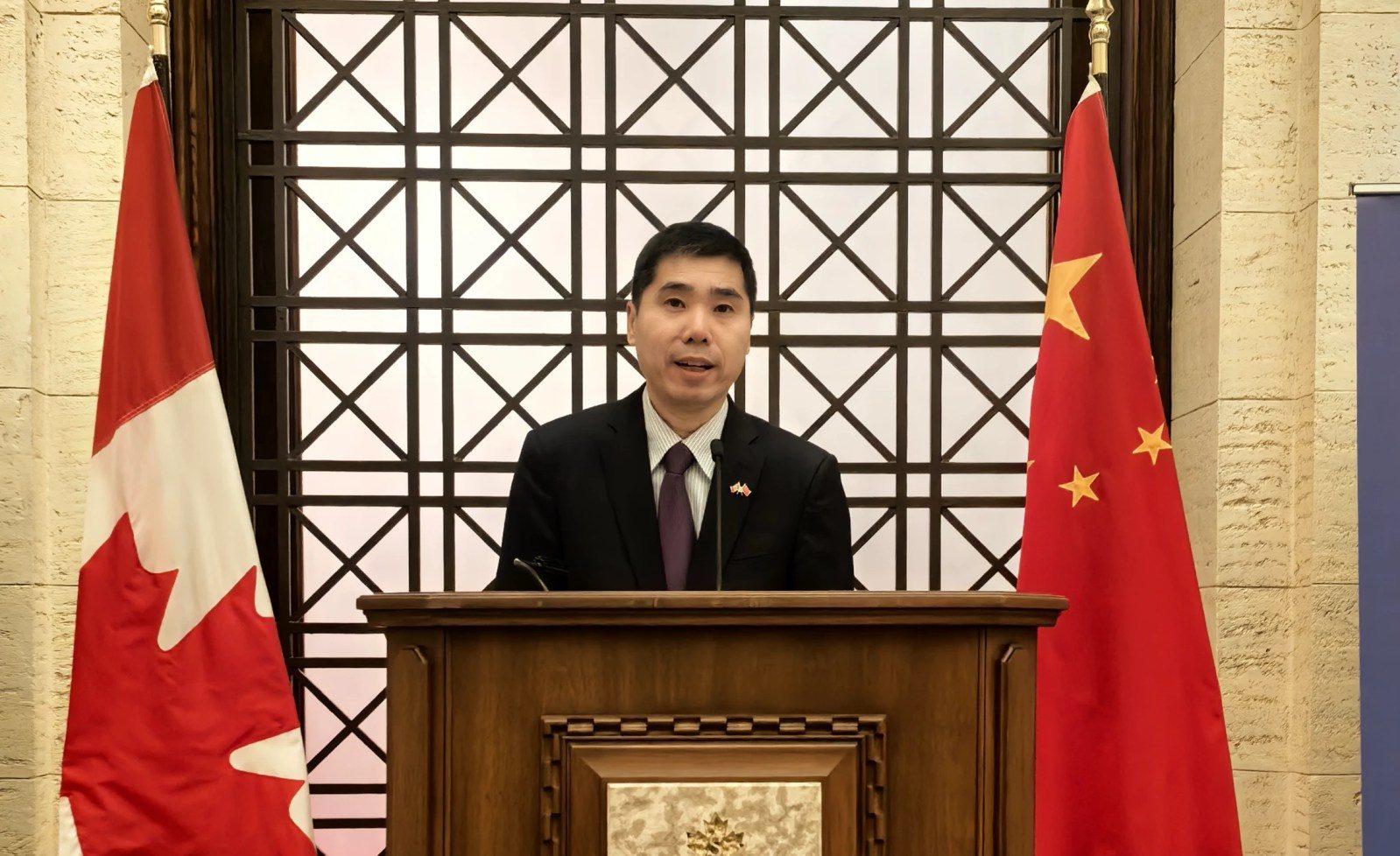

China’s Ambassador to Canada declined to challenge Ottawa’s rejection of a proposed Leapmotor knock-down kit assembly arrangement at Stellantis‘ Brampton plant.
In an exclusive interview with the Globe and Mail, the dispute was framed as a matter for the Canadian government to resolve domestically.
Wang Di’s first public comments on the Leapmotor rejection mark Beijing’s most direct engagement with Canada’s enforcement of its Chinese EV quota framework, which began permitting China-made electric vehicles into the country at a 6.1% tariff rate on March 1, 2026.
Stellantis acquired a roughly 21% stake in the Hangzhou-based Leapmotor in 2023 for approximately €1.5 billion.
The brand delivered approximately 600,000 vehicles globally in 2025 and aims to deliver one million this year alone.
When asked whether the Chinese government viewed Canada’s expectation of genuine local manufacturing — rather than kit assembly — as a feasible standard, Wang said the decision rests with the companies themselves.
“The Chinese government’s position remains consistent: we support mutually beneficial cooperation between enterprises of both countries in accordance with market principles,” Wang told the Globe and Mail.
The ambassador said specific cooperation models were not for governments to dictate.
“As for specific models of cooperation, those decisions rest solely with the companies themselves as independent entities. It is not the role of the government to intervene in commercial negotiations,” Wang said.
He framed Beijing’s role as institutional rather than directive.
“Our responsibility is to ensure a fair, transparent and predictable business environment that facilitates such cooperation,” Wang added.
Government Intervention Question
When pressed that Ottawa had clearly intervened by rejecting Leapmotor’s specific proposal on policy grounds, Wang redirected the question back to the Canadian government.
The ambassador first emphasized the state of bilateral diplomatic engagement.
“The communication channels between our two governments remain open and functioning well. We have been strengthening policy communication and mechanism coordination with the Canadian side,” Wang said.
He framed the relationship as one of expected mutual benefit rather than adversarial trade tension.
“We hope that there will be complementarities realized and mutual benefit achieved between our two sides. Through the communication channel between the two governments, we have been maintaining communication on issues of mutual interest,” Wang added.
He then redirected the line of inquiry to Ottawa.
“If you have any concerns about some of the policies of your government, I think you should raise your concerns to them directly,” Wang told the Globe and Mail.
Joly’s Three Conditions
Wang’s deflection comes against the backdrop of a structured Canadian policy response delivered by Industry Minister Mélanie Joly in Vancouver in early April.
In remarks that did not name Leapmotor but effectively ruled out the knock-down kit model, Joly laid out three conditions that any new production plan at the idled Brampton plant must meet.
The minister named labour standards at or above previous levels, participation in the Canadian auto parts supply chain, and vehicle software compliance with the Canada-United States-Mexico Agreement (CUSMA), as EV reported at the time.
“We can’t bring cars in a kit to Canada,” Joly said in Vancouver. “Why? Because one of the big parts of our auto industry is actually linked to the fact that we have a big auto parts sector. 200,000 workers. And we have the three biggest companies in the world in auto parts.”
The minister was referring to Magna International, Linamar, and Martinrea International — the three largest Canadian-headquartered auto parts manufacturers.
Wang’s “company-level decisions” framing in Friday’s interview avoids any direct engagement with Joly’s three-pillar policy framework, which constitutes the structural basis for Ottawa’s rejection rather than an ad hoc decision.
Subsidy Clawback Threat
Joly also reiterated on April 3 that Ottawa would recover federal subsidies granted to Stellantis unless production resumes at Brampton.
“I’ve been clear with the company and we will get our money back unless they bring back production,” Joly said.
Stellantis received up to $529 million in federal subsidies through the Strategic Innovation Fund as part of a commitment to retool Brampton for electric Jeep Compass production.
The company paused retooling work at the plant in February 2025 and confirmed in October that the next-generation Jeep Compass would instead be produced at its Belvidere, Illinois facility, with production there expected to begin in late 2027.
The Brampton plant has been idle since the retooling pause, leaving approximately 3,000 Unifor-represented workers furloughed.
The Canadian government has also cut Stellantis‘s tariff-free import remission quota by 50% and filed a notice of default against the company over the Brampton funding agreement.
Stellantis-Leapmotor
Stellantis was first reported by Bloomberg on April 2 to be proposing assembling Leapmotor vehicles at Brampton using imported parts from China — a knock-down kit approach that Unifor National President Lana Payne said would involve limited local manufacturing and few local suppliers.
Stellantis acquired a roughly 21% stake in the Hangzhou-based Leapmotor in 2023 for approximately €1.5 billion, and the two companies formed a joint venture, Leapmotor International, to distribute Leapmotor vehicles outside of China.
Leapmotor has used Stellantis‘s extended retail network to introduce its vehicles in markets where the Chinese brand had no prior presence, with announced SKD-based production already established in Spain, Brazil, and Malaysia.
The Canadian rejection makes Ottawa the first government to reject the SKD model that has anchored Leapmotor‘s global expansion through Stellantis.
Stellantis spokesperson LouAnn Gosselin said in an April 1 statement that the company “remains focused on a strong Canadian footprint and is actively evaluating future programs for Brampton, with the objective to ensure that any investment decision is sustainable and a long-term commitment that supports workers and suppliers.”
The company has not directly confirmed or denied the Leapmotor talks.
Leapmotor’s Global Position
Leapmotor delivered approximately 600,000 vehicles globally in 2025 and achieved annual profitability for the first time.
In the first quarter of 2026, the company reported global deliveries exceeding 110,000 units, with overseas exports surpassing 40,000 units — a record high.
Leapmotor is targeting one million deliveries this year.
The performance positions Leapmotor as one of China’s fastest-growing new energy vehicle brands and a credible global player, lending weight to the question of how Beijing views Ottawa’s enforcement stance.
Quota Continues, Brampton Drawn Apart
Joly reaffirmed on April 3 that the broader 49,000-vehicle Chinese EV quota would proceed regardless of the Brampton dispute.
“We’ll continue with what we’ve done, which is 49,000 electric vehicles coming from China. We already have companies approaching us,” Joly said. “And we’ll make sure that we abide by our agreement with China.”
The Carney government agreed in January to reduce tariffs on up to 49,000 Chinese-made EVs from 100% to 6.1%, in exchange for lower Chinese duties on Canadian canola, with Ottawa expecting Chinese joint-venture investment within three years of the deal.
The minister drew a clear distinction between the broader quota framework — which BYD, Chery, and Geely are confirmed for as early entrants — and the specific situation at Brampton, where she insisted on full manufacturing rather than kit assembly.
Tesla on Friday became the first Western automaker to operationalize a China-Canada supply chain shift under the framework, pricing the Shanghai-built Model 3 in Canada starting at $39,490 CAD.
Tesla‘s direct-import approach contrasts with the rejected Stellantis-Leapmotor kit assembly model — and falls comfortably inside what Ottawa’s enforcement pattern appears willing to accept.
Diplomatic Framing
Wang Di’s framing in Friday’s interview avoids any direct criticism of Ottawa’s enforcement stance while leaving open the possibility of future diplomatic engagement on the broader EV trade framework.
By treating the Leapmotor rejection as a matter for Stellantis and Leapmotor as private commercial actors — rather than as a Canadian policy that directly affects Chinese economic interests — Beijing has chosen not to escalate the issue at the diplomatic level, at least publicly.
The framing also leaves the burden of any pushback with the Canadian companies that participated in the proposal, rather than positioning China as a counterparty in a bilateral trade dispute.
The Brampton dispute sits at the intersection of Canada’s two most sensitive trade relationships — with China on the EV quota and with the United States on the broader auto sector.
Canada’s auto sector supports more than 500,000 workers, with production having fallen nearly 50% since 2016 to approximately 1.2 million vehicles last year and more than 90% of Canadian-made vehicles exported to the United States, where they face a 25% tariff on non-US content.
None of the three Chinese-headquartered automakers confirmed for Canadian market entry by year-end — BYD, Chery, or Geely — has yet shipped vehicles under the quota.
Lotus, the Geely-owned sports car brand, has previously said it expects to begin delivering Chinese-made Eletre SUVs in Canada in the third quarter of 2026.