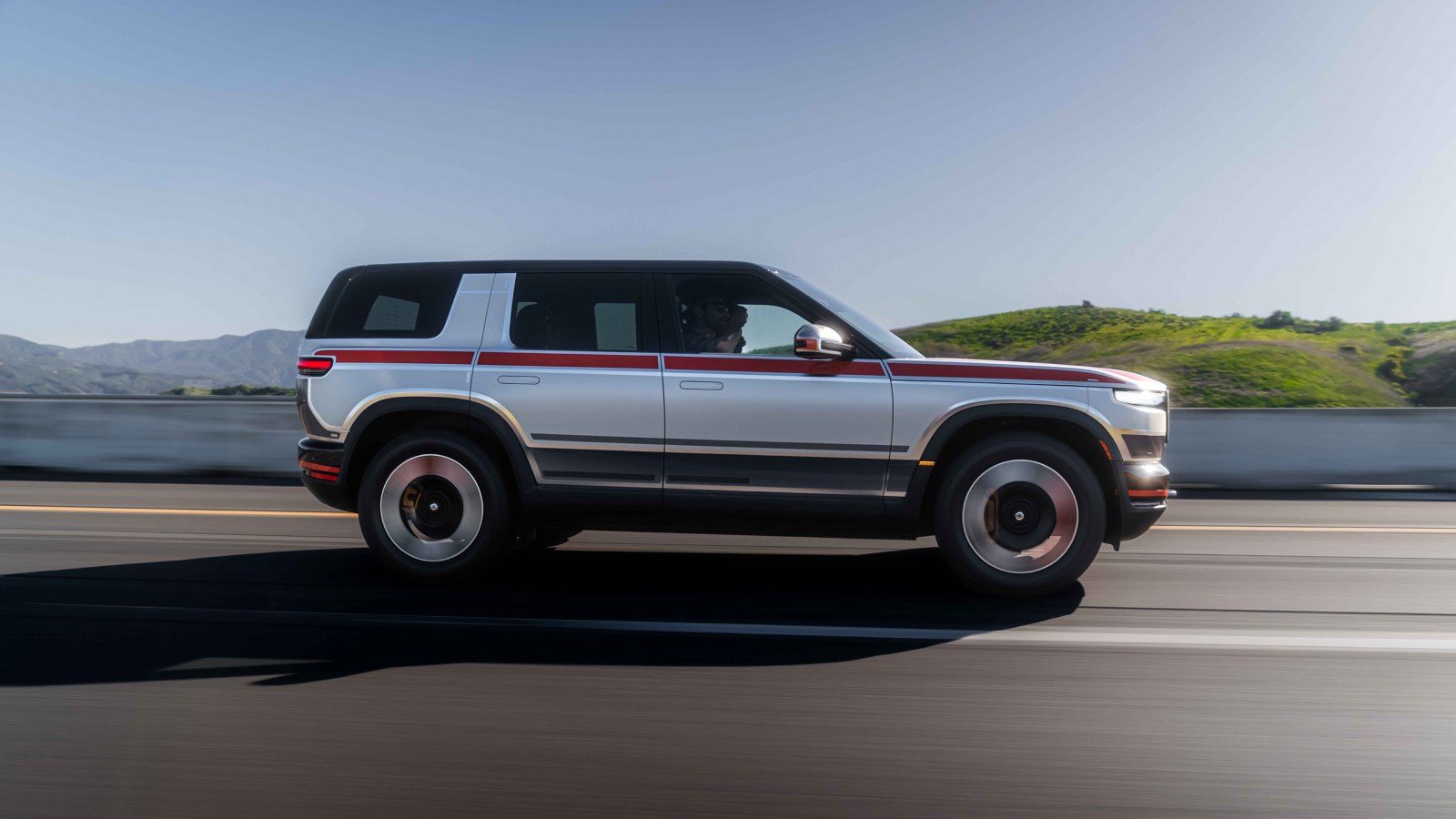

Rivian has reaffirmed its intention to sell its mid-size SUV R2 across several international markets, including Europe and China — the world’s largest EV market.
Michael Castiglione, the company’s Director of Exterior Design, revealed the information in a Forbes interview aired earlier this week — ahead of the mid-size SUV’s debut on Thursday.
“So what’s cool about R2 is it still feels very premium like the R1, but it’s more affordable,” Castiglione stated, “and so the idea is to get great design in the hands of more people.”
Highlighting that the mid-size SUV segment is the largest in the world, the designer said that Rivian is “hoping that we can sell it in more places other than the United States.”
“So we’re currently looking at Europe, potentially China, other things like that, so it’s more of a world car,” he added.
Europe Delay
Last month, the company quietly delayed the launch of the R2 in Europe, according to updates made to its website.
Rivian removed its previously stated 2027 target for Europe, replacing it with the message “Rivian is coming to Europe — be one of the first to get the latest news and updates” without specifying a launch year.
At the same time, it pushed back the model’s Canadian debut by a year, removing the 2026 mention and replacing it with 2027.
Rivian’s founder and CEO RJ Scaringe hinted last September that the company was eyeing European expansion via the same direct-to-consumer sales model it already uses in the US.
Two months later, the company’s CFO Claire McDonough reiterated the intent, saying that “from a distribution standpoint, we want to make sure we’re owning the customer relationship.”
Despite that, she indicated that Rivian “certainly can look and explore different avenues or approaches for the advancement of our products in new geographies.”
The company’s website now lists dedicated pages for 18 countries, including the UK, Germany, France, Spain, Italy, Sweden, and Austria, though no launch dates are provided for any market.
Rivian China Stance
RJ Scaringe previously commented on the possibility of Rivian entering China in August 2024, when he was interviewed by The InEVitable podcast.
“We’re committed to Europe,” he said, adding that the company is “thinking about China.”
“For us, we’ve been really clear that it’s, today we’re focused on, in terms of major markets, US and Europe with R2 and R3,” he said, adding that they were “watching how it plays out in China to determine whether or not we actually participate in China.”
Scaringe cited intense price competition in China as a key reason for the company’s cautious approach to the market.
“[…] To participate in that space today, it’s extremely price-competitive […] and to the point of competing well under cost,” he stated.
By then, the CEO had already flagged the existing subsidies for local brands as a challenge for overseas entities.
“There’s a pretty rich labyrinth of subsidies that exist for Chinese-based companies that also make it quite difficult for a non-Chinese entity. Plus 97 car brands. There’s a saturation,” he said.
Scaringe on Chinese EVs
Over the past twelve months, Scaringe has been commenting further on Chinese EV makers, noting that their success comes from lower costs on both manufacturing and labor.
“We’ve taken lots of cars apart, every car manufacturer does,” he said, and “there’s not something magical when you take it apart that’s allowing these really impressive cost structures.”
Still, Scaringe highlighted earlier this year that a handful of Chinese companies are “very, very strong in terms of technology,” in addition to benefiting from cost efficiencies.
“Companies like Xiaomi or BYD very much technically demonstrate a lot of leadership, and then from a price point of view, are quite competitive,” Scaringe exemplified.
Last month, a Xiaomi YU7 was spotted on Interstate 5 in Illinois.
Its ‘132’ plate fuelled speculation that the mid-size SUV is owned by Rivian, for competitive benchmarking and reverse engineering purposes.