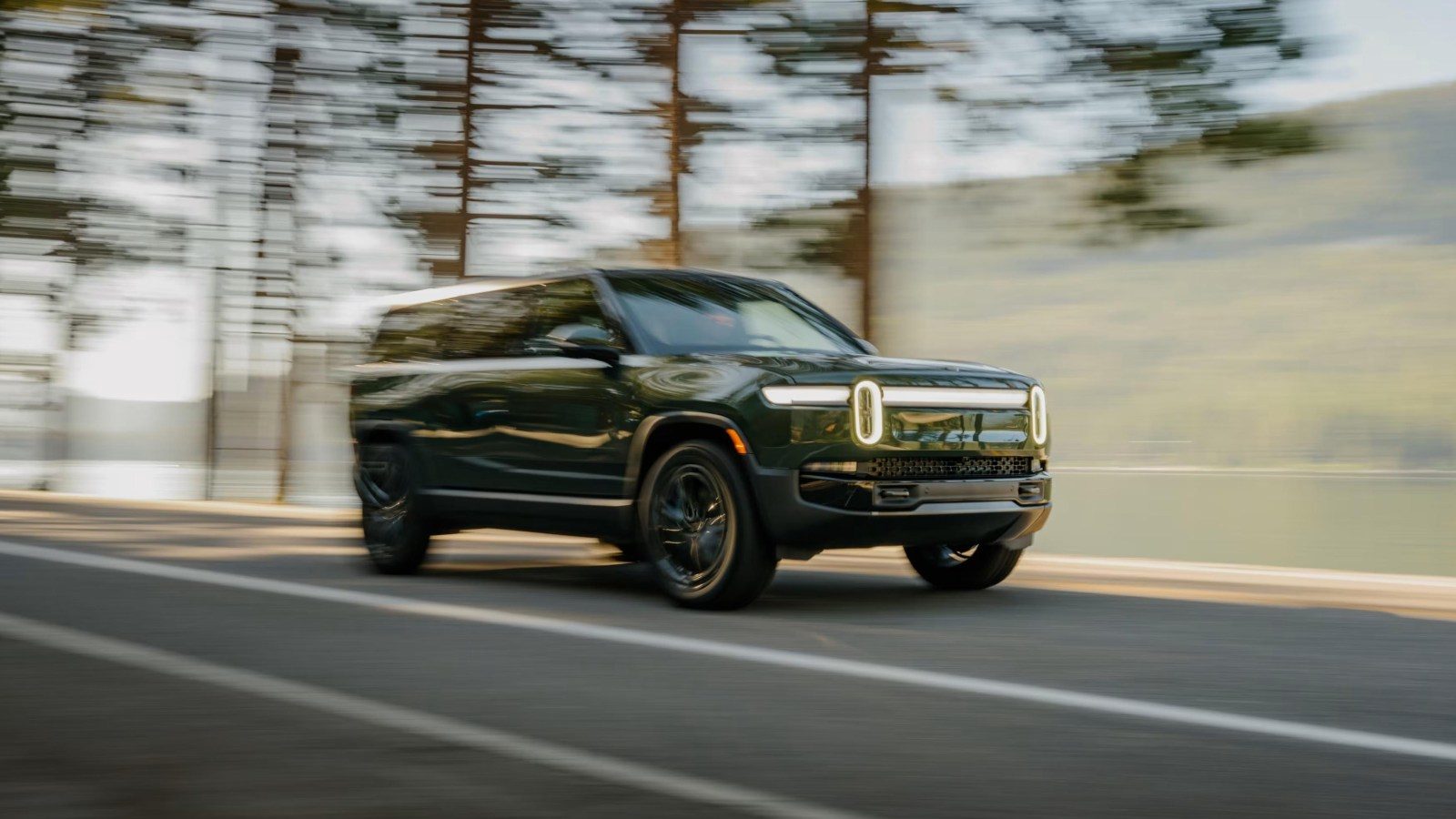

Rivian founder and CEO RJ Scaringe confirmed on Wednesday that the company’s EV plant began volume and saleable production of the R2 midsize SUV despite a tornado that struck the south end of the facility on Friday night, ripping the roof off part of the building.
Speaking to Bloomberg Tech host Ed Ludlow live from the Illinois factory, Scaringe said Rivian had not altered its production ramp plan despite the damage, which hit the plant’s logistics area and forced the company to reroute material flow through alternative dock doors.
“I mean, of course, you can’t plan for these kinds of things, and we didn’t expect a tornado to hit Friday night, but, you know, the teams responded really well,” Scaringe said.
“Fortunately, everyone was safe,” Rivian‘s founder and CEO clarified. “We followed our protocols as soon as we knew there were trainers in the area.”
Scaringe described the past three days as “around the clock” work to remove water from the facility and rebuild the damaged south end, calling the recovery effort “the ultimate example of resilience of the business.”
“We still had vehicles come off the line this morning,” Scaringe said.
Immediately after the announcement, Rivian shares were trading 3.6% higher at $17.77.
Ramp Plan Unchanged
Asked by Ludlow whether the tornado would force Rivian to adjust its ramp strategy or initial output volumes, Scaringe said the plan remained intact.
“Our ramp up this week and into next week, we’re not making changes to the plan,” Scaringe said without detailing the impact after that period.
“We’re obviously having to make some accommodations for the fact that it’s the logistics area the plant, and so the way that material was flowing into the plant through the dock doors is not — has to come in a different way. But, you know, we’re working through it.”
The Trim Launch Sequence
Scaringe described strong early demand for the R2 but confirmed that the variant Rivian is launching first is the top-of-range “launch edition” — not the $45,000 base specification Scaringe has consistently referenced in prior public commentary.
A mid-specification version and the $45,000 base model will follow over the next twelve months, Scaringe said.
“The average price of a new car in the United States is about $50,000, and so really important to us as we’re developing R2 is recognising we wanted to be right in that range,” Scaringe said.
“Having a variant that starts at 45 and then going up to our top spec of — for the performance version with all the kit for the interior — is at 57 allows us to really nicely straddle that,” he added before detailing the rollout strategy.
“It’s impossible to sort of make everyone happy with when you have a launch edition. So we decided to launch with the premium spec, but we’ll be introducing like a mid-spec vehicle, and then the $45,000 version will come thereafter, but that all rolls out over roughly the next year.”
Customer Demand Signals
Scaringe pointed to public reception events as early evidence of R2 demand strength.
He referenced a recent Denver event where Rivian hosted potential customers to experience the vehicle.
“We were in Denver a couple of days ago, and there’s, like, a super long line just to sit in the car,” Scaringe said. “So we love to see the enthusiasm. And I can’t wait to continue to ramp up production, start seeing these on the road.”
Scaringe said he has been driving an R2 personally “for a while,” describing the combination of “the package, the driving dynamics, the efficiency, of course, the design and just the aesthetic feel” as “incredible.”
Two-Stage AI Silicon Rollout
Rivian‘s launch-edition R2 will ship with the company’s existing NVIDIA-based compute stack and a further-developed version of the self-driving platform already deployed in the R1 lineup, Scaringe confirmed.
A second-generation autonomy stack — built around Rivian‘s in-house-developed silicon and LiDAR — will enter production at the end of 2026.
“Our in-house silicon, which is 800 TOPS per chip, we have two of those chips in the vehicle. We couple that with cameras, radar and a lidar that sits at the top of the windshield that comes in at the end of this year,” Scaringe said.
“Our launch edition still has a very highly capable self-driving platform, which is essentially a further development of what’s in our R1 vehicle now.”
Scaringe said the R2 architecture reflects fundamental re-engineering from the R1.
“Across the vehicle, you know, R2 just represents so many learnings for us as a business, whether it’s the drive line, the power electronics, just the way it’s being built, in terms of cost and cost efficiency. And so there’s not a detail in the car that hasn’t been thoughtfully evolved or developed relative to what we’ve done in R1.”
L2 + L3 Timeline
Scaringe mapped out Rivian‘s hands-off driving rollout across the launch-edition R2 and the second-generation R1.
Later this year, Rivian will begin rolling out “point-to-point Level 2” — described by Scaringe as hands-off wheel, eyes on road, where the driver types in the destination and the vehicle completes the journey.
“Into next year we’ll start to roll out Level 3,” Scaringe said. “So hands off, eyes off for specific domains. In this case, you know, starting with highways. And that will be true for gen two of R1, it’ll be true for the launch edition of R2, and of course, be true for the very vehicle — it has a higher compute stack and more capable perception.”
The higher-compute variant will reach “a higher ceiling of what the vehicle can ultimately achieve,” Scaringe said, and will serve as “a really valuable part” of Rivian‘s autonomy data flywheel.
Licensing Discussions
Ludlow pressed Scaringe on reports that Rivian is in discussions to license its autonomy stack and underlying technology to other automakers.
Scaringe did not confirm specific deals but framed licensing as a structural second revenue stream, citing the $5.8 billion Volkswagen software licensing deal signed in late 2024 as the template.
“I think in the fullness of time — and you look at what we’re building as a business — there’s really two revenue opportunities,” Scaringe said.
“One is we continue to grow by selling vehicles, and so of course R2 is the embodiment of that. But there’s another element of our business, which is leveraging the technology we’re developing.”
“In the first example, that was what we did with Volkswagen. We did a $5.8 billion software licensing deal, and that allows us to deploy our — this, not our self-driving, but our compute stack, and our software platform, our OS across a wide range of electric vehicles within the Volkswagen portfolio.
The German giant completed the winter testing of the first models earlier this year, with Rivian unlocking another $1 billion.
“And so we’re excited about the potential to do more deals like that, with our operating system in the vehicle, with our electric vehicle, and certainly, as we think about autonomy, the potential that’s there for us to also license that in the long term,” Scaringe stated.
The Volkswagen deal, formalised in late 2024, will see Rivian‘s zonal architecture and software stack debut in the German group’s upcoming ID.1 small electric car expected to launch in 2027.
Why It Matters
The R2 volume production start marks the end of Rivian‘s multi-year transition from its first-generation R1 platform — sold at premium price points — to a volume-oriented model positioned against the US industry average vehicle price of approximately $50,000.
Scaringe’s confirmation that the launch edition starts well above the long-promised $45,000 base price — with the cheapest variant “rolling out roughly over the next year” — is likely to draw investor scrutiny ahead of Rivian‘s first-quarter 2026 earnings.
In recent California registration data reported by EV on Tuesday, Rivian posted the steepest year-over-year decline among the state’s top 30 selling brands at -35.9% in the first quarter, with registrations falling to 1,841 units from 2,872 a year earlier.
The company has guided for full-year 2026 deliveries of 62,000 to 67,000 vehicles.