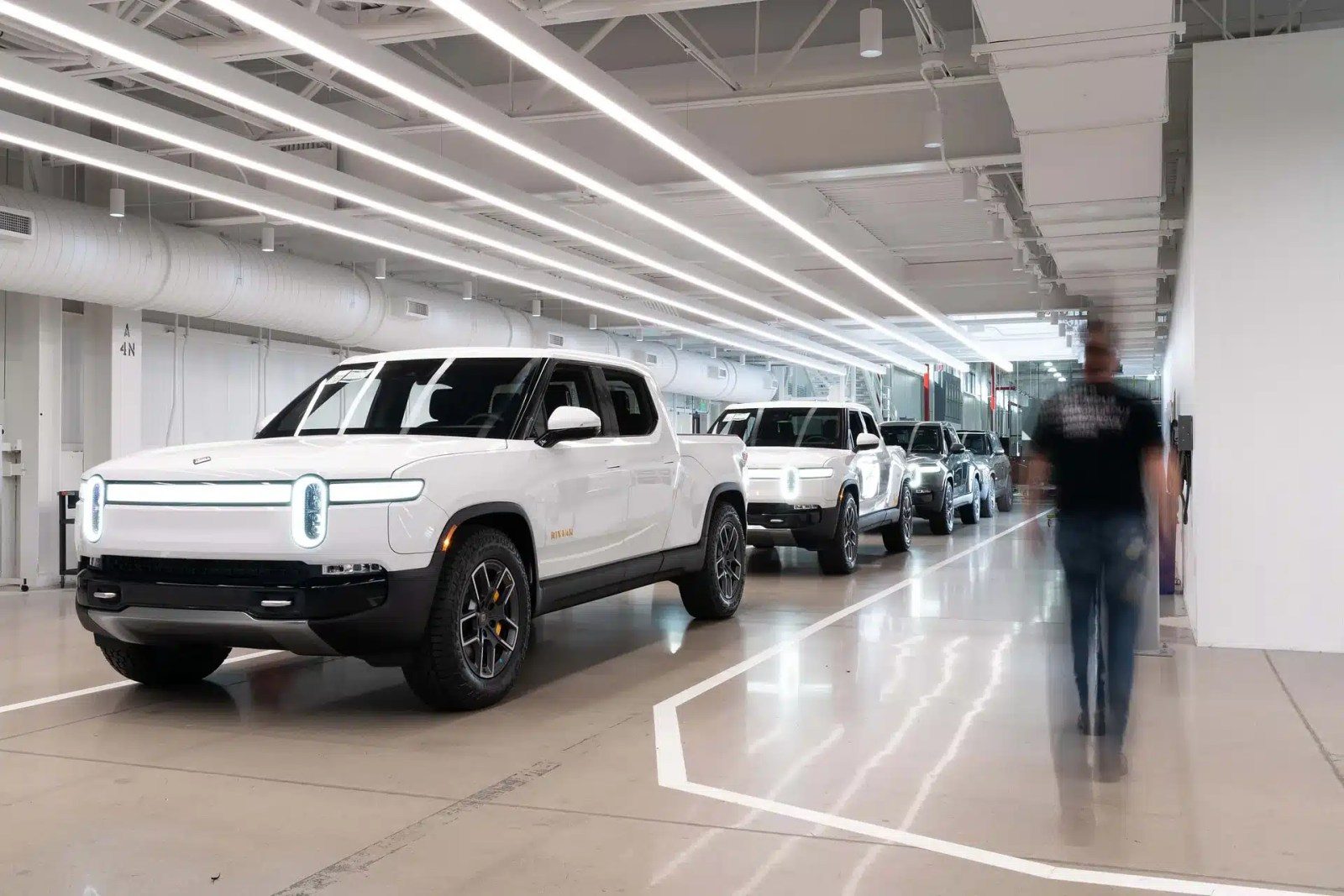

Analyst Tom Narayan raised RBC Capital’s price target on Rivian by 40% to $14, “reflecting a revised revenue outlook” on the company.
However, in a new research note released on Monday, Narayan said that “concerns persist about gross profit sustainability beyond regulatory credits, potential DOE [Department of Energy] loan delays, and the impact of IRA [Inflation Reduction Act] removal on price-sensitive R2/R3 products.”
Based on Friday’s closing price of $15.81, the new target implies a downside of 11.4%. The firm maintained the stock’s Sector Perform rating on Rivian shares.
Narayan noted that despite cutting both revenue and vehicle delivery guidance for this year, Rivian “increased projected gross profit to $301 million (from $205 million), supported by regulatory credits.”
The Irvine-based automaker reported a record gross profit of $206 million for the first quarter, marking its second straight quarter of positive profit, mainly due to $157 million in revenue from automotive regulatory credit sales.
The EV maker booked most of regulatory credits in the final quarter last year and reported half of its full-year guidance for 2025 in the first quarter alone.
“Additional funding commitments including $3.5 billion from VW, $1 billion contingent on positive gross profit in late 2024, and a $6.6 billion DOE loan” were pointed out by the analyst as motives for the company’s liquidity at $8.5 billion in the first quarter of 2025.
In a deal worth $5.8 billion, Volkswagen agreed to invest in the U.S.-based brand, provided the company remains profitable. In return, Rivian gave the German automaker access to its advanced EV architecture and software.
At the beginning of the year, the Department of Energy granted a $6.57 billion loan to Rivian to “support construction of a nine million square foot facility,” expected to “manufacture up to 400,000 mass-market electric SUVs” in Georgia.
Nayaran mentioned the EV maker’s “capital expenditure guidance of $1.8-1.9 billion to advance the R2 platform for a 2026 launch,” which requires a “one-month plant shutdown” in Normal, Illinois.
Similarly to last year, Rivian is closing its main plant temporarily to integrate key elements for the production of its upcoming SUV.
CEO RJ Scaringe confirmed on the latest earnings call that it will happen later this year, stating that the company remains on track “with the expected shutdown to both our consumer manufacturing lines in our Normal plant for approximately one month in the second half of 2025.”
The analyst added that “tariffs could increase costs by a few thousand dollars per unit in 2025, prompting efforts to secure U.S.-manufactured cells by 2027.”
Earlier this month, Barclays’ analyst Dan Levy had estimated that the impact of tariffs could be felt later in the year, with costs rising by as much as $13,000 per unit.
Although Rivian produces domestically, in Normal, Illinois, certain elements are imported. The batteries that the company used for its first two models were imported from China, and the brand is now switching to LG, U.S. sourced.
But for Levy it’s about the costs that will come “alongside expected removal of the EV tax credit.”
During the weekend, U.S. Treasury Secretary Scott Bessent stated in an interview on television that Trump will impose the tariffs he previously announced to any country that isn’t negotiating with the U.S.
“I would expect that everyone would come and negotiate in good faith,” Bessent said.
Since announcing new tariffs last month, the President has triggered a global trade war with China.
In the meantime, a 90-day pause has been placed on tariffs for other countries to allow time for negotiations aimed at reducing them. However, the 25% tariff applied to vehicles and auto parts was not altered.
After a month of escalating tariffs between the world’s two largest economies, the U.S. temporarily lowered the tariff on Chinese imports to 30% as both sides work toward a trade agreement.
Also on Monday, BNP Paribas Exane analyst James Picariello raised the price target on Rivian to $20 from $18 while maintaining the Outperform rating.
In a research note, Picariello said the company “continues to showcase gross profit improvement, with both clear operational flexibility to navigate the current dynamic tariffs environment, as well as a full slate of liquidity (via VW & and the DoE).”