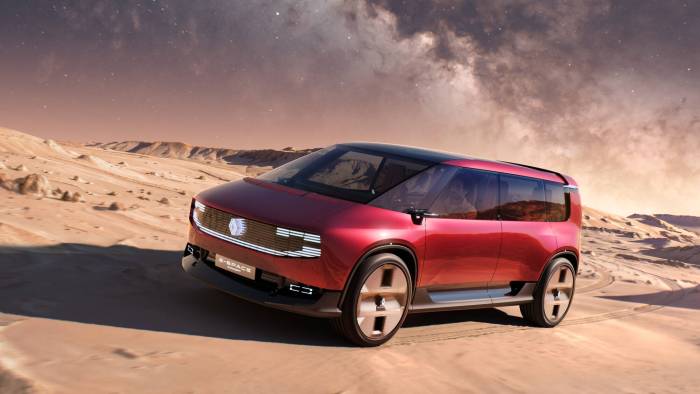
Renault will unveil an electric six-seat concept called E-Space at the Paris Motor Show next week, reviving the one-box shape of the 1984 Espace, while saying it has no plan for now to put the car into production.
The French carmaker announced the concept on Tuesday and said it would be shown in a world premiere at its press conference on October 12, the first day of the show.
The release answers its own question on whether the E-Space previews a production vehicle: “It is not planned for the moment.”
It adds that the car is a concept “that explores Renault’s vision for future electric family cars”.
Renault gave no battery, motor, range or platform details for the car and quoted no executive.
What Renault Has Shown
The E-Space Concept is 4.70 metres long, 2.02 metres wide and 1.67 metres tall and sits on 23-inch wheels, according to the company.
It has six individual seats in three rows on a completely flat floor.
Renault said the six seats are identical in size and design and can rotate slightly to make access easier, and that some configurations create a shared space around a large table.
A curved screen that Renault calls OpenR Panorama spans the width of the cabin and measures 1,130 millimetres wide by 110 millimetres high. That screen is the one element Renault ties to production, saying it “will be present on the future electric models of Renault’s upper range”.
The exterior is finished in a colour that Renault calls ruby black, with a wide U-shaped light signature at the front and at the rear.
Renault describes the car as an electric concept that reinterprets the codes of the minivan and of its “voitures à vivre”, the “cars for living” slogan it attached to the Espace in the 1980s.
The “E” in the name refers to E-Tech, the label Renault uses for its electrified models, the company said.
The Car It Recalls
The first Espace was revealed in 1984 and became the template for the European minivan.
Renault’s release says the concept arrives “nearly 40 years later”, although the gap is 42 years.
Renault presents the concept as the “contemporary heir” of that first generation.
The Espace name is still on sale, but not on a minivan.
The sixth generation, unveiled in March 2023, is a seven-seat SUV derived from the Austral and sold only as a hybrid.
Renault said the concept “deliberately sets itself apart from the dominant codes of the SUV”, with a one-box silhouette, contained ground clearance and a low beltline. It also said the car takes up the codes of the minivan while creating “a new automotive segment”.
Another Minivan Concept
The E-Space is the second one-box family concept Renault has shown in seven months.
The company presented the R-Space Lab on March 10, alongside its futuREady strategic plan, and described that car as a laboratory for interior ideas.
The R-Space Lab is 4.50 metres long and 1.52 metres tall with five seats, which makes the E-Space 20 centimetres longer, 15 centimetres taller and one row larger.
Both carry the full-width OpenR Panorama screen.
Fabrice Cambolive, the head of the Renault brand, said at the time that several of the R-Space Lab’s innovations would make their way into new models.
What the Strategy Allows
Renault said the E-Space “illustrates the futuREady strategy”, without saying how.
That plan, presented on March 10, includes a new electric platform called RGEV Medium 2.0 for cars from the upper small-car class to large family models.
Renault Group said the platform will have an 800-volt architecture, a range of up to 750 kilometres on the WLTP cycle as a battery-electric car and up to 1,400 kilometres with a range extender.
The group said the platform can underpin a “saloon, SUV and even MPV”, the one explicit opening in its plan for a body style like the E-Space.
Renault has not said that the concept uses that platform, and specifications attributed to the E-Space in some reports are the platform’s targets and not figures for the car.
The plan calls for 36 new models across the group by 2030, 16 of them electric, and for all of the Renault brand’s European sales to be electrified by that year.
If it were built, a 4.70-metre electric one-box would sit in the same size bracket as the Volkswagen ID. Buzz and the Kia PV5, both of which are about 4.7 metres long.
Why the Precedent Matters
Renault’s recent show cars have tended to reach showrooms.
The Renault 5 was shown as a prototype in 2021 and went on sale in 2024, the Renault 4 followed a 2022 concept, and the Twingo concept of November 2023 became a production car this year.
Each of those was presented with a stated production intent, which the E-Space does not have.
The company is meanwhile committing capital elsewhere, including €600 million for its Spanish plants and a compact EV it is considering building in Spain.
It has also leaned on partners to cut costs on small cars, sourcing the Twingo E-Tech’s motor from a Chinese supplier.
Renault Group’s battery-electric sales rose 77% in 2025.
The Rest of the Stand
Renault will show two other concepts in Paris on a 2,500-square-metre stand.
The Renault 8 Gordini Concept is a two-seat electric coupe that reinterprets the 1960s saloon, and the Renault 4 JP4x4 Concept is a four-wheel-drive leisure version of the Renault 4.
Production models on the stand include a revised Megane E-Tech with a 67 kWh lithium iron phosphate battery and a range of 500 kilometres, the Renault 5 Turbo 3E and a Twingo E-Tech with a panoramic glass roof.
The Paris Motor Show runs from October 12 to October 18.