Hon Hai Precision Industry, the Taiwanese manufacturer known as Foxconn, has agreed to buy 50% of Mitsubishi Electric’s automotive equipment unit for 115 billion yen ($727.8 million), and the Japanese seller expects to book an impairment loss of about 100 billion yen ($632.9 million) on the deal.
The agreement values the business at an enterprise value of 320 billion yen ($2.03 billion) and an equity value of 230 billion yen ($1.46 billion), and the 115 billion yen price corresponds to half of that equity value.
The two companies signed the share transfer agreement for Mitsubishi Electric Mobility on Friday.
The buyer is Lin Yin International Investment, a wholly owned investment subsidiary of Hon Hai.
Mitsubishi Electric said it expects the transfer to close in October 2027, and Hon Hai put the date at October 1, 2027 in its filing with the Taiwan Stock Exchange.
A 100 Billion Yen Writedown
Mitsubishi Electric said it expects to record the impairment loss of about 100 billion yen under “other profit (loss)” in its results for the fiscal year ending March 31, 2027.
The company is reviewing its full-year earnings forecast and plans to announce it on October 30, it said.
Mitsubishi Electric Mobility will stop being a consolidated subsidiary and become an equity-method affiliate from the third quarter of the fiscal year ending March 31, 2028, according to the filing.
After the deal, Mitsubishi Electric and Hon Hai will each hold 503 shares in the unit, or 50% of the voting rights, and will run it jointly.
The automotive equipment business had revenue of 875.6 billion yen ($5.54 billion) in the year to March 31, 2026, according to unaudited internal figures Mitsubishi Electric disclosed for the business as a whole.
Mitsubishi Electric Mobility itself, which took over the business on April 1, 2024, reported non-consolidated revenue of 657.6 billion yen ($4.16 billion) and an operating profit of 13.2 billion yen ($83.4 million) in the same year.
That was up from an operating loss of 1.1 billion yen a year earlier, though revenue fell from 690.4 billion yen.
The business brought 727.5 billion yen of assets and 375.4 billion yen of liabilities as of March 31, 2026, according to the filing.
How the Deal Works
Before the share sale, Mitsubishi Electric will move the remaining rights and obligations of the automotive business into Mitsubishi Electric Mobility through an absorption-type company split, and will also transfer the business held by its group companies in Japan and overseas to the unit.
Mitsubishi Electric expects to sign the company split agreement in the first half of the fiscal year ending March 2028, and both the split and the share transfer are scheduled to take effect in October 2027.
Mitsubishi Electric Mobility, led by President Kazunori Tanaka, buys raw materials and other materials from its parent, and the two share a cash management system, according to the filing.
A Mitsubishi Electric Executive Officer currently serves as the unit’s Representative Director, and Mitsubishi Electric employees are seconded to it.
The business accounted for about 15% of Mitsubishi Electric’s group revenue of 5.89 trillion yen ($37.3 billion) last fiscal year, based on the company’s figures.
Mitsubishi Electric’s automotive equipment business posted an operating profit of 54.4 billion yen ($344.3 million) last fiscal year, a margin of 6.2%, according to the company’s annual results presentation in April.
Its revenue fell by 43.5 billion yen from the year before, which Mitsubishi Electric attributed mainly to lower sales by Japanese carmakers in China and a downsizing of its car multimedia business in North America.
Powertrains for Hire
The companies said the joint operation would combine Mitsubishi Electric Mobility’s capabilities “particularly in electric powertrains, software and vehicle control” with Hon Hai’s “speed, scale and other strengths in market deployment.”
By providing high-quality electric vehicle platforms “developed in Japan,” they said they expected to contribute to the wider adoption of next-generation mobility.
“Over the medium to long term, the companies aim to expand Japanese technology and quality to global markets as well as further enhance the value of ‘Made in/by Japan,'” they said.
The statement was issued with a photograph of Hon Hai Chairman Young Liu and Mitsubishi Electric President and Chief Executive Officer Kei Uruma shaking hands.
A 1 Trillion Yen Target
The two companies set a goal of lifting Mitsubishi Electric Mobility’s revenue to 1 trillion yen ($6.33 billion) in the fiscal year starting April 2030, at a press conference in Tokyo on Monday.
That would be 22% above the 820 billion yen ($5.19 billion) the unit expects for the current fiscal year.
“The most attractive thing is the electronic control technology, and its software technology is also abundant,” said Jun Seki, Chief Strategy Officer of Hon Hai’s electric vehicle business, who attended alongside Mitsubishi Electric Mobility President Kazunori Tanaka.
“We want to make Mitsubishi Electric our anchor in Japan and team up with other parts makers and automakers,” Seki said.
From Media Reports to the Deal
Mitsubishi Electric first responded to media reports on March 18 that it had decided to accept a Hon Hai investment, saying the reports were not based on its own announcements.
It said then that it was examining the possibility of transferring part of its stake in Mitsubishi Electric Mobility, and that “at present, nothing has been decided.”
The two companies signed a memorandum of understanding on April 24 to explore jointly operating their automotive equipment businesses, with Mitsubishi Electric considering transferring 50% of the unit.
They said at the time they aimed to build synergies in electrification, autonomous driving and software-defined vehicle technologies, building on an existing relationship.
Foxconn’s Japanese Push
The purchase extends Hon Hai’s drive into Japanese auto manufacturing.
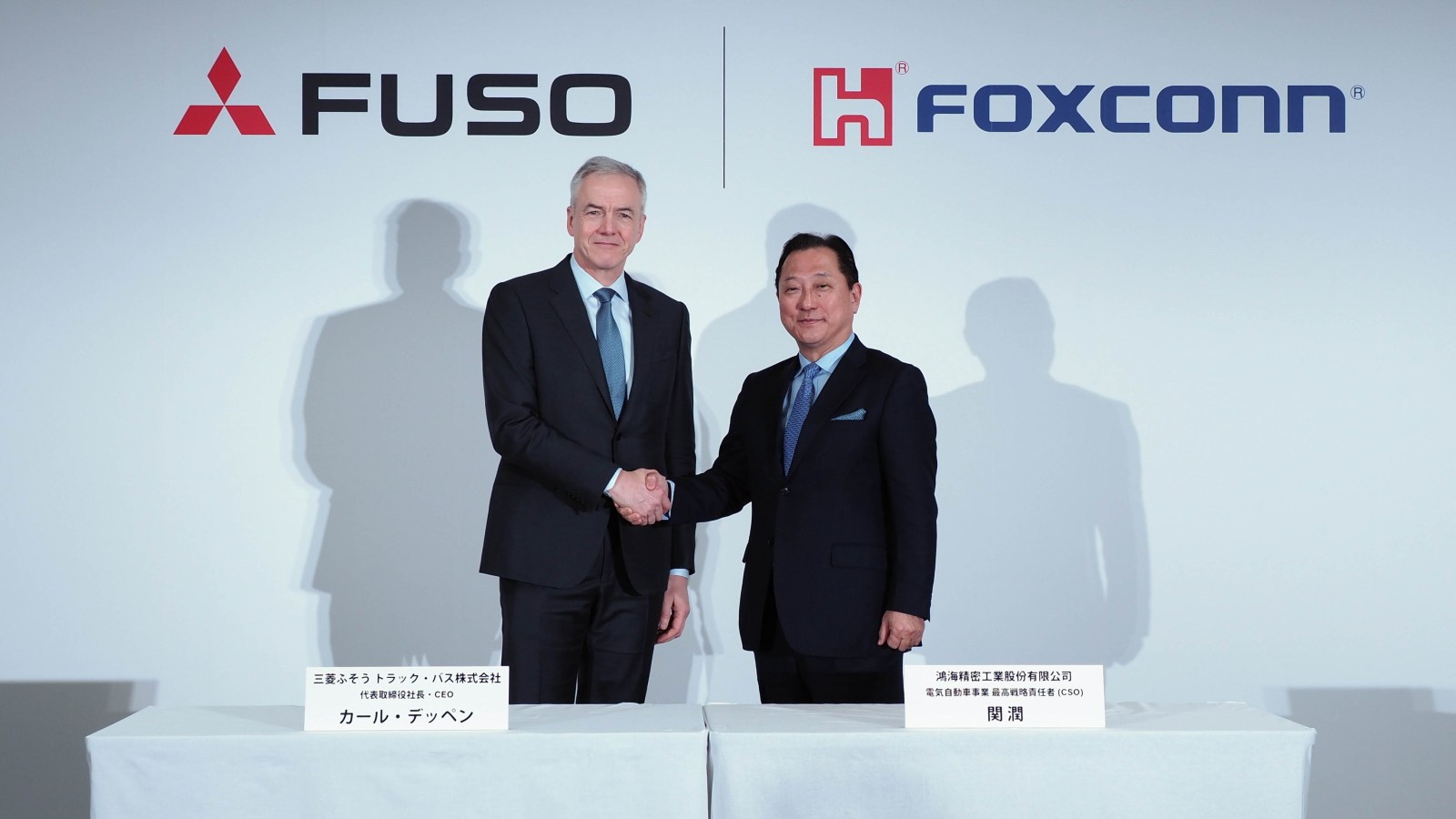
A Hon Hai subsidiary has agreed to form a joint venture with Daimler Truck’s Mitsubishi Fuso Truck and Bus to build electric buses in Japan, a company unrelated to Mitsubishi Electric despite the shared name.
Hon Hai is also a partner in Ceer, the Saudi electric vehicle brand it formed with the Public Investment Fund, which unveiled its first two models in September.
Electric vehicles are one of three industries Hon Hai targets under its “3+3+3” strategy, alongside digital health and robotics, according to the joint statement.