
Thailand’s consumer protection authority has summoned Volvo Car to explain two recent battery fires affecting its EX30 electric SUV — as the automaker is pressured to contain the fallout from a global recall of more than 40,000 vehicles.
The Office of the Consumer Protection Board (OCPB) called the Geely-backed carmaker to a meeting on May 21 (Thursday), after a second EX30 caught fire while charging at a customer’s residence last week.
According to local media coverage, the PM’s Office Minister Supamas Isarabhakdi is demanding answers on the cause of the fires, the timeline for completing battery replacements across 1,668 recalled vehicles in the country alone, and compensation for affected owners.
As of Wednesday, 45 owners of Volvo EX30s have filed complaints with the OCPB. While not all the complaints involved fires, the agency is now considering civil lawsuits on behalf of the owners to recover costs.
Sales of the model have been suspended in Thailand.
The developments mark the sharpest government response yet to the EX30’s battery problems, which have persisted since Volvo issued a worldwide recall earlier this year.
The recall covers Single Motor Extended Range and Twin Motor Performance variants, equipped with a roughly 69 kWh battery pack supplied by a Chinese manufacturer.
Latest Fix
The first Thai fire occurred around March 25 in Bangkok, prompting initial OCPB involvement.
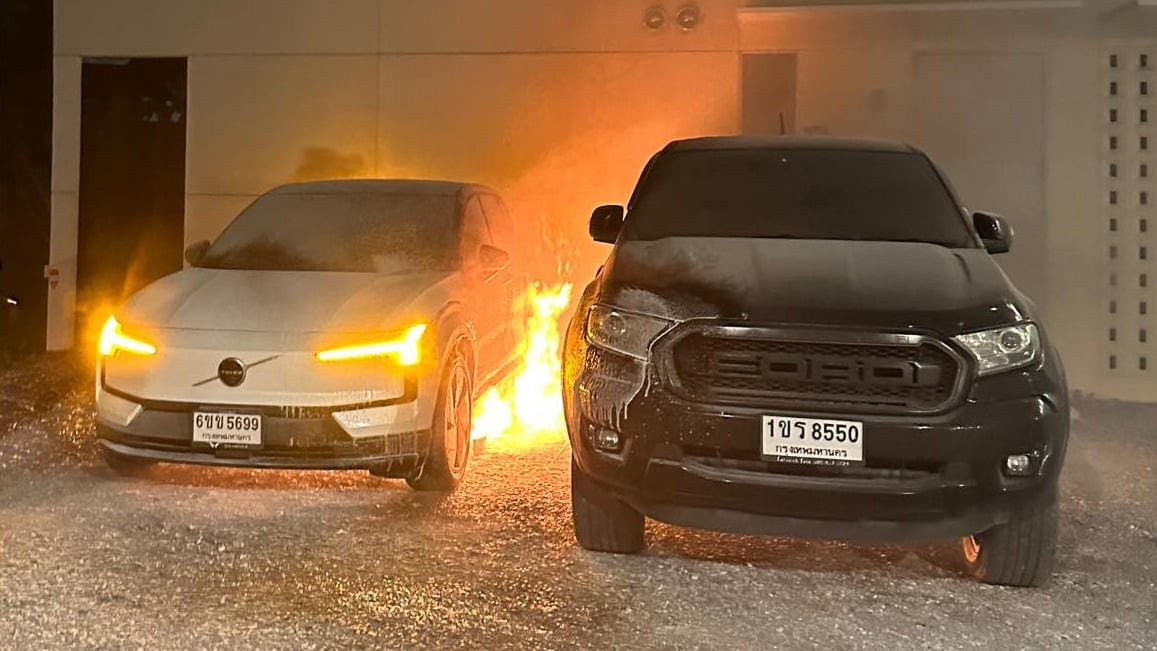
The second, on May 15, struck while an EX30 was charging at a private residence.
Images of the second fire were published on social media by the owner, Tomm Chairat, who wrote that “the car was a Volvo EX30, delivered around mid-2024.”
The fire affected both the EX30 unit and another pick-up truck parked next to it, plus spread to the nearest building, according to his testimony.
“Volvo Car Thailand contacted me in the morning to coordinate everything further and provided another car for temporary use until the process is complete,” Chairat added.
According to Volvo, the vehicles in both situations had been charged above the 70% limit the company recommended as an interim safety measure while owners awaited battery module replacements.
That explanation has not satisfied regulators or customers, however. The OCPB has ordered product testing within 30 days and is preparing legal action to recover funds for affected buyers.
Additionally, some owners have gone public with demands for full buybacks or model swaps.
Volvo maintains that the forthcoming battery replacements will resolve the underlying issue.
The company said it has provided immediate remedies to affected owners and urged all EX30 drivers in the recall population to observe the 70% limit until their vehicles are serviced.
Replacement Parts Arriving
Volvo said this week that replacement battery modules have arrived from China and are undergoing customs clearance.
The automaker first notified Thai owners about the replacement on February 25 — instructing them to bring their vehicle to service centers for free repairs.
However, the installation is only starting on May 25 — three months after the recall, a gap that left owners driving recalled vehicles with only the charging restriction as a protective measure.
Volvo targets completing the replacements on all 1,668 affected vehicles within three months.
That delay is at the core of the OCPB’s scrutiny: the agency wants to know why replacement parts took so long to reach Thailand and what Volvo intends to offer owners who have been unable to use their vehicles normally during the waiting period.
1 in Every 4 Vehicles Recalled
The Thailand crisis is the latest chapter in a troubled stretch for the EX30.
Volvo recalled more than 40,000 units globally after discovering that high-voltage battery packs could overheat due to a defect in modules supplied by a Geely-backed joint venture, Shandong-Geely-Sunwoda Power Battery Co.
The recall covered approximately 23.4% of all EX30s sold in the past two years, which indicates that nearly one in every five units on the road could have the defect.
Alongside the recall, the company warned owners globally to limit charging to 70% and to park their vehicles outdoors, away from structures, as a precaution against thermal events.
Seven units were reported to have caught fire at the time of the recall announcement, with no injuries reported.
Volvo has since launched an updated version of the EX30 with revised battery components and a lower price point.
The refresh included a new, smaller 51 kWh battery pack alongside the existing 69 kWh option, Vehicle-to-Load capability, and a redesigned UX.
EX30 US Exit and EX60 Pivot
The EX30’s problems extend beyond battery safety.
Volvo has pulled the model from its US lineup entirely, citing shifting market conditions and financial factors tied to the model’s Chinese production base.
The company opened US orders for the EX60 this week, starting from $58,400, redirecting its North American EV strategy toward the larger model as competition in the mid-size SUV segment increases in the country.
The model is produced in Volvo‘s Swedish manufacturing facilities.
Volvo‘s EX30 footprint is now concentrated in Europe and Asia-Pacific markets, where the model had found stronger traction before the recall.
Setbacks Started in 2024
The EX30 has faced setbacks since before its first customer handovers.
Early production was marred by delays and software issues that pushed back deliveries and frustrated customers who had placed deposits months in advance.
Software glitches affected infotainment and charging functions, adding to what was already a difficult launch for the model Volvo had positioned as its most affordable electric vehicle.
The Geely-backed automaker began production of the EX30 in late 2023 in China, later adding European production at its Ghent plant in Belgium in May 2025.
According to global data shared by Volvo, 98,065 EX30s were sold in 2024 and an additional 75,169 units were delivered last year.
Reuters calculated that the new EX30 battery packs could cost about $195 million, without considering logistics and repair costs.
Volvo said those calculations were “speculative in nature,” adding that it was in discussions with the supplier.