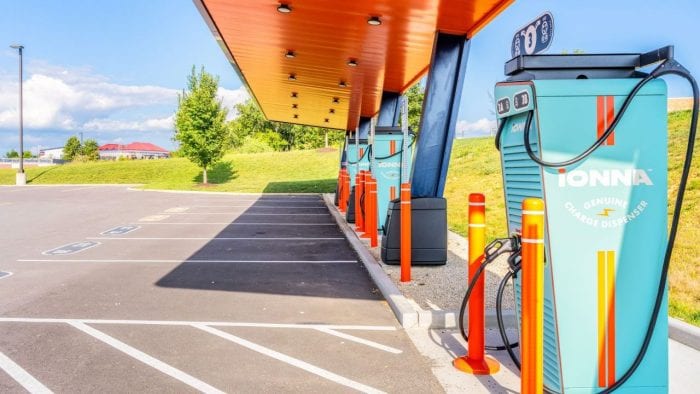
Porsche will begin decommissioning its electric vehicle charging network in China from March 2026, despite the recent commitment to continue investing in the world’s largest automotive market.
The company confirmed it will gradually shut down approximately 200 proprietary chargers, though it said partnerships with third-party charging providers will continue.
‘In China, for China’
Last month, Porsche opened its first integrated R&D center outside Germany in Shanghai’s Hongqiao central business district.
The 10,000-square-meter facility, operational since early November, is designed to accelerate local innovation under the company’s “In China, for China” strategy.
“The Shanghai R&D hub is already delivering results. Its first major achievement is a next-generation, China-exclusive infotainment system, set to launch across several Porsche model lines starting mid-2026,” the company said in a statement.
Manufacturing Strategy
The retrenchment on the charging network comes as Volkswagen Group CEO Oliver Blume recently acknowledged that Porsche‘s traditional business model — manufacturing exclusively in Germany and exporting globally — has become untenable.
“We still export 100% of our products from Europe,” Blume said in a recent interview. “Now, the luxury car market in China has shrunk by more than 80% in a short period, and the United States faces high tariff barriers.”
With those two markets representing more than half of global sales, Porsche recorded an operating loss of $1.03 billion in the third quarter, erasing nearly all profits generated earlier in the year.
Profit Collapse
Group operating profit plunged to 40 million euros in the first nine months of 2025, down from 4.04 billion euros a year earlier. Operating return on sales collapsed to 0.2% from 14.1%.
“The reasons for this are the extraordinary expenses associated with the realignment of the product strategy; the challenging market conditions in China, especially in the luxury segment; the ‘one-off’ effects relating to battery activities; and organisational changes,” Porsche said when reporting financial results in October. “In addition, increased expenses from the US import tariffs also had an impact.”
China Strategy Shift
Blume ruled out exiting China and said Porsche is exploring an electric sports car designed exclusively for Chinese buyers — a departure from its one-size-fits-all global approach.
“Volkswagen Group can provide local production for this,” Blume said.
The remark has been widely interpreted as confirmation that Porsche is preparing to manufacture vehicles in China for the first time, leveraging Volkswagen’s existing local facilities.
Electric Ambitions Scaled Back
The charging network closure follows a broader retreat from Porsche’s electrification targets.
Two years ago, the company pledged that more than half of sales would be electric by 2025 and over 80% by 2030. Instead, electric and plug-in hybrid vehicles made up just 27% of 2024 deliveries.
This year brought further pullbacks.
Porsche restructured its battery subsidiary Cellforce in August, scrapping plans for in-house cell production. A month later, it announced a slower transition to electric vehicles and committed to extending the life of combustion and hybrid models.