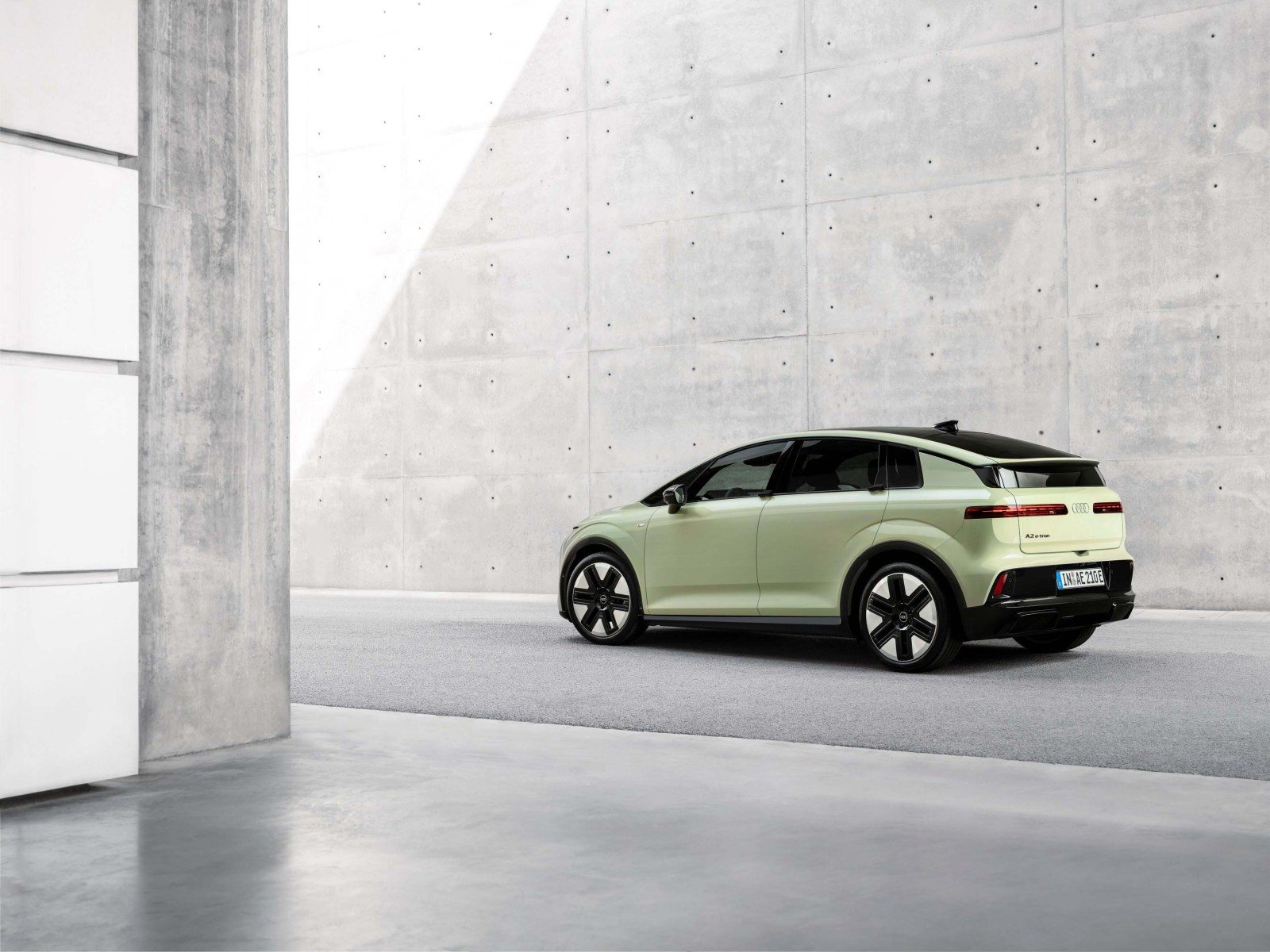

Audi unveiled the A2 e-tron on Monday, a compact electric hatchback built in Ingolstadt that becomes the brand’s cheapest electric car at 38,200 euros in Germany and, at 12.8 kWh per 100 kilometers on the WLTP cycle, the most efficient model it has ever put into series production.
Orders open on September 10 and the first cars reach dealers in December, Audi said, meeting the fall unveiling and 2026 delivery timing it set when it announced the model at its annual media conference in March.
“The A2 e-tron is more than a new model: It represents Audi’s renewal,” CEO Gernot Döllner said in the release. “It shows how we are rethinking premium for Europe: using resources more intelligently without compromising on quality, technology, or customer experience.”
The car revives a badge Audi retired in 2005, when the aluminium-bodied original, built at Neckarsulm.
Four Motors, Three Batteries
The A2 e-tron is rear-wheel drive throughout, with permanent-magnet synchronous motors in four outputs: 125 kW and 350 Nm in the entry car, 140 kW, 170 kW, and 240 kW with 545 Nm in the top model.
Gross battery capacity is 52 kWh or 61 kWh in lithium iron phosphate cells bonded directly into the pack housing in a cell-to-pack layout, or 84 kWh in a modular nickel manganese cobalt pack reserved for the 170 kW and 240 kW versions.
WLTP range runs from up to 423 km (263 miles) in the 125 kW car to up to 646 km in the 170 kW car with the 84 kWh pack; the 240 kW model manages up to 630 km.
Peak DC charging is 100 kW for the 52 kWh pack, 105 kW for the 61 kWh pack and 183 kW for the 84 kWh pack, with 10-to-80% times of 24, 26 and 29 minutes respectively.
Audi’s own FAQ gives 25 minutes for the 61 kWh pack, a one-minute discrepancy within the same release.
The 12.8 kWh figure applies to the 140 kW car with an optional efficiency package that Audi said trims consumption by up to 0.9 kWh per 100 km through a 0.24 drag coefficient, aero wheels, an active cooling intake, wheel-arch gap reducers and a largely enclosed underbody.
Base consumption across the range starts at 13.7, 12.8, 13.9 and 14.2 kWh per 100 km for the four power levels.
Acceleration to 100 km/h spans 8.8 seconds to 5.7 seconds, and top speed is 160 km/h except for the 240 kW car at 200 km/h.
Pricing
German prices are 38,200 euros ($44,400) for the 125 kW car with the 52 kWh pack, 41,900 euros with the 61 kWh pack, 48,900 euros ($56,800) for the 170 kW car with 84 kWh, and 51,200 euros ($59,500) for the 240 kW model.
The entry price sits 1,975 euros above the VW ID.3 Neo Life,and 1,200 euros above the Tesla Model 3 in Germany, which starts at 36,990 euros and returns 12.2 kWh per 100 km on the same cycle.
Bidirectional charging is optional.
Vehicle-to-load through a socket in the trunk or an adapter at the charge port, and vehicle-to-home in Germany, Austria and Switzerland through a compatible DC wallbox, with discharge confined to a 20-to-80% window and an “Instant Charge” override to fill the pack before a long trip.
Assisted Driving Tech
Standard driver assistance includes adaptive cruise control that reads speed limits and slows for curves and junctions, emergency and swerve assist, a reversing camera, parking sensors and exit warning.
An optional adaptive cruise assist plus adds lane guidance to 210 km/h, automatic stops at red lights, are set to arrive in an update promised shortly after launch, automatic lane changes on the turn signal.
Door handles are fully electric, opening on a light pull to a sensor with a door-mounted energy store as backup if the car’s electrical system fails.
More than 300 components use recycled material, more than 100 of them post-consumer, and the Softwrap and sports-seat fabrics are 100% recycled polyester.
Built Faster, Built Cheaper
Audi said it brought the car from concept to series production 21 months faster than comparable predecessors, reusing more than 1,200 existing production assets including about 250 robots previously employed on other models, and building A2 e-tron bodies alongside the A3 in a roughly 110,000-square-metre facility at Ingolstadt.
The plant is also adopting the “pearl chain” build sequence already used at Neckarsulm, fixing the order of customer builds six days before assembly so suppliers can deliver parts pre-sequenced.
The model was announced at Audi’s annual media conference on March 17, shown in winter testing in Lapland and in the Ingolstadt wind tunnel in May, and had its efficiency figures released on August 4, ahead of Monday’s full reveal.
The A2 e-tron slots below the Q4 e-tron as the brand’s entry point to electric cars, in a European compact EV market where the ID.3, Cupra Born, Renault 5, Kia EV3 and Volvo EX30 compete on price and range and where Audi has had no electric hatchback.