
Slate Auto is planning to add 392 jobs and invest $10.4 million at its Troy, Michigan headquarters — as the Jeff Bezos-backed startup prepares to begin production of its low-cost electric pickup later this year.
The company emerged from stealth about a year ago, generating significant attention for its deliberately stripped-down approach aimed at reducing production costs and consequently the final price.
The new engineering, design, and administrative positions would be added over the next five years to bolster the company’s research and development capabilities, Crain’s Detroit Business first reported on Thursday citing sources.
Additionally, the expansion would nearly double Slate‘s Michigan workforce, which currently exceeds 300 employees split between its Troy headquarters and an R&D lab in Orion Township.
Michigan’s state government is offering a $5 million performance-based grant to support the project, which is expected to go before the Michigan Strategic Fund board for consideration on Tuesday.
The new jobs are expected to pay a starting wage of $43 per hour, the sources said.
Hiring Spree Across the Board
The planned Michigan expansion adds to a hiring campaign that has seen Slate recruit senior talent from some of the biggest names in the auto industry in recent weeks.
In late April, Slate poached Lucid’s former Head of North America Sales, who had previously held senior positions at Tesla and two other EV startups.
Yeager took on the title of Head of Sales at Slate, where she will lead the startup’s direct-to-consumer sales model and go-to-market execution ahead of customer deliveries later this year.
Earlier this month, the company hired a manufacturing veteran with nearly 15 years of experience across General Motors, Lucid, and Ford as Senior Manufacturing Leader.
In March, the company also replaced its founding CEO Christine Barman with Peter Faricy, a former Amazon Marketplace VP who later served as CEO of Discovery’s direct-to-consumer business and SunPower Corporation.
Barman, Slate‘s first hire and one of only two women running a US automaker at the time, transitioned to the role of President of Vehicles.
$1.4 Billion in Funding
The Michigan expansion comes on the back of a major funding milestone.
In April, Slate closed a $650 million Series C round led by TWG Global, the investment firm run by Guggenheim Partners chief executive Mark Walter and investor Thomas Tull.
The round brought total funding to roughly $1.4 billion since the company’s founding in 2022.
Previous backers include Jeff Bezos’s family office, General Catalyst, Slauson & Co, and former Amazon executive Diego Piacentini.
The startup was co-founded by former Amazon Consumer CEO Jeff Wilke.
However, Bezos’s direct representation on the company’s board has diminished.
Earlier this month, Melinda Lewison, the head of Bezos Expeditions — the family office through which the Amazon founder’s investment was channelled — stepped down from Slate’s board, removing the most direct line between Bezos and the company at a critical juncture.
Production and the Road Ahead
Slate is targeting production start at its reindustrialised factory in Warsaw, Indiana later this year, with first customer deliveries expected before the end of 2026.
The investment to retrofit a former LSC Communications printing plant at the site nears $400 million, with the plant expected to create more than 2,000 jobs and build up to 150,000 vehicles per year once fully utilised.
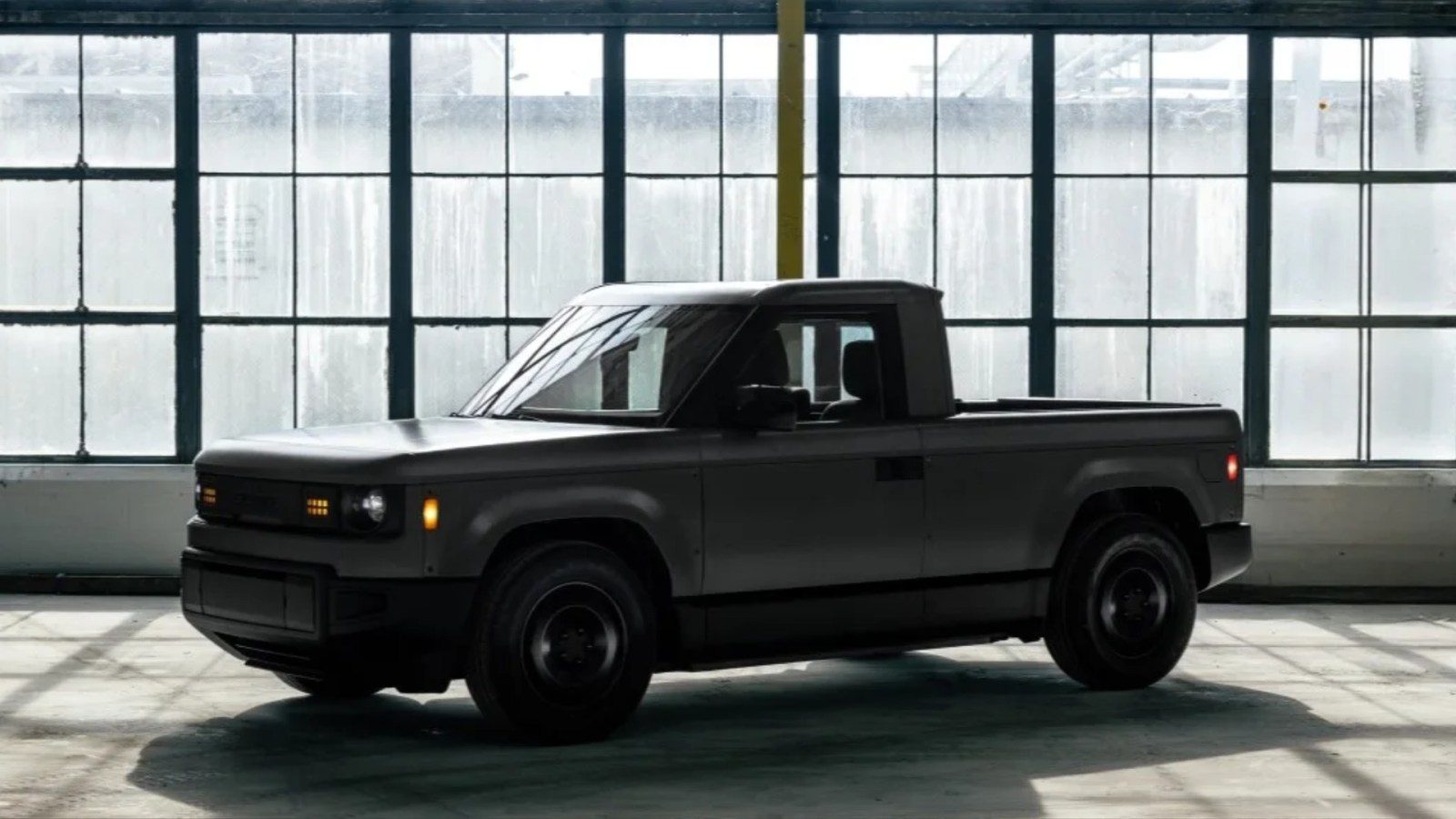
The startup has taken more than 160,000 refundable $50 reservations for its minimalist two-seat electric pickup, which is expected to start in the mid-$20,000s. Preorders are set to open in June.
Slate originally advertised a sub-$20,000 starting price after incentives, but adjusted that figure upward after the elimination of the $7,500 federal EV tax credit last September.
The company’s truck lacks power windows, an infotainment system, and other accessories that are standard on new vehicles but that Slate argues drive prices up unnecessarily.
Slate positions its pickup as a customisable platform — customers can add features after purchase, including an SUV conversion kit priced at around $5,000 and interchangeable wraps for the exterior.
The startup has also been exploring potential fleet opportunities. At the Michigan Defense Expo/Xponential event this week at Huntington Place in downtown Detroit, a Slate representative said the company is in early talks with US defense procurement officials about vehicles for the military, which is in search of low-cost, market-ready options.
Automakers x Michigan
If approved by the Michigan Strategic Fund, the grant to Slate would represent a welcome win for the Michigan Economic Development Corporation.
A deal with Lucid Motors two years ago, structured similarly to the one being offered to Slate, has fared well.
The state pledged $6 million to support a $10 million investment and 260 new jobs in Southfield.
Lucid has created 259 jobs, paying an average annual salary of more than $142,000, according to the MEDC’s most recent annual report.
Competition for the affordable electric pickup segment is also heating up.
Ford has unveiled plans for its own $30,000 electric pickup, a direct competitor expected to launch next year.
CEO Jim Farley has described the upcoming model as one of the company’s most ambitious projects as the Dearborn automaker works to turn its EV business profitable by 2029.
The last auto-related project brought before the Michigan Strategic Fund was in January, when the board approved a $4 million grant to Volkswagen.